Back to Blog
WhatsApp Business

WhatsApp Business API UAE 2026: Per-Message Pricing, Compliance, and Deployment Playbook

NXTAA Team

AI and WhatsApp Solutions

February 8, 2026
22 min read
WhatsApp Business API UAE 2026: Per-Message Pricing, Compliance, and Deployment Playbook

WhatsApp Business API UAE 2026: Per-Message Pricing, Compliance, and Deployment Playbook

This is the top-funnel decision guide for UAE teams evaluating or scaling WhatsApp Business API.

What this page is for

  • Pricing and cost structure.
  • Compliance and operating constraints.
  • Setup options and rollout model.
  • Strategic use-cases for support and growth.

What this page is not for

1. Pricing Model in 2026

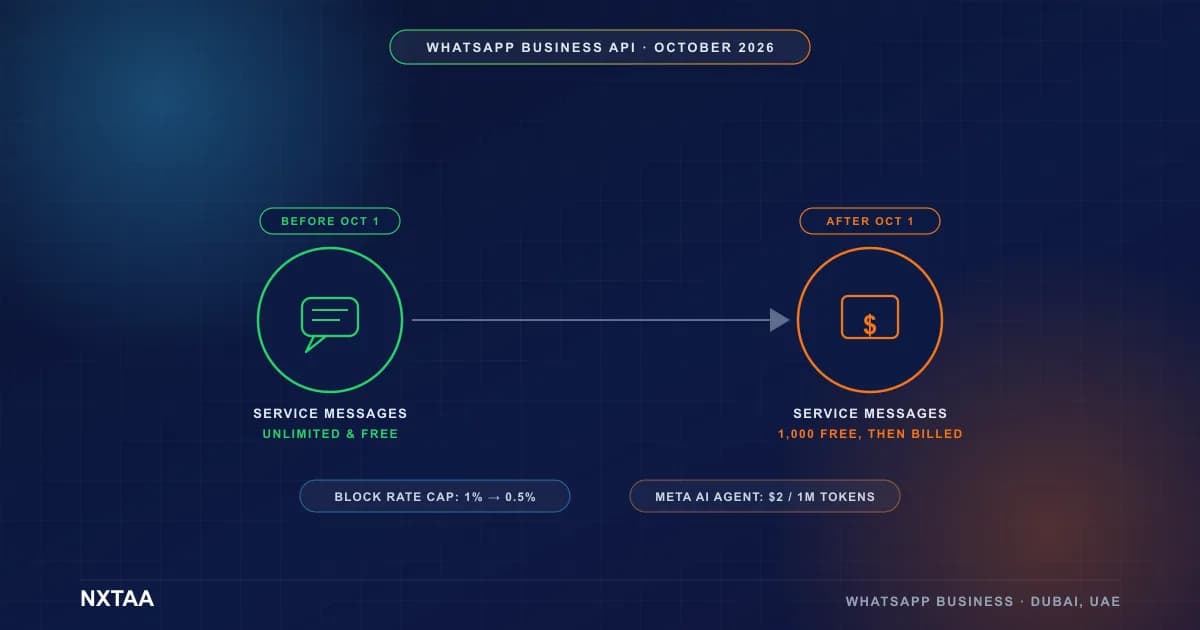
WhatsApp Business API costs usually have three layers:

  1. Meta messaging fees by category.
  2. BSP platform fee.
  3. Optional integration and automation operations.

Use these planning principles:

  • Budget by outcome (cost per qualified conversation), not only message count.
  • Separate service traffic from promotional traffic for cleaner analysis.
  • Track campaign-level block/report rates as a hard cost signal.

2. UAE Compliance Baseline

Every production setup should include:

  • Explicit, auditable opt-in capture.
  • Clear opt-out handling.
  • Profile and business identity consistency.
  • Policy-compliant template operations.

Operationally, compliance should be treated as an engineering checkpoint, not only legal review.

3. Where API Creates Business Value

Customer support

  • Faster triage with automation + agent handoff.
  • Shared context for team workflows.

Revenue operations

  • Cart, payment, and appointment reminders.
  • Re-engagement programs for opted-in users.

Process automation

  • CRM sync, ticketing, and event-triggered notifications.

4. Deployment Path (Pilot to Scale)

Phase 1: Pilot (2-4 weeks)

  • One use case.
  • One audience segment.
  • Quality and conversion baseline.

Phase 2: Controlled expansion

  • Add templates and journeys gradually.
  • Add compliance gates and monitoring dashboards.

Phase 3: Scaled program

  • Multi-team ownership model.
  • Channel governance for quality and performance.

5. KPI Stack for Leadership Reporting

Minimum KPI set:

  • Delivery rate.
  • Reply rate.
  • Qualified conversation rate.
  • Conversion and revenue influence.
  • Complaint/block trend by campaign.

6. Cost Modeling Framework for CFO Review

Most teams under-estimate two items: operational workload and compliance overhead. A better model separates fixed and variable costs.

Cost BucketFixed or VariableTypical OwnerTracking Unit
Meta messaging feesVariableGrowth / CS OpsCost per delivered template
BSP platform feeFixedFinanceMonthly platform cost
Integrations and automationMixedEngineeringFeature delivery + maintenance hours
Compliance operationsMixedCompliance / OperationsAudit hours + incident count

Build scenario models before rollout:

  1. Low-volume support-first scenario.
  2. Balanced support plus re-engagement scenario.
  3. High-volume campaign scenario with strict frequency controls.

For each scenario, report:

  • Cost per qualified conversation.
  • Cost per resolved support ticket.
  • Cost per conversion assisted through WhatsApp.

7. Architecture Patterns That Scale Safely

Strong implementations use clear system boundaries:

Pattern A: CRM-led orchestration

  • CRM is source of truth for consent and segment state.
  • WhatsApp is a delivery channel connected through event triggers.
  • Best for teams already running lifecycle programs.

Pattern B: Support-led orchestration

  • Ticketing or helpdesk is source of truth for service windows.
  • WhatsApp is used for triage, updates, and handoff workflows.
  • Best for high support volume organizations.

Pattern C: Hybrid orchestration

  • Shared event bus feeds both support and marketing workflows.
  • Strict policy rules prevent category misuse between service and promotional messages.
  • Best for mature teams with dedicated operations ownership.

8. Compliance Operating Model by Team

A production channel needs role clarity:

RoleWeekly ResponsibilityFailure Mode if Missing
Marketing ownerAudience eligibility and campaign intent reviewComplaint spikes from poor targeting
Support ownerService-message quality and handoff controlsSlow resolutions and low CSAT
Engineering ownerIntegration reliability and suppression logicDuplicate sends or opt-out failures
Compliance ownerPolicy checks and incident closureRepeat restrictions and trust damage

Minimum cadence:

  1. Weekly quality review meeting.
  2. Monthly template library audit.
  3. Quarterly incident simulation (restriction recovery drill).

9. 90-Day Execution Roadmap

Days 1-30

  • Launch one support use case and one utility template sequence.
  • Track quality daily and keep audience sizes controlled.
  • Validate opt-out and suppression behavior in live traffic.

Days 31-60

  • Add one revenue workflow (for example, reminder and follow-up).
  • Expand template set only after quality remains healthy.
  • Introduce leadership KPI reporting with cost and revenue influence.

Days 61-90

  • Scale to additional business units.
  • Add automation depth only where consent and quality remain stable.
  • Lock governance playbook for long-term operations.

Related WhatsApp Guides

Planning WhatsApp API Rollout in UAE?

Get a WhatsApp API Readiness Assessment

Extended Strategic Platform Planning Module 1: Governance Blueprint

In practical operations, leadership, growth, and digital transformation teams should treat cost model underestimation as an early-warning condition rather than a late-stage failure. This module defines how program director can apply scenario-based cost model with explicit decision timing, evidence logging, and escalation boundaries that are understandable to business stakeholders and technical teams. The objective is to improve cost per qualified conversation while preserving policy-safe execution under the scenario of support-first rollout.

  1. Define a weekly operating standard where program director validates current exposure to cost model underestimation, confirms that scenario-based cost model is active, and documents unresolved dependencies with accountable owners and due dates.
  2. Add an operational checkpoint before each major action so teams can verify expected impact on cost per qualified conversation, confirm scenario assumptions for support-first rollout, and avoid making irreversible changes without rollback planning.
  3. Use a shared incident or campaign ledger that records hypothesis, action, outcome, and confidence level, then links each decision to the applicable control standard and policy rationale.
  4. Create threshold-based escalation rules where negative movement in cost per qualified conversation automatically triggers a cross-functional review, a temporary risk hold, and a defined recovery experiment sequence.
  5. Close every operating cycle with a concise retrospective that identifies what reduced cost model underestimation, what strengthened scenario-based cost model, which scenario assumptions failed, and which controls are moving from draft to mandatory SOP.

Operational verification: teams should be able to demonstrate that controls are not only designed but repeatedly executed, measured, and improved under realistic workload pressure.

Extended Strategic Platform Planning Module 2: Risk Triage Matrix

In practical operations, leadership, growth, and digital transformation teams should treat unclear ownership boundaries as an early-warning condition rather than a late-stage failure. This module defines how finance partner can apply governance charter with explicit decision timing, evidence logging, and escalation boundaries that are understandable to business stakeholders and technical teams. The objective is to improve support resolution impact while preserving policy-safe execution under the scenario of commerce-led rollout.

  1. Define a weekly operating standard where finance partner validates current exposure to unclear ownership boundaries, confirms that governance charter is active, and documents unresolved dependencies with accountable owners and due dates.
  2. Add an operational checkpoint before each major action so teams can verify expected impact on support resolution impact, confirm scenario assumptions for commerce-led rollout, and avoid making irreversible changes without rollback planning.
  3. Use a shared incident or campaign ledger that records hypothesis, action, outcome, and confidence level, then links each decision to the applicable control standard and policy rationale.
  4. Create threshold-based escalation rules where negative movement in support resolution impact automatically triggers a cross-functional review, a temporary risk hold, and a defined recovery experiment sequence.
  5. Close every operating cycle with a concise retrospective that identifies what reduced unclear ownership boundaries, what strengthened governance charter, which scenario assumptions failed, and which controls are moving from draft to mandatory SOP.

Operational verification: teams should be able to demonstrate that controls are not only designed but repeatedly executed, measured, and improved under realistic workload pressure.

Extended Strategic Platform Planning Module 3: Execution Controls

In practical operations, leadership, growth, and digital transformation teams should treat unsupported scale assumptions as an early-warning condition rather than a late-stage failure. This module defines how growth lead can apply multi-phase rollout plan with explicit decision timing, evidence logging, and escalation boundaries that are understandable to business stakeholders and technical teams. The objective is to improve conversion influence while preserving policy-safe execution under the scenario of multi-brand portfolio expansion.

  1. Define a weekly operating standard where growth lead validates current exposure to unsupported scale assumptions, confirms that multi-phase rollout plan is active, and documents unresolved dependencies with accountable owners and due dates.
  2. Add an operational checkpoint before each major action so teams can verify expected impact on conversion influence, confirm scenario assumptions for multi-brand portfolio expansion, and avoid making irreversible changes without rollback planning.
  3. Use a shared incident or campaign ledger that records hypothesis, action, outcome, and confidence level, then links each decision to the applicable control standard and policy rationale.
  4. Create threshold-based escalation rules where negative movement in conversion influence automatically triggers a cross-functional review, a temporary risk hold, and a defined recovery experiment sequence.
  5. Close every operating cycle with a concise retrospective that identifies what reduced unsupported scale assumptions, what strengthened multi-phase rollout plan, which scenario assumptions failed, and which controls are moving from draft to mandatory SOP.

Operational verification: teams should be able to demonstrate that controls are not only designed but repeatedly executed, measured, and improved under realistic workload pressure.

Extended Strategic Platform Planning Module 4: Monitoring and Alerting

In practical operations, leadership, growth, and digital transformation teams should treat weak consent economics as an early-warning condition rather than a late-stage failure. This module defines how customer support director can apply cross-team KPI framework with explicit decision timing, evidence logging, and escalation boundaries that are understandable to business stakeholders and technical teams. The objective is to improve quality stability index while preserving policy-safe execution under the scenario of new-market launch.

  1. Define a weekly operating standard where customer support director validates current exposure to weak consent economics, confirms that cross-team KPI framework is active, and documents unresolved dependencies with accountable owners and due dates.
  2. Add an operational checkpoint before each major action so teams can verify expected impact on quality stability index, confirm scenario assumptions for new-market launch, and avoid making irreversible changes without rollback planning.
  3. Use a shared incident or campaign ledger that records hypothesis, action, outcome, and confidence level, then links each decision to the applicable control standard and policy rationale.
  4. Create threshold-based escalation rules where negative movement in quality stability index automatically triggers a cross-functional review, a temporary risk hold, and a defined recovery experiment sequence.
  5. Close every operating cycle with a concise retrospective that identifies what reduced weak consent economics, what strengthened cross-team KPI framework, which scenario assumptions failed, and which controls are moving from draft to mandatory SOP.

Operational verification: teams should be able to demonstrate that controls are not only designed but repeatedly executed, measured, and improved under realistic workload pressure.

Extended Strategic Platform Planning Module 5: Escalation Workflow

In practical operations, leadership, growth, and digital transformation teams should treat tooling fragmentation as an early-warning condition rather than a late-stage failure. This module defines how platform architect can apply vendor scorecard with explicit decision timing, evidence logging, and escalation boundaries that are understandable to business stakeholders and technical teams. The objective is to improve operational cost variance while preserving policy-safe execution under the scenario of vendor migration.

  1. Define a weekly operating standard where platform architect validates current exposure to tooling fragmentation, confirms that vendor scorecard is active, and documents unresolved dependencies with accountable owners and due dates.
  2. Add an operational checkpoint before each major action so teams can verify expected impact on operational cost variance, confirm scenario assumptions for vendor migration, and avoid making irreversible changes without rollback planning.
  3. Use a shared incident or campaign ledger that records hypothesis, action, outcome, and confidence level, then links each decision to the applicable control standard and policy rationale.
  4. Create threshold-based escalation rules where negative movement in operational cost variance automatically triggers a cross-functional review, a temporary risk hold, and a defined recovery experiment sequence.
  5. Close every operating cycle with a concise retrospective that identifies what reduced tooling fragmentation, what strengthened vendor scorecard, which scenario assumptions failed, and which controls are moving from draft to mandatory SOP.

Operational verification: teams should be able to demonstrate that controls are not only designed but repeatedly executed, measured, and improved under realistic workload pressure.

Extended Strategic Platform Planning Module 6: Evidence and Audit Discipline

In practical operations, leadership, growth, and digital transformation teams should treat missing measurement discipline as an early-warning condition rather than a late-stage failure. This module defines how compliance owner can apply quarterly capability review with explicit decision timing, evidence logging, and escalation boundaries that are understandable to business stakeholders and technical teams. The objective is to improve time to scale safely while preserving policy-safe execution under the scenario of AI-assisted conversation scaling.

  1. Define a weekly operating standard where compliance owner validates current exposure to missing measurement discipline, confirms that quarterly capability review is active, and documents unresolved dependencies with accountable owners and due dates.
  2. Add an operational checkpoint before each major action so teams can verify expected impact on time to scale safely, confirm scenario assumptions for AI-assisted conversation scaling, and avoid making irreversible changes without rollback planning.
  3. Use a shared incident or campaign ledger that records hypothesis, action, outcome, and confidence level, then links each decision to the applicable control standard and policy rationale.
  4. Create threshold-based escalation rules where negative movement in time to scale safely automatically triggers a cross-functional review, a temporary risk hold, and a defined recovery experiment sequence.
  5. Close every operating cycle with a concise retrospective that identifies what reduced missing measurement discipline, what strengthened quarterly capability review, which scenario assumptions failed, and which controls are moving from draft to mandatory SOP.

Operational verification: teams should be able to demonstrate that controls are not only designed but repeatedly executed, measured, and improved under realistic workload pressure.

Extended Strategic Platform Planning Module 7: Quality Stabilization Actions

In practical operations, leadership, growth, and digital transformation teams should treat cost model underestimation as an early-warning condition rather than a late-stage failure. This module defines how program director can apply scenario-based cost model with explicit decision timing, evidence logging, and escalation boundaries that are understandable to business stakeholders and technical teams. The objective is to improve cost per qualified conversation while preserving policy-safe execution under the scenario of support-first rollout.

  1. Define a weekly operating standard where program director validates current exposure to cost model underestimation, confirms that scenario-based cost model is active, and documents unresolved dependencies with accountable owners and due dates.
  2. Add an operational checkpoint before each major action so teams can verify expected impact on cost per qualified conversation, confirm scenario assumptions for support-first rollout, and avoid making irreversible changes without rollback planning.
  3. Use a shared incident or campaign ledger that records hypothesis, action, outcome, and confidence level, then links each decision to the applicable control standard and policy rationale.
  4. Create threshold-based escalation rules where negative movement in cost per qualified conversation automatically triggers a cross-functional review, a temporary risk hold, and a defined recovery experiment sequence.
  5. Close every operating cycle with a concise retrospective that identifies what reduced cost model underestimation, what strengthened scenario-based cost model, which scenario assumptions failed, and which controls are moving from draft to mandatory SOP.

Operational verification: teams should be able to demonstrate that controls are not only designed but repeatedly executed, measured, and improved under realistic workload pressure.

Extended Strategic Platform Planning Module 8: Cross-Team Ownership

In practical operations, leadership, growth, and digital transformation teams should treat unclear ownership boundaries as an early-warning condition rather than a late-stage failure. This module defines how finance partner can apply governance charter with explicit decision timing, evidence logging, and escalation boundaries that are understandable to business stakeholders and technical teams. The objective is to improve support resolution impact while preserving policy-safe execution under the scenario of commerce-led rollout.

  1. Define a weekly operating standard where finance partner validates current exposure to unclear ownership boundaries, confirms that governance charter is active, and documents unresolved dependencies with accountable owners and due dates.
  2. Add an operational checkpoint before each major action so teams can verify expected impact on support resolution impact, confirm scenario assumptions for commerce-led rollout, and avoid making irreversible changes without rollback planning.
  3. Use a shared incident or campaign ledger that records hypothesis, action, outcome, and confidence level, then links each decision to the applicable control standard and policy rationale.
  4. Create threshold-based escalation rules where negative movement in support resolution impact automatically triggers a cross-functional review, a temporary risk hold, and a defined recovery experiment sequence.
  5. Close every operating cycle with a concise retrospective that identifies what reduced unclear ownership boundaries, what strengthened governance charter, which scenario assumptions failed, and which controls are moving from draft to mandatory SOP.

Operational verification: teams should be able to demonstrate that controls are not only designed but repeatedly executed, measured, and improved under realistic workload pressure.

Extended Strategic Platform Planning Module 9: Decision Thresholds

In practical operations, leadership, growth, and digital transformation teams should treat unsupported scale assumptions as an early-warning condition rather than a late-stage failure. This module defines how growth lead can apply multi-phase rollout plan with explicit decision timing, evidence logging, and escalation boundaries that are understandable to business stakeholders and technical teams. The objective is to improve conversion influence while preserving policy-safe execution under the scenario of multi-brand portfolio expansion.

  1. Define a weekly operating standard where growth lead validates current exposure to unsupported scale assumptions, confirms that multi-phase rollout plan is active, and documents unresolved dependencies with accountable owners and due dates.
  2. Add an operational checkpoint before each major action so teams can verify expected impact on conversion influence, confirm scenario assumptions for multi-brand portfolio expansion, and avoid making irreversible changes without rollback planning.
  3. Use a shared incident or campaign ledger that records hypothesis, action, outcome, and confidence level, then links each decision to the applicable control standard and policy rationale.
  4. Create threshold-based escalation rules where negative movement in conversion influence automatically triggers a cross-functional review, a temporary risk hold, and a defined recovery experiment sequence.
  5. Close every operating cycle with a concise retrospective that identifies what reduced unsupported scale assumptions, what strengthened multi-phase rollout plan, which scenario assumptions failed, and which controls are moving from draft to mandatory SOP.

Operational verification: teams should be able to demonstrate that controls are not only designed but repeatedly executed, measured, and improved under realistic workload pressure.

Extended Strategic Platform Planning Module 10: Scenario Stress Testing

In practical operations, leadership, growth, and digital transformation teams should treat weak consent economics as an early-warning condition rather than a late-stage failure. This module defines how customer support director can apply cross-team KPI framework with explicit decision timing, evidence logging, and escalation boundaries that are understandable to business stakeholders and technical teams. The objective is to improve quality stability index while preserving policy-safe execution under the scenario of new-market launch.

  1. Define a weekly operating standard where customer support director validates current exposure to weak consent economics, confirms that cross-team KPI framework is active, and documents unresolved dependencies with accountable owners and due dates.
  2. Add an operational checkpoint before each major action so teams can verify expected impact on quality stability index, confirm scenario assumptions for new-market launch, and avoid making irreversible changes without rollback planning.
  3. Use a shared incident or campaign ledger that records hypothesis, action, outcome, and confidence level, then links each decision to the applicable control standard and policy rationale.
  4. Create threshold-based escalation rules where negative movement in quality stability index automatically triggers a cross-functional review, a temporary risk hold, and a defined recovery experiment sequence.
  5. Close every operating cycle with a concise retrospective that identifies what reduced weak consent economics, what strengthened cross-team KPI framework, which scenario assumptions failed, and which controls are moving from draft to mandatory SOP.

Operational verification: teams should be able to demonstrate that controls are not only designed but repeatedly executed, measured, and improved under realistic workload pressure.

Extended Strategic Platform Planning Module 11: Leadership Reporting

In practical operations, leadership, growth, and digital transformation teams should treat tooling fragmentation as an early-warning condition rather than a late-stage failure. This module defines how platform architect can apply vendor scorecard with explicit decision timing, evidence logging, and escalation boundaries that are understandable to business stakeholders and technical teams. The objective is to improve operational cost variance while preserving policy-safe execution under the scenario of vendor migration.

  1. Define a weekly operating standard where platform architect validates current exposure to tooling fragmentation, confirms that vendor scorecard is active, and documents unresolved dependencies with accountable owners and due dates.
  2. Add an operational checkpoint before each major action so teams can verify expected impact on operational cost variance, confirm scenario assumptions for vendor migration, and avoid making irreversible changes without rollback planning.
  3. Use a shared incident or campaign ledger that records hypothesis, action, outcome, and confidence level, then links each decision to the applicable control standard and policy rationale.
  4. Create threshold-based escalation rules where negative movement in operational cost variance automatically triggers a cross-functional review, a temporary risk hold, and a defined recovery experiment sequence.
  5. Close every operating cycle with a concise retrospective that identifies what reduced tooling fragmentation, what strengthened vendor scorecard, which scenario assumptions failed, and which controls are moving from draft to mandatory SOP.

Operational verification: teams should be able to demonstrate that controls are not only designed but repeatedly executed, measured, and improved under realistic workload pressure.

Extended Strategic Platform Planning Module 12: Continuous Improvement Loop

In practical operations, leadership, growth, and digital transformation teams should treat missing measurement discipline as an early-warning condition rather than a late-stage failure. This module defines how compliance owner can apply quarterly capability review with explicit decision timing, evidence logging, and escalation boundaries that are understandable to business stakeholders and technical teams. The objective is to improve time to scale safely while preserving policy-safe execution under the scenario of AI-assisted conversation scaling.

  1. Define a weekly operating standard where compliance owner validates current exposure to missing measurement discipline, confirms that quarterly capability review is active, and documents unresolved dependencies with accountable owners and due dates.
  2. Add an operational checkpoint before each major action so teams can verify expected impact on time to scale safely, confirm scenario assumptions for AI-assisted conversation scaling, and avoid making irreversible changes without rollback planning.
  3. Use a shared incident or campaign ledger that records hypothesis, action, outcome, and confidence level, then links each decision to the applicable control standard and policy rationale.
  4. Create threshold-based escalation rules where negative movement in time to scale safely automatically triggers a cross-functional review, a temporary risk hold, and a defined recovery experiment sequence.
  5. Close every operating cycle with a concise retrospective that identifies what reduced missing measurement discipline, what strengthened quarterly capability review, which scenario assumptions failed, and which controls are moving from draft to mandatory SOP.

Operational verification: teams should be able to demonstrate that controls are not only designed but repeatedly executed, measured, and improved under realistic workload pressure.

Anonymized Industry Insights (2026 Planning Lens)

  • Across large messaging programs, teams that enforce strict consent provenance and weekly suppression audits consistently sustain healthier quality signals than teams that optimize only for short-term send volume.
  • Benchmark studies show that response speed and message relevance influence conversion and retention more than raw campaign frequency, which supports a quality-first scaling approach for WhatsApp in UAE.
  • Programs with clear ownership between marketing, operations, compliance, and engineering tend to recover faster from incidents because root-cause correction and escalation are coordinated instead of fragmented.
  • High-performing teams run structured pre-send checkpoints, detect risk early through complaint and block trend monitoring, and scale only after stability is validated over multiple campaign cycles.
  • Channel trust is usually damaged by repeated low-relevance outreach, so mature operators prioritize segmentation discipline, intent alignment, and transparent opt-out handling in every workflow.

These insights are included as market-level operating patterns and should be interpreted alongside official WhatsApp policy, Meta platform documentation, and UAE regulatory requirements.

Authoritative Sources and 2026 Industry Signals

The following sources were selected to strengthen evidence quality for this topic. Prioritize official policy and platform documentation first, then research and industry benchmarks for strategic interpretation.

Use these references to keep operating decisions aligned with policy updates, technical platform constraints, and current customer-experience expectations as of February 23, 2026.

Tags

WhatsApp Business API UAE
WABA Pricing 2026
UAE Compliance
Messaging Automation
Customer Experience

Ready to Transform Your Business Communication?

Let's discuss how NXTAA can help you achieve your goals