How to Deploy AI Customer Service in the UAE: An Implementation Guide
AI Solutions Architect
Nxtaa Team

How to Deploy AI Customer Service in the UAE: An Implementation Guide
The era of simple, rule-based chatbots is over. In 2026, we are fully in the age of AI Agents—autonomous, intelligent systems capable of reasoning, planning, and executing complex tasks. For businesses in the UAE, where consumer expectations for speed and luxury are world-leading, adopting this technology is no longer optional.
The AI chatbot market is now valued at $10-11 billion in 2026, with projections reaching $27 billion by 2030. Today, 95% of customer interactions are powered by AI, and Gartner predicts that 10% of all customer service interactions will be fully automated through conversational AI systems by year end.
Here is your comprehensive guide to the AI customer service landscape in 2026.
1. From "Chatbots" to "Autonomous AI Agents"
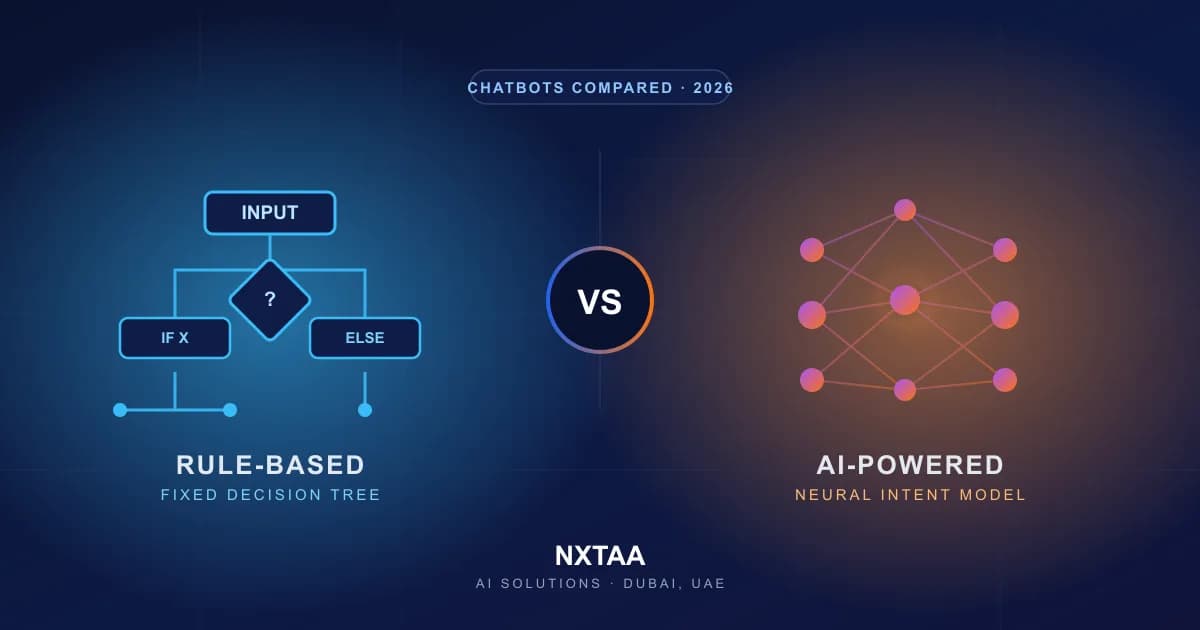
The biggest shift in 2026 is the evolution from reactive chatbots to autonomous AI Agents capable of resolving entire conversations without human intervention.
- Old Way (Chatbot): "I can answer FAQs based on a script."
- New Way (AI Agent): "I see you're having trouble with your payment. I've already tried an alternative gateway and processed your refund—here's your confirmation."
- Autonomy: AI Agents now handle complete service journeys: processing refunds, updating CRM records, scheduling appointments, and escalating only truly complex issues.
- Impact: 91% of businesses with 50+ employees now use AI chatbots in their customer journey.
2. Multimodal Support: Beyond Text
2026 marks the shift from omnichannel to multimodal support—customers can now fluidly mix text, images, and video within a single conversation.
- Natural Interactions: Send a photo of a broken product, get instant visual recognition and replacement options.
- 76% of customers prefer this capability over switching between channels.
- Continuous Context: The AI maintains context across different media types without restarting conversations.
3. Memory-Rich AI: True Personalization
Modern AI agents feature memory-rich capabilities that retain information, context, and preferences across sessions.
- Contextual Awareness: The AI knows your customer's entire history—web visits, past purchases, and previous complaints—before saying "Hello."
- Predictive Suggestions: "Welcome back, Ahmed. Based on your usual order pattern, shall I process your regular coffee bean subscription?"
- Impact: This leads to significantly more efficient and personalized support experiences.
4. Voice AI: The New Core Channel
Conversational Voice AI is replacing traditional IVR systems in 2026.
- Natural Speech: Customers speak naturally instead of pressing buttons or following rigid menu trees.
- Multilingual Mastery: The latest LLMs achieve near-native fluency in Modern Standard Arabic (MSA), Khaleeji and Levantine dialects, plus English, Hindi, Tagalog, and Urdu.
- 24/7 Availability: Voice AI handles calls around the clock without staffing concerns.
5. Proactive Support: Solving Problems Before They Happen
AI models use predictive analytics to identify issues before the customer is even aware of them.
- Scenario: An airline's AI agent detects a flight delay and automatically rebooks the passenger on the next best flight, sending them a notification with the new boarding pass before they arrive at the airport.
- Impact: This shift from reactive to proactive support reduces inbound contact volume by 20-30%.
6. The Economic Impact: 30% Cost Reduction
For UAE businesses facing rising operational costs, AI offers a lifeline.
- Efficiency: AI agents handle up to 80% of routine inquiries instantly.
- Savings: Companies implementing advanced AI support see an average 30% reduction in operational costs.
- Global Impact: Conversational AI is projected to reduce contact center labor costs by $80 billion by 2026.
- Scalability: Handle Ramadan or Black Friday traffic spikes without hiring temporary staff.
- ROI: 57% of companies report substantial ROI within the first year, with an average return of $8 for every $1 invested.
7. Human-AI Collaboration
While AI automates routine tasks, human agents remain crucial for complex or emotional issues.
- Agent Augmentation: AI acts as an intelligent partner, providing real-time insights, conversation summaries, and suggested responses.
- Focus on Value: Your human agents handle the 20% of complex, high-empathy, or VIP interactions that require a human touch.
- 51% of consumers prefer interacting with bots for immediate service, while 62% prefer chatting with a bot over waiting for a human.
8. What to Automate First
The most common deployment mistake is starting with the hardest queries because they are the most expensive. That inverts the risk: your least reliable automation meets your most frustrated customers.
Rank candidate use cases on two axes - volume and determinism (whether a correct answer can be derived from data you hold).
Automate first: high volume, high determinism
- Order and delivery status.
- Appointment booking, rescheduling, and reminders.
- Account balance, plan details, and payment status.
- Store hours, locations, and service availability.
- Password and access resets.
These have verifiable answers, and a wrong answer is immediately obvious and cheap to correct.
Automate second: high volume, lower determinism
- Product recommendations and comparisons.
- Returns and refunds within policy.
- Basic troubleshooting flows.
These need guardrails and a clean escalation path, but the volume justifies the work.
Do not automate early: low volume, low determinism
- Complaints with an emotional charge.
- Billing disputes.
- Anything touching a legal, medical, or financial commitment.
- VIP and high-value account interactions.
Low volume means automation saves little; low determinism means errors are expensive. The return does not justify the risk, and these are the conversations where a bad automated answer costs you the customer.
9. What It Actually Costs to Run
Vendor pricing covers the platform. It does not cover the work that makes the platform useful, and that work is where budgets break.
Build
- Integration into your CRM, order system, and ticketing - usually the largest line, and always larger than estimated.
- Knowledge base preparation. Your content almost certainly needs restructuring before it can ground an AI reliably.
- Conversation design and escalation logic.
- Arabic and English content, reviewed separately.
Run
- Platform or per-conversation fees.
- Model or API usage, which scales with volume and with how much context you pass per turn.
- Ongoing content maintenance. A knowledge base that stops being updated degrades the AI's accuracy within months.
- Human review of escalations and failed conversations, which is a permanent role, not a launch task.
The line most teams forget Someone has to read the transcripts. Not all of them, but a sample, every week, permanently. This is the only mechanism that reveals what the AI is getting wrong, and it is the first thing cut when the project is declared finished. Deployments that skip it do not fail loudly; they quietly get worse while the dashboard still shows a healthy resolution rate.
Budget the first year as roughly half build and half run. Teams that budget only for the build tend to find the run costs from their support headcount, which defeats the purpose.
10. Where AI Agents Fail
Knowing the failure modes lets you design around them rather than discover them in production.
Confident wrong answers. The most damaging failure, because nothing in the conversation signals it. An agent grounded on outdated documentation states stale policy with complete assurance. Mitigation: ground answers in a maintained source of truth, and have the agent cite or link what it drew on so a human can verify.
Escalation that loses context. The customer explains the problem, the agent gives up, and the human agent opens with "how can I help?" This single failure erases the goodwill from an otherwise successful automation. The full transcript and any data the agent gathered must travel with the handover.
The loop. An agent that cannot resolve and cannot escalate will keep rephrasing itself. Set an explicit failure counter - two unsuccessful attempts at the same intent should route to a human, unconditionally.
No exit. Customers who want a human and cannot find the route stop trusting the channel entirely. Make the escape hatch obvious and always available. Hiding it to protect automation rates damages satisfaction far more than the deflection is worth.
Language and dialect gaps. Modern models handle Modern Standard Arabic well; performance across Gulf dialects and code-switched Arabizi is less consistent. Test on real customer language from your own transcripts, not on textbook phrasing.
Silent drift. Your products, policies, and pricing change. The AI's grounding does not update itself. Without scheduled content review, accuracy decays steadily while the resolution metrics look unchanged, because a confidently wrong answer still counts as resolved.
Measure resolution, not deflection
Deflection rate counts conversations that did not reach a human. Resolution rate counts conversations where the customer's problem was actually solved. A customer who gave up and abandoned the chat improves your deflection number and damages your business. Track whether they came back, whether they contacted you on another channel within a day, and whether they were satisfied - those tell you what deflection cannot.
11. A Rollout That Does Not Damage Service
Deploy in stages. A full cutover on day one means your worst-performing version of the agent meets your entire customer base at once.
Stage 1 - Shadow mode (2 weeks). The agent drafts answers that only your human agents see. Nothing reaches customers. You learn where it is confidently wrong at zero risk, and your team builds a feel for its behaviour. This stage is skipped more often than any other and is the cheapest insurance in the whole project.
Stage 2 - Narrow live deployment (2-4 weeks). One or two of the high-determinism use cases from Section 8, on one channel, with an obvious route to a human. Watch resolution rate, escalation rate, and the reasons behind escalations.
Stage 3 - Widen by use case, not by channel. Add intents the agent handles well before adding new places it appears. Each new intent needs its own grounding and its own testing; each new channel mostly re-exposes problems you already have.
Stage 4 - Add channels. Once the intent coverage is stable, extend to WhatsApp, web chat, and voice. Voice last - speech recognition adds a failure layer on top of everything above, and errors there are harder for customers to correct.
Set the exit criteria before you start
Decide in advance what performance justifies moving to the next stage, and what performance triggers a rollback. Written down, before launch, while nobody is invested in the result. Projects without rollback criteria do not roll back; they absorb the damage and call it a learning curve.
Tell your team before you tell your customers
Support staff who discover an AI agent by seeing it in their queue will assume it is there to replace them, and will not report its failures. Staff who understand it is absorbing routine volume so they can handle the complex work become your most effective source of failure reports. That framing decides whether your feedback loop works at all.
One number worth watching after launch
Repeat contact rate within 24 hours. If a customer returns the next day with the same issue, the first conversation was recorded as resolved and was not. This single metric catches most of the failure modes above, and unlike satisfaction surveys it requires nothing from the customer.
Implementing AI Agents with NXTAA
At NXTAA, we don't just build chatbots; we engineer intelligent ecosystems.
- Data Unification: We connect your CRM, ERP, and support tickets to give the AI a 360-degree view.
- Custom Training: We fine-tune models on your specific industry data (Real Estate, E-commerce, Healthcare).
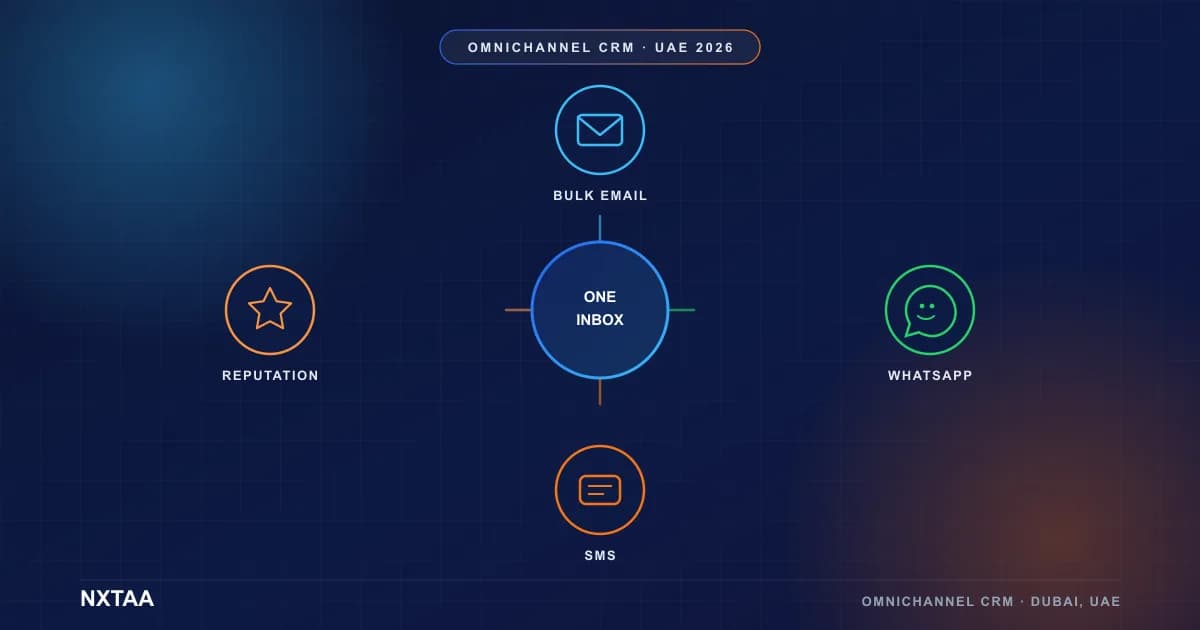
- Omnichannel Deployment: Your AI agent lives on WhatsApp, Instagram, Web Chat, and handles Voice calls.
Conclusion
2026 is the year businesses are scaling AI from pilots to production. The question isn't "Should we use AI?" but "How fast can we deploy autonomous AI Agents?" The businesses that master this transition will define the standards of customer loyalty in the UAE.
Still deciding on the underlying technology? Start with AI Chatbots vs Rule-Based Chatbots: What Is the Difference? to understand where scripted logic still wins and where AI is worth the investment. And when the AI does hit its limit, chatbot-to-human agent handover best practices covers the escalation design that keeps customers from churning at the handoff.
Ready to upgrade your workforce? Contact NXTAA to build your custom AI Agent today.