Digital Marketing Trends in UAE: The 2026 Strategic Forecast
NXTAA Team
Digital Marketing Strategists

Digital Marketing Trends in UAE: The 2026 Strategic Forecast
The United Arab Emirates continues to be a digital powerhouse. With internet penetration exceeding 99% and a mobile-first population spending an average of 7 hours daily on their devices, the UAE digital marketing environment is hyper-competitive. In 2026, the market is defined by AI-driven personalization, social commerce integration, and immersive brand experiences.
Here are the critical trends defining the UAE digital marketing market in 2026.
1. The $12.3 Billion E-commerce Boom
The UAE e-commerce market has reached $12.3 billion in 2026 and is projected to climb to $21 billion by 2031 (11.29% CAGR).
- Mobile Dominance: Smartphones account for 78.67% of the UAE e-commerce market, with mobile shopping continuing to grow at 16.24% CAGR.
- Digital Wallets: Digital payment methods hold 43.92% market share, with Buy Now Pay Later (BNPL) options showing the fastest growth at 13.27% CAGR.
- B2B Growth: While B2C leads with 67.89% revenue share, B2B channels are growing at 17.43% CAGR through 2031.
2. Social Commerce Revolution
The integration of social media and e-commerce has transformed shopping habits.
- Direct Purchases: 46% of consumers now make purchases directly through social media platforms.
- UAE Social Users: 12.5 million active social media users (+16.7% year-over-year).
- Platform Growth (2025):
- TikTok: +1.79 million users (+16.7%)
- Instagram: +1.15 million users (+16.7%)
- Facebook: +650K users (+7.2%)
- Reddit: +1.60 million users (+188%)
- Social Ad Spend: Projected to reach $500 million in the UAE.
3. Short-Form Video: The Engagement King
Video content drives up to 90% of daily content consumption in the GCC.
- TikTok & Reels: These are primary search engines for discovery, not just entertainment.
- Edutainment: The best performing content educates while entertaining. Think "3 Tips for Buying Property in Dubai" in 60 seconds.
- Snapchat Reach: 5.13 million users (44.9% of UAE population).
4. Retail Media Networks: The New Ad Frontier
Retail Media Networks are among the fastest-growing ad channels in 2026.
- What They Are: Advertising platforms built into e-commerce and marketplace sites.
- First-Party Data: They leverage purchase intent data for highly targeted reach at the point of purchase.
- Higher ROI: More effective than traditional display ads due to proximity to conversion.
5. Generative AI for Marketing
AI is revolutionizing content creation and customer personalization.
- Content Creation: AI generates ad copy, social posts, and personalized email content at scale.
- Predictive Behavior: AI algorithms predict consumer behavior and optimize campaign timing.
- Dynamic Personalization: Real-time content adaptation based on user preferences and behavior.
6. Immersive Experiences: AR/VR Integration
Augmented Reality (AR) and Virtual Reality (VR) have moved from futuristic concepts to core digital marketing tools.
- Virtual Try-Ons: Fashion and beauty brands offer AR-powered product previews.
- Property Tours: Real estate agents provide immersive 3D walkthroughs.
- Brand Engagement: Interactive AR experiences drive deeper brand connections.
7. Voice Search & Conversational SEO
Smart speakers and voice assistants continue growing in UAE households.
- Natural Language: Queries are longer and more conversational ("Where can I find the best Italian restaurant open now?").
- Multilingual Voice: Optimizing for voice queries in Arabic dialects and English is a massive opportunity.
- Local Intent: Voice searches often have local intent, requiring robust Local SEO strategies.
8. Micro-Influencers: Trust Over Reach
The shift to "realist" influencer marketing continues.
- High Engagement: Micro-influencers (10k-50k followers) often deliver 2x the engagement of celebrities.
- Niche Authority: Brands partner with specific experts (Dubai tech reviewers, Abu Dhabi food bloggers) for authentic storytelling.
- Better ROI: Lower cost per post with higher conversion intent.
9. Privacy-First Data Strategy
With stricter global privacy regulations, owning your audience is critical.
- First-Party Data: Building email lists and SMS databases you control.
- Cookieless Strategies: Preparing for a world without third-party cookies.
- Trust & Transparency: Ethical data usage is a key brand differentiator.
10. Localization & Cultural Nuance
Tailoring content to local trends and cultural nuances is essential.
- Multilingual Content: Arabic and English content for maximum reach.
- Cultural Sensitivity: Understanding prayer times, Ramadan, and local holidays.
- UAE Economy: Expected to grow 5% in 2026, with digital economy contributing $27 billion to GDP.
How to Prioritise These Trends on a Real Budget
Ten trends, one budget. Chasing all of them produces ten underfunded experiments and no results. The useful question is not which trend is biggest, but which one closes a gap you actually have.
| If your problem is... | Start with | Skip for now |
|---|---|---|
| Nobody knows we exist | Short-form video, micro-influencers | AR/VR, retail media |
| Traffic arrives but doesn't buy | Social commerce, conversational follow-up | Immersive experiences |
| We sell well but acquisition costs too much | Retail media networks, first-party data | Broad awareness video |
| Leads come in and go cold | Conversational AI, automated follow-up | New channel expansion |
| We can't prove what's working | Privacy-first measurement, attribution | Anything new until this is fixed |
That last row deserves emphasis. Adding channels while your attribution is broken multiplies the confusion rather than the revenue. Fix measurement before you widen the funnel, or you will spend the year unable to defend any of it.
Sequence, don't parallelise
Most UAE marketing teams can execute one significant new capability per quarter properly, or four badly. Pick the one that addresses your actual constraint, resource it fully, measure it, and only then add the next. The trends in this article will still be here next quarter; the budget you burned proving nothing will not.
Building for Arabic-First Audiences
The single largest missed opportunity in UAE digital marketing is treating Arabic as a translation layer rather than a creative decision.
Translation is not localisation. English creative rendered into Arabic almost always reads flat - the humour does not carry, the idioms do not land, and the calls to action feel imported. Content conceived in Arabic performs differently from content converted into it, and audiences notice the difference immediately.
The technical side matters too. Right-to-left layouts break carelessly built templates. Check that your landing pages, email templates, and ad creative render correctly in RTL before you spend media budget driving traffic to them. A broken layout wastes the entire click.
Code-switching is normal here. Much of the UAE audience moves fluidly between Arabic and English within a single sentence, and a meaningful share reads Arabizi. Rigidly monolingual creative can feel more foreign than a natural mix. Test both registers with your actual audience rather than assuming which is correct.
Search behaves differently by language. Arabic search queries are frequently structured differently from their English equivalents, and the competitive landscape for Arabic keywords is often far less crowded. Teams running English-only SEO in this market are usually leaving the cheaper half of the opportunity untouched.
The UAE Marketing Calendar
Timing carries unusual weight in this market, and campaigns designed on a European or North American calendar routinely misfire.
Ramadan reshapes everything: when people are online, what tone lands, and what they buy. Engagement shifts substantially toward late evening. Brands that plan Ramadan creative months ahead consistently outperform those adapting existing campaigns two weeks out. Tone matters more than usual - promotional aggression reads badly against the period.
Eid drives concentrated spending in both gifting and travel, with a short, intense window. Inventory and fulfilment planning matter as much as creative here.
The retail calendar carries its own peaks: Dubai Shopping Festival, White Friday, and back-to-school each move meaningful volume, and each is intensely competitive on paid media. Expect cost per click to rise and plan the bid strategy accordingly rather than discovering it mid-campaign.
The working week matters for B2B. The UAE weekend does not align with much of the world, and campaigns scheduled on a Monday-to-Friday assumption lose reach at both ends. Check what your analytics say about your own audience rather than inheriting a default.
Summer empties out. A significant share of the resident population travels, and July and August behave differently from the rest of the year. This is either a reason to reduce spend or an opportunity to buy attention cheaply, depending on whether your audience is the part that leaves.
Plan the calendar before the channels
Decide when your commercially important moments are, then choose the channels that reach people at those moments. Teams that pick channels first and slot campaigns in afterwards consistently find themselves launching their biggest push into their quietest window.
What's Overhyped Right Now
A trends list is only useful if it also tells you where not to spend. Three areas absorb disproportionate budget in this market relative to what they return for most businesses.
AR and VR, for most categories. Genuinely valuable in real estate, automotive, and high-consideration retail, where a virtual walkthrough replaces a physical visit. For most other businesses the production cost is high, the audience reach is narrow, and the novelty fades faster than the invoice clears. If you cannot name the specific purchase decision the experience removes friction from, it is a brand campaign with a technology budget.
Influencer reach numbers. Follower counts remain the metric most often bought and least often predictive. Engagement quality, audience overlap with your actual market, and whether the audience is genuinely UAE-based matter far more. Ask for audience geography and engagement breakdowns before you ask for rates, and treat reluctance as an answer.
AI content volume. Generative tools make it trivial to produce more content, which is rarely the actual constraint. Most brands do not have a content quantity problem; they have a content relevance problem, and generating four times as much undifferentiated material makes that worse rather than better. Use AI to research, structure, and iterate faster - not to fill a calendar nobody asked for.
The unglamorous work that still outperforms
Site speed on mobile connections. A checkout that works on the first attempt. Replying to enquiries within minutes rather than days. Clean tracking that survives a privacy setting. None of these appear on a trends list, and all of them beat a new channel for most businesses in this market. If your fundamentals are shaky, every trend above amplifies the leak rather than fixing it.
Measurement After Third-Party Cookies
Every trend above depends on being able to tell whether it worked, and the measurement layer most UAE marketing teams still rely on was built for tracking that no longer functions reliably.
Own the data you can. First-party data - email, WhatsApp opt-ins, loyalty sign-ups, logged-in behaviour - is the only audience asset that does not degrade when a platform changes its rules. Every campaign should have an explicit answer to what identifiable data it captures, not just what it sells.
Server-side tracking is now the baseline. Browser-based tags are blocked, stripped, or truncated often enough that client-only measurement systematically undercounts. Moving conversion tracking server-side recovers a meaningful share of the signal you are currently losing.
Accept modelled data, and know where it starts. Platforms increasingly report estimates rather than observed conversions. That is workable, but you need to know which figures are modelled before you present them as fact to a board.
Hold one source of truth. When the ad platforms, your analytics, and your CRM disagree - and they will - decide in advance which one governs commercial decisions. Teams without that agreement spend their reporting time reconciling numbers instead of acting on them.
Test with holdouts. The most reliable measurement available is still withholding a campaign from a comparable segment and comparing outcomes. It costs a little reach and answers questions attribution models can only estimate.
Conclusion
Success in 2026 requires blending technical precision (AI, Voice Search, Retail Media) with human authenticity (Micro-influencers, Social Commerce). The brands that win will be those that stop interrupting and start adding value.
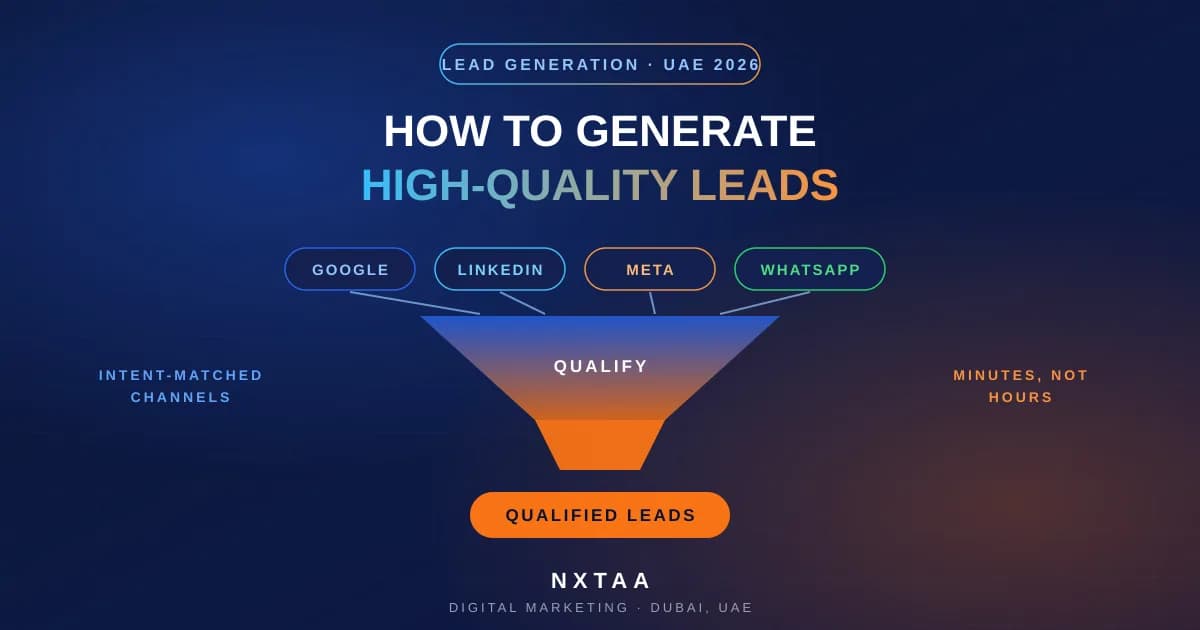
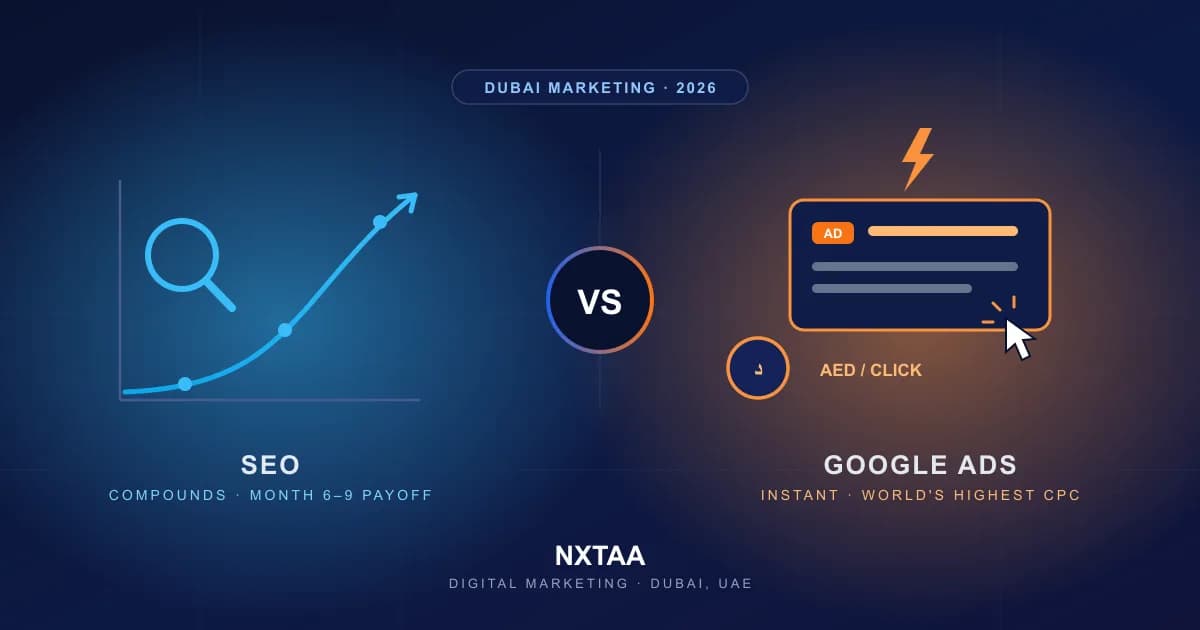
Deciding where the first dirham of your 2026 budget goes? Our breakdown of SEO vs Google Ads for Dubai businesses covers the real CPCs, ROI timelines, and the budget split that works. And once the traffic arrives, our 2026 playbook on generating high-quality leads in the UAE shows how to turn it into qualified pipeline.
Need a 2026-ready marketing audit? Contact NXTAA to consult with our digital strategists.