How to Generate High-Quality Leads in the UAE: A 2026 Playbook for Businesses
NXTAA Team
Digital Marketing Strategists
The Short Answer
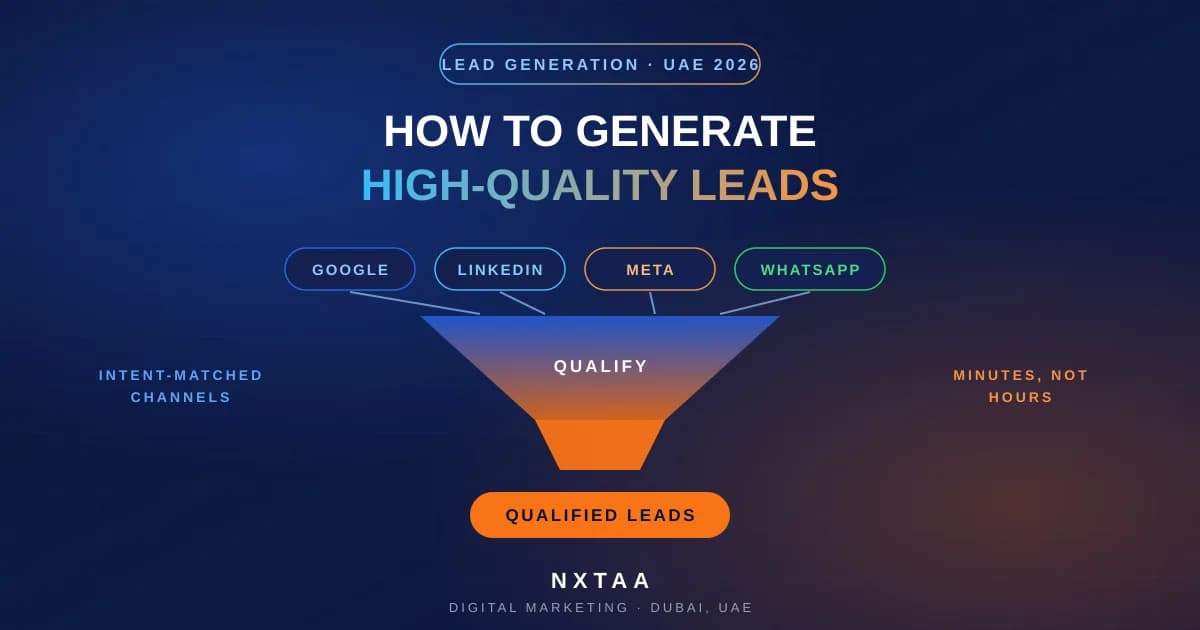
High-quality lead generation in the UAE comes down to three decisions: choosing the channel that matches your buyer's intent (Google for demand capture, LinkedIn for B2B, Meta and WhatsApp for volume), qualifying leads before your sales team touches them, and responding within minutes — because in this market, speed is the single biggest conversion lever you control.
Everything else is detail. Expensive detail, but detail.
Why "More Leads" Is the Wrong Goal Here
Dubai is one of the most expensive lead generation markets in the GCC, and it's getting pricier. More advertisers keep bidding for an audience of roughly 11 million people. More dirhams chasing the same eyeballs. That math only moves one direction.
The current benchmarks tell the story. A qualified enterprise B2B lead runs AED 1,200 to 3,500. Financial services or government leads can cross AED 8,000. Per lead. Not per customer.
At those prices, a pipeline full of tyre-kickers isn't a marketing problem — it's a budget fire. The businesses winning in this market stopped optimizing for lead count two years ago. They optimize for qualified pipeline per dirham, and every tactic below flows from that shift.
Pick Channels by Intent, Not by Habit
Each major channel in the UAE has a distinct cost and intent profile. Match them wrong and you'll pay LinkedIn prices for Facebook-quality leads.
Google Search: capture existing demand
Google Ads leads in the UAE cost roughly AED 80–400 depending on industry. That's not cheap — the UAE is one of the most expensive CPC markets in the world — but these are people actively searching for what you sell. For anything with clear search demand (clinics, legal, home services, B2B software), search should anchor the mix. Pair it with SEO so you're not renting every click forever; we've broken down that trade-off in detail in SEO vs Google Ads for Dubai businesses.
LinkedIn: expensive, and worth it for B2B
AED 200–900+ per lead. Painful. But LinkedIn is where you can target UAE decision-makers by job title, seniority and company size, and B2B leads from it tend to arrive better qualified than leads from other social platforms. If your deal size is five figures or more, the per-lead premium disappears inside one closed contract.
LinkedIn Without Ads: Founder Content and Sales Navigator
Not every B2B company can stomach those per-lead prices, and you do not have to start there.
Picture a Dubai HR software company with a small team and no LinkedIn ad budget. The founder posts twice a week about what actually goes wrong with UAE hiring and payroll, and comments on the posts of 30 target buyers. Sales Navigator, a paid subscription rather than ad spend, filters UAE HR heads by company size and saves them as a list. Connection requests mention something specific that person said. The first message contains no pitch. Only after a real exchange does the conversation move to a call, or to WhatsApp if the prospect agrees.
The catch is time, not money. Someone senior has to do this every week for months, and it does not scale the way media spend does. Measure conversations started and meetings booked, not followers.
One boundary to keep: a LinkedIn connection is not marketing consent. Talking to someone directly is one thing. Adding them to a mailing list is another, and building a permission-based database needs a proper opt-in.
Meta: volume at low cost, quality if you work for it
AED 40–200 per lead makes Meta the cheapest paid entry point in the UAE. It's also where most wasted budget lives, because low friction attracts low intent. Two fixes change the economics completely: qualifying questions on instant forms (budget, timeline, location), and Click-to-WhatsApp ads instead of form fills — which brings us to the channel that actually decides outcomes here.
WhatsApp: not a channel, the infrastructure
WhatsApp is the default messaging app in the UAE, and buyers expect to message a business the same way they message a friend. In UAE real estate, the agents who work leads on WhatsApp first tend to reach buyers sooner than agents relying on portal inquiries and callbacks.
If your lead flow doesn't land in WhatsApp — through Click-to-WhatsApp ads, a site widget, or the WhatsApp Business API — you're forcing UAE buyers onto channels they've already abandoned.
Qualify Before You Chase
Here's a pattern we've watched sink real budgets. A Dubai fit-out company was pulling 300 Meta leads a month at AED 60 each and celebrating — until someone checked and found sales was converting under 1%, and reps were spending entire mornings calling people who wanted a AED 2,000 job from a firm whose minimum project was AED 150,000. They added two questions to the lead form (project budget, start date) and a WhatsApp chatbot to pre-screen. Lead volume dropped 60%. Closed revenue went up the next quarter.
That's the whole lesson. A lead is only "high-quality" relative to your capacity to serve it.
Practical qualification layers, cheapest first:
- Form friction on purpose. Budget ranges, timelines, company size. Yes, volume drops. That's the feature.
- Chatbot pre-screening on WhatsApp. An AI agent asks the qualifying questions the instant the lead arrives — at 2pm or 2am — and routes only qualified conversations to humans. Our WhatsApp chatbot guide for Dubai businesses covers how to build one.
- Lead scoring in your CRM. Even simple rules (job title + company size + engagement) stop your best reps from working your worst leads.
Respond in Minutes or Lose the Deal
UAE buyers treat response speed as a proxy for professionalism. In real estate — the most competitive lead market in the country — the agent who replies first usually wins the site visit. This holds across industries: a lead that sits for four hours isn't a lead anymore, it's a contact record.
Landing pages carry the same urgency logic. Most UAE visitors arrive on a phone, and slow-loading pages lose people before the form even renders. Track your own conversion rate by traffic source, and treat a sudden drop as a sign that the page or the message is broken. Fast pages, instant replies. The pattern is speed all the way down.
Automation is what makes minute-level response possible without hiring a night shift. An acknowledgment within seconds, a qualifying flow within the first minute, a human follow-up for hot leads within the hour. Our guide to automating lead follow-up in Dubai shows the order to build it in.
Nurture the Leads Who Don't Buy Today
Most leads — even qualified ones — aren't ready the week they inquire. In the UAE this is where email and WhatsApp work as a pair: most people on your email list are also on WhatsApp, so a nurture sequence that alternates useful email content with well-timed WhatsApp touchpoints keeps you present without becoming spam.
Two rules keep nurture from backfiring. Get consent properly — UAE data protection law and WhatsApp's own policies both require it, and building a permission-based database the right way pays off for years. And send things worth reading: market updates, pricing guides, case studies. A monthly "just checking in" is how you train people to ignore you.
What a Working UAE Lead Engine Looks Like
Stripped to its skeleton: intent-matched paid channels feeding leads directly into WhatsApp, a chatbot qualifying them on arrival, instant response for hot leads, scored handoff to sales, and an email-plus-WhatsApp nurture track for everyone not ready yet. Measure cost per qualified lead and cost per closed deal — never cost per lead alone.
Budget-wise, serious B2B lead generation in Dubai starts around AED 30,000 a month across media, tools, and content. Businesses spending less than that usually do better concentrating on one channel done properly than spreading thin across four.
How NXTAA Builds Lead Engines for UAE Businesses
Everything above is exactly what NXTAA's Digital Marketing team sets up for businesses across the UAE:
- Intent-matched campaigns. We build and run Google, LinkedIn, Meta, and Click-to-WhatsApp campaigns against your real cost-per-qualified-lead numbers — not vanity lead counts.
- WhatsApp-first capture and qualification. Through the WhatsApp Business API, leads land in WhatsApp, get qualified by an AI chatbot in the first minute, and reach your sales team already scored.
- Automated nurture that converts later. Our marketing automation flows keep the leads who aren't ready today warm across email and WhatsApp — with proper consent, so the database keeps its value.
Ready to stop paying premium UAE prices for low-quality leads? Talk to NXTAA — we'll audit your current lead flow and show you where the qualified pipeline is leaking.
Track the Metrics That Actually Predict Revenue
Most UAE lead reports measure the wrong end of the funnel. Cost per lead is the number everyone quotes and the number that misleads most, because it rewards whichever channel produces the cheapest form fills regardless of whether any of them close.
Measure these instead, in this order:
| Metric | What it tells you | Why it beats cost per lead |
|---|---|---|
| Cost per qualified lead | Spend divided by leads that passed your qualification criteria | Strips out the volume channels inflate their numbers with |
| Lead-to-meeting rate | What share of qualified leads actually book | Exposes a qualification bar set too low |
| Cost per meeting | The first number a sales team recognises as real | Ties marketing spend to something with a calendar entry |
| Pipeline per channel | Value of opportunities created, by source | The only view that survives a budget conversation |
| Speed to first response | Minutes from submission to human or automated reply | The strongest single predictor of conversion in this market |
The pattern this exposes is consistent: the channel with the lowest cost per lead is frequently the most expensive per meeting. Meta produces cheap volume; if only a small fraction qualifies, its true cost sits well above a Google Search lead that cost four times more and converted.
Attribution in a WhatsApp-first market
Standard analytics breaks the moment a lead moves to WhatsApp, because the conversation happens outside the browser. Two practical fixes:
- Use per-campaign click-to-WhatsApp links so the entry point is recorded before the conversation starts.
- Capture source as a contact field in your CRM at creation, not at close. Retrofitting attribution after a deal closes produces the numbers people want rather than the numbers that happened.
The review cadence that works
Weekly, look at speed to response and qualified lead volume - both are correctable within days. Monthly, look at cost per meeting and pipeline by channel, which need enough volume to be meaningful. Quarterly, revisit the qualification criteria themselves, because a bar that never changes is usually a bar nobody is testing.
Set one owner for the numbers. Lead reporting split across an agency, a marketing lead, and a sales manager reliably produces three different figures and no decision.
Common Reasons UAE Lead Engines Underperform
Four failure patterns account for most of the gap between spend and pipeline in this market:
Leads route to an inbox nobody owns. A shared sales@ address is where response time goes to die. Assign an owner and an SLA per channel, and alert on breach rather than reporting it at month end.
Qualification happens after the call, not before. If your sales team is qualifying on the call, you are paying for meetings that should never have been booked. Push the budget and timeline questions into the form or the chatbot.
The follow-up sequence stops at two attempts. Most UAE B2B deals need considerably more contact than that before a first meeting, spread across channels. Teams that stop early conclude the leads were bad, and the data agrees with them for the wrong reason.
Nobody closes the loop back to the ad account. If closed-won never returns to the channel that sourced it, you are optimising toward form fills forever. Feed outcomes back monthly at minimum.
You Might Also Like
- SEO vs Google Ads: Which Is Better for Dubai Businesses in 2026?
- The Complete WhatsApp Chatbot Guide for Dubai Businesses
- How to Build an Email Marketing Database in the UAE
- NXTAA Digital Marketing Services
- NXTAA WhatsApp Business API Services
- Who Owns This Lead? Building an Accountable WhatsApp Enquiry Workflow
- Reactivating Dormant B2B Vendors with WhatsApp and Sales Follow-Up
Frequently Asked Questions
What is a good cost per lead in the UAE? It varies wildly by channel and industry: AED 40–200 on Meta, AED 80–400 on Google Search, AED 200–900+ on LinkedIn, and AED 1,200–3,500 for qualified enterprise B2B leads.
Which channel generates the highest-quality leads in the UAE? Google Search for active demand and LinkedIn for B2B produce the highest intent; Meta produces the highest volume, which becomes high-quality only with proper qualification.
Why is WhatsApp so important for lead generation in the UAE? It is the default messaging app for most UAE residents, so a lead that lands in WhatsApp gets seen and answered faster than one waiting in an inbox or a portal.
How fast should a business respond to a new lead? Within minutes. UAE buyers read response speed as professionalism, and in competitive categories the first business to reply usually wins the meeting.
What's a realistic monthly budget for lead generation in Dubai? Around AED 30,000/month is the floor for serious B2B efforts across media, tools, and content; predictable mid-market pipeline typically needs AED 60,000–120,000.
How do I stop getting low-quality leads from Facebook ads? Add qualifying questions (budget, timeline) to your forms, switch to Click-to-WhatsApp ads, and pre-screen with a chatbot before leads reach sales.
Is buying lead lists a good shortcut in the UAE? No — cold lists convert poorly, damage sender reputation, and messaging people without consent violates UAE data protection rules and WhatsApp's policies.
Does LinkedIn work without ads in the UAE? Yes for B2B, through consistent founder content and targeted outreach with Sales Navigator. It costs time rather than media budget, so expect months of steady work before meetings become predictable.