Reactivating Dormant B2B Vendors with WhatsApp (and Why Sales Still Has to Follow Up)
NXTAA Team
B2B Marketing Specialist
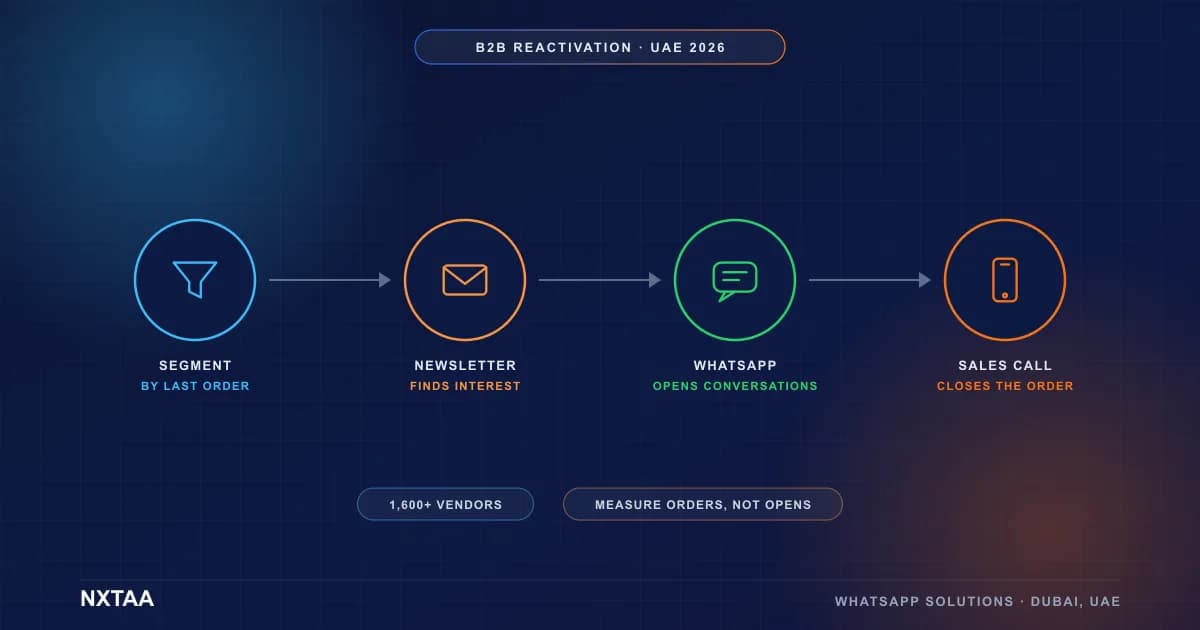
You reactivate dormant B2B vendors by segmenting them by how quiet they are, sending relevant WhatsApp and newsletter touches with a clear reason to reply, and handing every response to a salesperson within hours. Messaging reopens the conversation. A human closes it.
Key Takeaways
- A large vendor list is usually a few active accounts and a long quiet tail, so treat the tail as its own segment
- Segment by last order, category and value before sending anything
- Newsletters build awareness at low cost, while WhatsApp prompts a direct, personal reply
- Every reply must reach a named salesperson fast, or the campaign wastes its own results
- Message value (new lines, price moves, stock) beats generic "we miss you" notes
- Track reactivation by orders, not by opens or reads
The Network That Went Quiet
A UAE FMCG distributor supplies thousands of small outlets: groceries, kiosks, cafeterias, mini-marts. Over the years it onboarded more than 1,600 vendors. Order books looked healthy on the surface, but the sales director suspected the truth: a few hundred accounts produced most of the volume. The rest ordered rarely or had stopped.
The sales team of a dozen reps could not call 1,600 accounts regularly. They called the big ones, because those were the ones that rang them. The quiet tail sat in the CRM, aging.
The marketing lead proposed a campaign: reach the whole network with newsletters and WhatsApp, and see who wakes up.
It worked, but not for the reason anyone expected. Messaging got replies. The replies only turned into orders when a rep picked up the phone the same day. Where reps were slow, interest evaporated within a week.
Looking back, the campaign did not reactivate vendors. It found the ones who were ready, and sales converted them.
Why Dormant Vendors Go Quiet
Understand the silence before you try to break it. In our experience, quiet B2B accounts fall into a few groups:
- Forgotten: they would order again but nobody reminded them
- Out of range: the products they need are not in the offer they remember
- Price-moved: a competitor undercut a few lines
- Operational change: new owner, new location, new supplier relationship
- Gone: closed or switched for good
Messaging can recover the first two and sometimes the third. Pretending the last group exists wastes effort. Segmentation sorts them out.
Segment Before You Send
The first week was spent on data, not messages. The team pulled order history and sorted the list.
| Segment | Definition | Approach |
|---|---|---|
| Recently lapsed | No order in 60 to 120 days | Direct WhatsApp nudge plus a rep call |
| Long dormant | No order in 120 to 365 days | Newsletter first, WhatsApp to responders |
| Very cold | No order in over a year | Newsletter only, low priority |
| High potential | Large outlet or strong category fit | Rep-led outreach with WhatsApp support |
| Unreachable | No valid number or email | Data clean-up task |
As the table shows, the same message to everyone would have wasted effort. Recently lapsed accounts needed a prompt and a person. Very cold accounts needed patience and a low-cost drip.
When Does a Vendor Count as Dormant?
There is no universal number. The distributor's 60-day line fits outlets that reorder often, and copied into another trade it would mislabel half the list.
Measure dormancy in missed order cycles, not calendar days. Work out each account's usual gap from its order history, then start with three missed cycles:
- A grocery outlet ordering weekly: three weeks of silence means something has changed.
- A cafeteria ordering monthly: three months.
- A packaging buyer ordering quarterly: nine months. Calling this account after 60 days only proves you did not check.
Use two missed cycles for your largest accounts, because they are worth catching early. Then look for seasonal explanations before you send. A school canteen that goes quiet in July is on holiday, not lost.
The first message needs an approved template unless the vendor has messaged you in the last 24 hours. A win-back with an offer will normally count as marketing, which Meta bills per delivered message, so check the current pricing rules when you size the campaign.
The Two Channels, and What Each One Does
Newsletters: wide and cheap
Email newsletters carried the news that does not need a reply: new product lines, seasonal promotions, price lists, a short note from the sales director. They keep the brand visible to the whole network. They also tell you who is still paying attention, since clicks reveal interest. For the mechanics, see our guides on email marketing best practices and building an email marketing database in the UAE.
WhatsApp: personal and direct
WhatsApp carried the questions: "Are you still stocking X?" "We have new stock of Y at a better price, shall I send the list?" It reads like a message from a person, not a blast, and vendors reply to it. That is the point. The channel exists to start a conversation. Our guide to high-converting WhatsApp marketing templates shows how to write messages that earn replies.
Both channels need proper consent and opt-out handling. Read our guide to sending bulk WhatsApp messages without getting banned before the first send.
The Campaign Timeline
Here is how the work was sequenced over about six weeks.
| Week | Work | Purpose |
|---|---|---|
| 1 | Clean data, segment, confirm consent and opt-in status | Know who you can contact |
| 2 | Send the first newsletter to all segments | Reintroduce the brand, spot engaged accounts |
| 3 | WhatsApp nudge to recently lapsed and clickers | Open direct conversations |
| 4 | Reps follow up on every reply within hours | Convert interest into orders |
| 5 | Second newsletter with a targeted offer | Keep warm accounts moving |
| 6 | Review results, retire dead accounts, plan next cycle | Learn and prune |
Messages That Earn a Reply
Generic "we miss you" messages do poorly. B2B buyers respond to reasons. Examples of the kind of message that worked:
- Stock news: "New lines in the snacks range arrived this week. Want the list?"
- Price news: "We have adjusted prices on a few fast-moving items. Shall I send the updated sheet?"
- Useful reminder: "Ramadan ordering opens soon. Want us to pencil in your usual quantities?"
- Direct question: "Are you still stocking our beverage range, or has something changed?"
Each one is short, specific and ends with a low-effort question. Notice what is missing: no giant promotional image, no long paragraph, no pressure.
Sitting on a vendor list that has gone quiet? Talk to NXTAA about a reactivation campaign. We will help you segment the list and design the messages and the follow-up.
Why Sales Still Has to Follow Up
This is the lesson that mattered most. Replies arrived in waves, mostly in the first few hours after a send. Reps who checked the inbox that afternoon and called or messaged back turned many replies into orders. Reps who looked two days later found that the vendor had moved on, or had ordered elsewhere.
So the team set three rules:
- Every reply has a named owner within the hour. The owner is the rep who covers that vendor's area
- Replies are answered the same day. A call or a personal message, not another template
- Every conversation ends with a recorded outcome: ordered, price objection, not interested, wrong contact
Automation opens the door, but it cannot negotiate credit terms or arrange a delivery slot. Those are human jobs. A campaign without a follow-up process is a very expensive newsletter.
A Sample Message Sequence
Cadence matters as much as content. Here is a simple sequence for the recently lapsed segment. Adjust it to your trade rhythms.
| Day | Channel | Message purpose |
|---|---|---|
| 0 | Email newsletter | Reintroduce the range and share a short update |
| 3 | Personal check-in with one specific question | |
| 5 | Rep call | Follow up on every reply, and on clickers who did not reply |
| 10 | Share a relevant offer or stock news to non-responders | |
| 21 | Email newsletter | Second update with a targeted promotion |
| 30 | Review | Decide who moves to the regular cycle and who is paused |
Three or four touches over a month is plenty. More than that and you start to look like noise.
Building the Offer Behind the Message
A good message cannot rescue a weak reason to order. Before you send anything, give the sales team something worth talking about:
- A returning-vendor incentive, such as a better price on a first reorder or a delivery-fee waiver
- A curated list, not the whole catalogue: ten fast movers for that vendor's category
- A credit or terms conversation, where the account is blocked for payment reasons, handled privately by a rep
- A reason tied to the calendar, like a festival or season when demand rises
Vendors do not go quiet because they never heard from you. They go quiet because something stopped making ordering easy or worthwhile. The campaign finds that out, and the rep fixes it.
The Rep's Same-Day Call
A short outline helps reps who are not used to warm calls:
- Open with the reply: "Thanks for getting back to us about the new snack range."
- Ask one open question: "What has changed since your last order?"
- Listen for the real blocker, whether price, range, service or ownership change
- Offer one concrete next step, such as a quote, a visit or a trial order
- Record the outcome in the CRM straight after the call
Reps who follow this tend to learn more about the network in a month than in the previous year, and that insight feeds the next cycle.
Mistakes We Made
- We sent to everyone at once. The first plan blasted the full list. We caught it in review. Segmenting by recency avoided annoying active accounts and risking complaints
- We measured the wrong thing first. Read rates looked great. Orders told the real story. We switched to orders and reply-to-order conversion
- We forgot language. Some vendors preferred Arabic, Urdu or Hindi. Adding language to the segment improved replies
- We did not prune. Accounts that never responded to three touches stayed on the list. We now move them to a quarterly low-touch cycle
What to Measure
Track these, in this order:
- Reactivated accounts: vendors who place an order after the campaign
- Reply-to-order rate: share of replies that become orders
- Time to first human response after a reply
- Revenue from reactivated accounts over the next 90 days
- Opt-out and complaint rate: your safety check
Opens, reads and clicks are supporting signals only. They tell you who to call. They do not tell you whether the campaign worked.
The Bigger Pattern
This is not only a distributor problem. Any business with a long B2B tail has the same opportunity: wholesalers, equipment suppliers, packaging firms, trade-show organisers, SaaS vendors with SME customers. The recipe repeats. Clean the list, segment by recency and value, use cheap channels to find interest, use personal channels to start conversations, and make sure a salesperson owns every response.
Reactivation Checklist
- Clean the vendor list and confirm consent for each channel
- Segment by last order date, category and value
- Write short, specific messages with a single question
- Send newsletters first, WhatsApp to engaged and recently lapsed accounts
- Assign every reply to a named rep within an hour
- Require same-day follow-up and a recorded outcome
- Measure orders and reply-to-order rate, not reads
- Prune the dead accounts and repeat the cycle
How NXTAA Can Help
We help UAE distributors and trade businesses wake up their networks:
- WhatsApp campaigns with opt-in, templates and reply routing on the WhatsApp Business API
- Newsletters and segmentation through our email marketing service
- Triggered follow-ups and rep alerts with marketing automation
Ready to turn a quiet vendor list into orders? Speak to NXTAA and we will plan the segments, the messages and the follow-up with you.
You Might Also Like
- How to Send Bulk WhatsApp Messages Without Getting Banned
- High-Converting WhatsApp Marketing Templates
- Design WhatsApp Journeys, Not Broadcasts
- Who Owns This Lead? Building an Accountable WhatsApp Enquiry Workflow
FAQ
How do I reactivate inactive B2B customers? Segment them by last order and value, send relevant newsletters and WhatsApp messages with a clear reason to reply, and have a salesperson follow up on every response quickly.
Is WhatsApp better than email for B2B win-back? They do different jobs. Email reaches the whole list cheaply and signals interest. WhatsApp starts personal conversations with the accounts that respond.
How soon should sales follow up on a reply? Within the hour to assign an owner and the same day to respond. Interest fades quickly, and slow follow-up wastes the campaign.
How often should I message dormant vendors? Lightly. A few well-targeted touches over several weeks beats a daily blast. Accounts that ignore several touches move to a slower cycle.
What should a reactivation message say? Something specific and useful, such as new stock, a price change or a seasonal ordering window, followed by one easy question.
Do I need consent to message business contacts on WhatsApp? Yes. Collect opt-in, give a simple way to opt out, and follow WhatsApp's policies and UAE messaging rules.
How do I know the campaign worked? Count reactivated accounts, reply-to-order rate and revenue over the following 90 days. Opens and reads are only supporting signals.
Do reactivation messages need an approved template? Yes, unless the vendor messaged you within the last 24 hours. A win-back containing an offer will normally be a marketing template.
When does a distributor account count as dormant? Measure it in missed order cycles rather than days, starting at three missed cycles and two for your largest accounts. A weekly outlet can be dormant in three weeks, while a quarterly buyer is not dormant for nine months.