How to Build an Email Marketing Database in the UAE
NXTAA Team
Email Marketing Strategists
How to Build an Email Marketing Database in the UAE
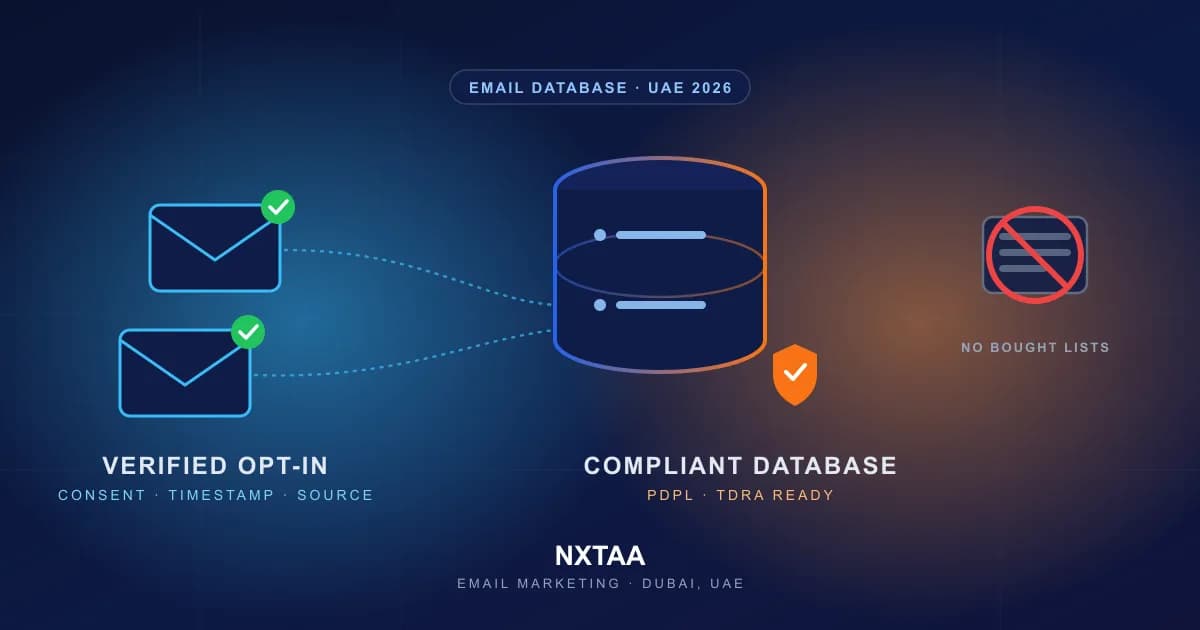
You build an email marketing database in the UAE by collecting explicit, verifiable opt-in consent from every contact before you email them — no purchased lists, no scraped addresses, no "implied consent" from a business card exchange. The UAE's rules are stricter than most Western markets, and getting this wrong doesn't just hurt deliverability. It can trigger a TDRA fine of up to AED 150,000.
Key Takeaways
- Consent is required before you send — the UAE has no "implied consent" or B2B exemption, unlike the US CAN-SPAM model. No consent record means the contact isn't marketing-ready.
- Never buy lists. Beyond the legal exposure, purchased UAE data tanks your sender reputation and can take your entire email channel dark for weeks.
- Build with lead magnets, LinkedIn lead forms, event sign-ups, and on-site opt-ins — the channels where the consent context is clear.
- Quality beats size: 800 segmented, engaged subscribers outperform 10,000 cold contacts on click-through and revenue per recipient.
- Keep timestamped consent records — as of late 2025 TDRA expects opt-in proof in a formal Consent Management System before a campaign runs.
Why UAE List-Building Is Not Like Everywhere Else
Most marketers coming from the US assume email works like CAN-SPAM: send freely, include an unsubscribe link, you're compliant. The UAE doesn't work that way.
Explicit consent is required before sending marketing emails to UAE recipients, full stop. There's no implied consent exception, no "legitimate interest" carve-out, and — this is the part that trips up most B2B marketers — no distinction between B2C and B2B communications. A salesperson emailing a procurement manager cold, even with a professional pitch, needs consent under UAE law exactly the same as a retailer emailing a consumer.
The legal backbone here is a stack of overlapping frameworks: the Personal Data Protection Law (PDPL), the Telecommunications Law, the Regulations on Unsolicited Electronic Communications, and general Consumer Protection Law. The Telecommunications and Digital Government Regulatory Authority enforces all of it, and enforcement has gotten more organized, not less — as of late 2025, TDRA requires businesses sending marketing messages to upload opt-in proof to a formal Consent Management System before a campaign goes out.
That single requirement changes how you should think about list-building from day one. If you can't produce a timestamped opt-in record for a contact, that contact isn't marketing-ready, no matter how it landed in your CRM. (The same consent-first logic governs SMS — see our UAE SMS marketing guidelines for that channel's rules.)
What Actually Counts as Consent
Not every "yes" clears the bar. A contact handing you a business card at a Dubai trade show did not consent to your newsletter — they consented to being contacted about whatever the card exchange was for, and nothing beyond that.
Real consent, the kind that survives an audit, looks like this:
- A clear, standalone checkbox or opt-in action — never pre-ticked, never bundled into a "by using our site you agree to everything" blanket clause.
- Specific language about what they're signing up for (a newsletter, product updates, promotional offers) rather than a vague "stay in touch."
- A timestamp and source record — when they opted in, and through what channel, stored somewhere retrievable.
- A working, immediate unsubscribe mechanism that actually removes them, not one that "processes within 5–7 business days."
Double opt-in — where a subscriber confirms via a follow-up email link before entering your active list — isn't strictly mandated everywhere, but it's the safer standard, and it's what most compliant UAE list-building tools default to now for exactly this reason.
Building the List: What Actually Works
Forget purchased lists entirely. Beyond the legal exposure, purchased UAE contact databases are almost universally low quality — outdated, unconsented, and a fast route to spam-complaint rates that tank your sender reputation for every future campaign, not just the one that used the bad list.
The channels that build a real, compliant database are the unglamorous ones.
Lead magnets on your own site do the heaviest lifting. A free market report, a pricing calculator, a downloadable checklist relevant to your industry — something specific enough that a UAE professional in real estate, finance, or healthcare (the sectors where email still performs strongest here) trades their email address for it willingly. That trade is your consent event.
LinkedIn lead generation campaigns targeting UAE company sizes, job titles, and industries convert well precisely because the consent context is clear: someone filling out a LinkedIn lead form knows exactly what they're opting into.
Event and webinar registrations are another clean source, provided the registration form itself asks for marketing consent separately from event logistics — don't bury it in the "I agree to attend" checkbox.
And your existing website traffic is underused by most businesses. A well-placed, clearly worded opt-in on your homepage and service pages, offering something specific rather than a generic "subscribe to our newsletter," converts far better than most businesses expect.
Not sure your opt-in forms and consent records would survive a TDRA check? NXTAA's Email Marketing team audits your current list and capture flows, then builds the compliant funnel for you. Get a free list audit.
Segment Before You Grow, Not After
A list of 800 genuinely interested, properly segmented subscribers outperforms 10,000 cold contacts every time. That's not a motivational line — it shows up directly in click-through and revenue-per-recipient numbers, which have become the metrics that matter more than raw open rates now that privacy changes have made open tracking unreliable.
Segment by how the contact entered your funnel (lead magnet topic, event, product interest), not just by generic demographic fields. A contact who downloaded a report on UAE compliance requirements should get a different nurture sequence than one who registered for a product demo webinar — sending both the same generic blast is how engagement quietly erodes even on a fully consented list.
The Sequences a UAE Business Actually Needs
Once contacts are in, structure matters as much as acquisition. Most well-run UAE email programs run at minimum:
A welcome sequence — roughly five emails over ten days — that establishes expertise and makes a soft ask, not a hard sell on email one. A lead-nurture sequence triggered specifically by what the contact downloaded or attended, building on that exact topic for another four emails over about twelve days. And a re-engagement sequence for contacts who've gone quiet for 60–90 days, before you consider suppressing them entirely — sending to disengaged contacts long-term hurts deliverability for your entire list, not just those addresses.
Building these flows by hand doesn't scale — this is exactly what marketing automation platforms are for, and where the tactics in our 2026 email marketing playbook come into play.
A Scenario Worth Learning From
A Dubai-based fit-out contractor bought a "verified UAE business emails" list from an offshore data broker, loaded 40,000 contacts into their CRM, and sent a single promotional blast. Spam complaints hit within hours. Their sending domain landed on a blocklist inside a week, and even their transactional emails — invoices, project updates to actual clients — started landing in spam. It took nearly two months of domain warm-up and a new sending IP to recover deliverability, and the original campaign generated exactly zero qualified leads. The cost of "shortcutting" list-building here wasn't a fine. It was the entire email channel going dark for two months.
How to Tell Whether Your Database Is Actually Healthy
A big list means nothing if the addresses on it don't open, click, or convert — and in 2026, inbox providers judge you on exactly those signals. A few numbers tell you whether your database is an asset or a liability:
- Engagement rate over the last 90 days. What share of your list has opened or clicked recently? If a large chunk has been silent for months, they're not just dead weight — they actively drag your deliverability down, because mailbox providers read low engagement as a spam signal for the whole domain.
- Spam-complaint rate. Keep this well under 0.1% (one complaint per thousand sends). Anything higher and you're one campaign away from a blocklist. A rising complaint rate almost always traces back to weak consent — people who don't remember opting in.
- List growth vs. churn. A healthy database grows through genuine opt-ins faster than it loses people to unsubscribes and hard bounces. If churn is outpacing clean growth, the acquisition channels feeding your list are the problem, not the emails.
- Revenue or qualified leads per recipient. The bottom-line metric. It cuts straight through vanity numbers — a smaller list with higher revenue per recipient is simply a better business asset than a bigger one that converts nobody.
Track these from the start, not after something breaks. The businesses that treat list health as a monthly review — pruning disengaged contacts, watching complaint trends, checking which sources produce the most engaged subscribers — are the ones whose email keeps landing in the inbox while competitors quietly slide into spam.
A Note on Deliverability Foundations
Consent and engagement do most of the work, but the technical basics matter too. Make sure your sending domain has SPF, DKIM, and DMARC records properly configured — these authenticate your mail and are increasingly required by Gmail and Outlook for bulk senders. Warm up any new sending domain or IP gradually rather than blasting from cold. And keep marketing and transactional mail on separate subdomains, so a promotional misstep never threatens the invoices and receipts your business actually depends on reaching the inbox.
Common Mistakes That Sink UAE Email Programs
Treating a business card or LinkedIn connection as marketing consent is the most common one — it isn't, under UAE rules, and it's the easiest thing for a regulator or an angry recipient to challenge.
Skipping the consent record is the second. Even a compliant opt-in is worthless if you can't produce proof of it later — store the timestamp, the source, and the exact language the contact agreed to.
And chasing list size over list quality — a business that measures success by subscriber count rather than engagement and revenue per recipient will eventually pay for it in deliverability, because inbox providers penalize senders whose lists show high complaint and low engagement rates, regardless of how the list was built.
How NXTAA Helps UAE Businesses Build Compliant Email Programs
Getting all of this right — consent capture, TDRA-ready record keeping, segmentation, and the nurture sequences that actually convert — is what NXTAA's Email Marketing Services are built for:
- Consent-first list architecture. Opt-in forms, double opt-in flows, and timestamped consent records designed to satisfy the TDRA Consent Management System from day one.
- Segmented automation. Welcome, nurture, and re-engagement sequences wired through marketing automation, triggered by how each contact actually entered your funnel.
- Multi-channel follow-through. Email working alongside WhatsApp Business API and compliant SMS, so the same consented contact gets the right message on the right channel.
Want a list that regulators can't touch and inboxes don't reject? Book a free consultation with NXTAA and we'll audit your current database and map the compliant path to growth.
You Might Also Like
- The Renaissance of Email Marketing in 2026
- UAE SMS Guidelines 2026: Compliance & Best Practices
- WhatsApp Business API in UAE: 2026 Guide
- NXTAA Email Marketing Services
Frequently Asked Questions
Is cold emailing legal in the UAE? No, not without prior explicit consent — the UAE requires opt-in consent for all marketing emails, with no exceptions for existing business relationships or B2B communication.
Can I buy an email list of UAE businesses? You can, but you shouldn't — purchased lists lack verifiable consent, violate UAE regulations, and typically damage sender reputation badly enough to hurt your legitimate email channel too.
What's the penalty for non-compliant email marketing in the UAE? TDRA can impose fines up to AED 150,000 for serious violations of telecommunications and unsolicited communications rules.
Do I need double opt-in for my UAE email list? It's not universally mandated, but it's the safer standard — a confirmed opt-in gives you stronger proof of consent if your list is ever challenged.
How long should I keep consent records? Indefinitely for active subscribers, and for a reasonable retention period after unsubscribe, since you may need to prove consent was valid at the time a message was sent.
What makes UAE email marketing rules different from the US CAN-SPAM Act? CAN-SPAM allows sending without prior consent as long as an opt-out is provided; UAE law requires consent before you send, with no opt-out-only option.
What's a good email open rate to aim for in the UAE in 2026? Industry benchmarks put a good open rate above 30%, with 45–50% considered strong, though click-through and revenue per recipient are increasingly the more reliable success metrics.