One WhatsApp Number or Two? When to Separate Operational Notifications from Sales and Support
NXTAA Team
WhatsApp Business Platform Specialist
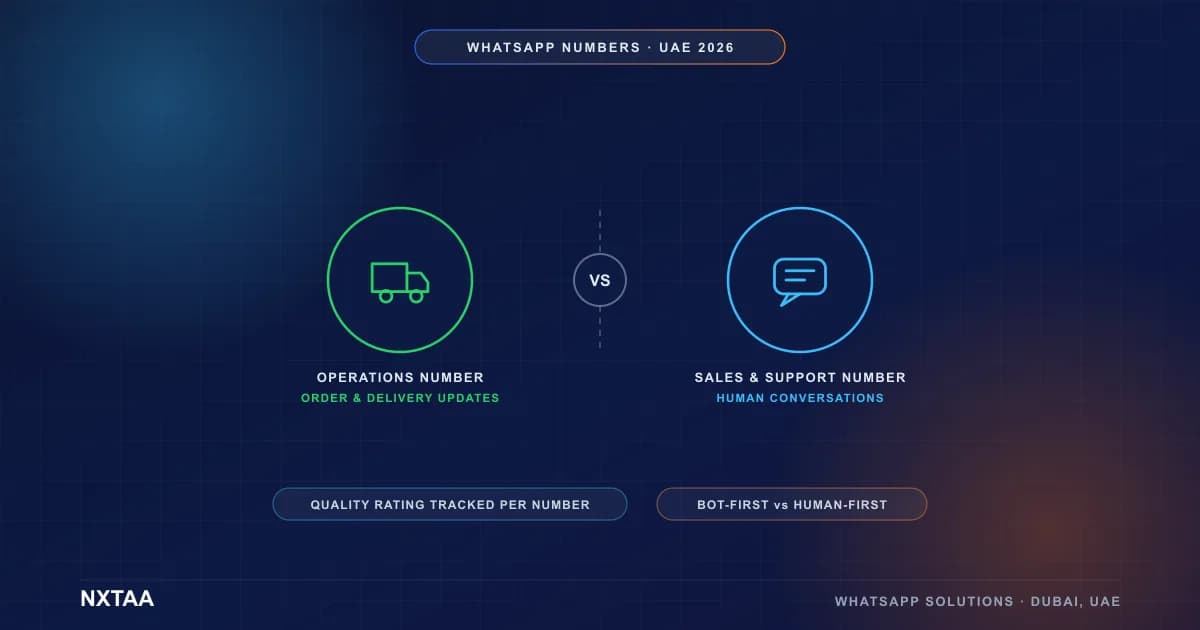
Use two WhatsApp numbers when automated operational messages (order confirmations, delivery updates, invoices) share a channel with human-led sales or support chats. One number is fine at low volume with one small team. Split them once notification traffic can bury your agents, or once a single bad campaign could drag down the number your customers rely on.
Key Takeaways
- The deciding factor is purpose and risk, not message volume alone
- Quality rating, display name and profile are managed per number, so a complaint spike on one number does not have to hurt the other
- Customers reply to notifications with sales questions, so every split needs a deliberate reply-routing rule
- A split protects you from quality problems, not from policy violations, which can reach the whole business account
- Plan on about four weeks to split cleanly, mostly spent on templates, routing and telling customers
- Keep one number if a single team handles low volumes of both kinds of conversation
The Week One Number Stopped Being Enough
Picture a UAE retail and distribution business with a busy e-commerce arm. One WhatsApp number, registered on the API through a provider, does everything. It sends order confirmations and delivery updates to thousands of customers a day. It also receives enquiries from trade buyers who want quotes, stock checks and credit terms. Two sales agents and one support coordinator work from the same inbox.
For months it works. Nobody complains.
Then a regional courier has a bad week. Deliveries slip across three emirates, and the automated "your order is delayed" message goes out to a few thousand people in two days. Every one of them has a question. Replies pour into the shared inbox. The sales agents, who were halfway through two large quote conversations, now share a queue with hundreds of "where is my parcel" messages. A buyer waiting on a pricing answer waits six hours. Another gives up and calls a competitor.
It gets worse. A handful of customers, annoyed, block the number. Blocks and reports feed the quality rating of that number, and the rating drops. Now the team is worrying about whether the number that carries every customer conversation, sales included, is about to have its sending limited, all because of a logistics problem.
Looking back, the delivery delay was not the real failure. The real failure was that one phone number was doing two jobs with opposite temperaments, and nobody had decided what happens when one of them goes wrong.
Why the Split Matters
Three things change when you separate the jobs.
Quality is tracked per number
WhatsApp scores each business number on how recipients react: blocks, reports, and how often messages get engagement. That rating influences what you are allowed to do with the number. Put marketing sends, notifications and conversations on a single number and one noisy category can hurt all the others. Put them on separate numbers and a rough week for notifications stays contained to the notification number.
Be precise about what this does not do. Separate numbers isolate quality problems. They do not isolate policy violations. If you break WhatsApp's commerce or messaging policy, enforcement can reach the whole business account, not one number. We cover how that plays out in our guide to WhatsApp Business account bans and recovery.
Queues behave differently
Operational conversations are high volume, short, and mostly answerable by a bot or a status lookup. Sales conversations are low volume, long, and worth money. Mix them and the loud queue starves the valuable one. Separate them and you can staff, route and measure each properly: first-response targets in minutes for sales, bot-first handling for tracking questions.
Customers hold different expectations
A number that sends "Your order has shipped" is a utility. People do not expect a conversation, and they do not mind if it is automated. A number named after your sales team is an invitation to talk, and people expect a human within a reasonable time. Blending them breaks both promises.
Two Numbers Still Share One Messaging Limit
A second number does not buy you more sending capacity. Be clear on this before you budget for one.
Meta sets messaging limits at the business portfolio level, and every number in that portfolio shares them. Say your portfolio sits at the 2,000 tier. Your notifications number reaches 1,500 customers with templates today, which leaves about 500 for the sales number until the rolling 24-hour window frees up. Now replay that courier week from the story above. The split keeps the agents' queue clean, but a big enough notification run can still leave sales short of template sends.
Replies inside the customer service window do not count against this limit, so ongoing conversations carry on. What gets squeezed is the business-initiated message: the quote follow-up or the reminder.
Numbers have a cap of their own too. Meta starts you at two, rising to 20 after business verification or reaching the 2,000 tier.
So split for quality and for queues. If you need more capacity, the route is verification, then a good quality rating and steady use of your current limit. Quality stays per number. Capacity does not.
Two Numbers on One Phone Is a Different Question
Plenty of people searching for "two numbers" mean something smaller: one person, one handset, two lines. Dual-SIM phones can generally run two WhatsApp accounts, one per number. That suits a founder keeping a personal line and a business line apart.
It does not solve the problem in this article. Both numbers still sit in one person's hand, with no routing and no shared view. An API number is normally answered through an inbox rather than a phone app, by however many agents you assign. Meta also says a number already in use with WhatsApp cannot be registered until it is deleted, so ask your provider about current migration and coexistence options before you pick a number.
Avoid cloned or modified apps sold as a way around this. They are one of the fastest routes to a ban.
One Number vs Two: Side by Side
Here is how the two setups compare in practice for a retail, distribution or e-commerce operation.
| Factor | One number | Two numbers |
|---|---|---|
| Setup effort | Lowest | Moderate: two profiles, two sets of templates |
| Quality-rating risk | One bad category affects everything | Contained to the number that caused it |
| Inbox clarity | Everything mixed | Operations and sales separated |
| Staffing model | One pool covers both | Bot-first for operations, humans for sales |
| Customer clarity | "Who is this number for?" | Obvious from name and behaviour |
| Reporting | Blended metrics hide problems | Clean metrics per purpose |
| Best for | Small teams, low volume | Mixed automated and human traffic |
As the table shows, the extra cost of two numbers is mostly one-time setup work. The ongoing benefit is clarity.
When One Number Is Still the Right Call
Do not split for the sake of looking sophisticated. One number is the right answer when:
- A single small team handles all conversations and can see the whole picture
- Automated messages are a trickle, not a flood
- You send almost no marketing, so quality risk is low
- Your customers are mostly one-to-one relationships, such as a small consultancy
A boutique distributor with 80 trade accounts and one account manager does not need two numbers. They need a clean template library and a shared inbox. We looked at that setup in our omnichannel CRM guide for UAE businesses.
A Decision Framework You Can Run in Ten Minutes
Answer these in order. Stop at the first "yes."
- Do automated notifications go to more than a few hundred customers a day? If yes, split.
- Do the same agents handle notification replies and sales conversations? If yes, split, or at least separate the queues.
- Do you send or plan to send marketing broadcasts? If yes, give marketing its own number or a very disciplined opt-in list.
- Would a quality-rating drop on this number block revenue conversations? If yes, split.
- None of the above? Stay on one number and revisit when volume grows.
The framework is blunt on purpose. In our experience the answer is usually obvious by question two.
Not sure which side of the line your volume falls on? Ask NXTAA for a WhatsApp number architecture review and we will map your message types, queues and risks before you buy anything.
How the Split Actually Happened: A Four-Week Timeline
Back to the retail business. They split the setup over four weeks. Nothing was rushed, and nothing broke.
| Week | Work | Outcome |
|---|---|---|
| 1 | Audit message types, count volumes, decide which number keeps which role | A one-page "number charter" |
| 2 | Register and verify the second number, set display name and profile, build separate template sets | Second number ready, not yet live |
| 3 | Add routing rules, bot flows for tracking questions, and an escalation path to sales | Tested in a closed pilot |
| 4 | Move notifications to the new number, update website and signatures, tell customers | Cutover with the old number kept for sales |
Note which number moved. They kept the original number for sales, because trade buyers had saved it in their phones, and moved the automated notifications to the new one. Moving the noisy traffic and leaving the relationship number alone avoided a round of "who is this?" messages from buyers.
The Reply Problem Nobody Plans For
Here is the part that catches teams out. Customers reply to notifications.
Someone gets "Your order has shipped" from the notifications number, and they reply: "Can I add two more cartons to this?" That is a sales message sent to a number built to ignore sales messages.
You need an explicit rule for it. Three options work:
- Auto-reply with a handoff. The notification number replies once with a short message and a tap-to-chat link to the sales number
- Smart routing. A bot classifies the reply and either answers a tracking question or forwards it to a human with context
- Operations-first inbox. A small operations team owns the notification number, answers status questions and passes real sales intent over
The retail team used the first two together. Status questions got a bot answer, and anything with buying intent got a link to the sales number with the order reference pre-filled. Agents stopped seeing "where is my parcel" altogether.
Routing Rules That Keep the Two Numbers Honest
A split only holds if the rules stay boring and written down:
- Notifications number: utility templates only, no promotions, no "while you are here, check our new range"
- Sales number: conversations and approved sales templates, with opt-in required for anything promotional
- Every notification reply gets one of three outcomes: answered by bot, escalated to a human, or redirected to the right number
- Nobody sends a broadcast from the notifications number, ever
That last rule sounds obvious. It is the one teams break first, usually when a manager asks for "just one quick promo to everyone who ordered last month." If you want to understand why that is dangerous, read our guide to sending bulk WhatsApp messages without getting banned.
Mistakes We Made
Honest list, since the lessons are the useful part:
- We named the second number badly. The first display name was too generic and was not accepted. It needs to clearly relate to your business name
- We forgot the invoice PDFs. Finance had a template attaching invoices that nobody remembered. It kept going out from the old number for three days
- We under-briefed the sales team. Agents did not know customers might now get a second number, and a couple told customers the notifications were "spam"
- We did not test the reply path. A closed pilot caught most of it, but not the Arabic-language replies that the bot mis-routed
Every one of these was cheap to fix once spotted. All of them were cheaper to catch in week three than in week five.
What About Cost?
Since mid-2025 WhatsApp bills per delivered template message rather than per conversation, and from October 2026 some message types that used to be free are billed too. How free allowances and charges apply across several numbers depends on how your account and provider are set up, so confirm it with them before you plan around any saving. Our breakdown of the October 2026 pricing changes covers what changed. The main point stands regardless: the second number costs far less than a lost quote. Login codes are a third stream again; many businesses keep OTPs on SMS with WhatsApp as backup, using an enterprise SMS gateway for OTP fallback.
A Setup Checklist
- Write the number charter: what each number is for and what it never does
- Verify your business and register the second number
- Choose display names that clearly relate to your business
- Build separate template sets, utility only on the notification number
- Configure reply routing with the three outcomes above
- Brief every agent before launch
- Pilot with a small segment, including Arabic-language replies
- Cut over, keep the relationship number stable, and announce the change
How NXTAA Can Help
We design and run multi-number WhatsApp setups for UAE businesses with mixed automated and human traffic:
- Number architecture and verification through our WhatsApp Business API service
- Shared inbox, routing and escalation for sales and support teams, built into our contact center solutions
- Notification automation and templates connected to your order and delivery systems via marketing automation
Thinking about splitting your WhatsApp number? Talk to NXTAA. We will review your volumes, recommend one number or two, and give you a clear plan either way.
You Might Also Like
- Shared Team Inbox vs Personal WhatsApp Phones
- Design WhatsApp Journeys, Not Broadcasts
- WhatsApp Business API in the UAE: 2026 Guide
- How to Register for WhatsApp Business API in the UAE
FAQ
Can one WhatsApp Business account hold more than one number? Yes. One WhatsApp Business Account can hold several numbers, and a verified business can register more of them. Each number has its own profile, display name and quality rating.
Does a second number protect me if my account is banned? Not fully. A second number isolates quality problems, but policy violations can affect the whole business account. Follow the policies on every number.
Which number should keep the existing customer-facing line? Keep the number customers already know for sales or support, and move the automated notifications to the new one. It avoids confusion and saved contacts.
How should I handle customers who reply to order updates? Give the notification number a reply rule: a bot answers status questions, and anything with buying intent gets handed to the sales number or a human agent.
Do I need two numbers for a small business? Usually not. If one small team handles low volumes of both kinds of conversation, one number with clean templates and a shared inbox is enough.
How long does the split take? About four weeks for a mixed-traffic business: audit, second number setup, routing and bots, then cutover. Verification timing depends on Meta.
Can I use the same templates on both numbers? Technically yes, but it defeats the purpose. Keep utility templates on the notification number and sales templates on the sales number so each stays clean.
How many WhatsApp numbers can a business have? Meta's starting cap is two numbers, rising to 20 after business verification or reaching the 2,000 messaging limit. Ask your provider to confirm the current cap on your account.
Do two WhatsApp numbers get separate messaging limits? No. Meta sets messaging limits at the business portfolio level, so all numbers in it share them, while quality ratings stay per number.