Chatbot-to-Human Agent Handover: Best Practices That Actually Keep Customers
NXTAA Team
AI & Customer Experience
Chatbot-to-Human Agent Handover: Best Practices That Actually Keep Customers
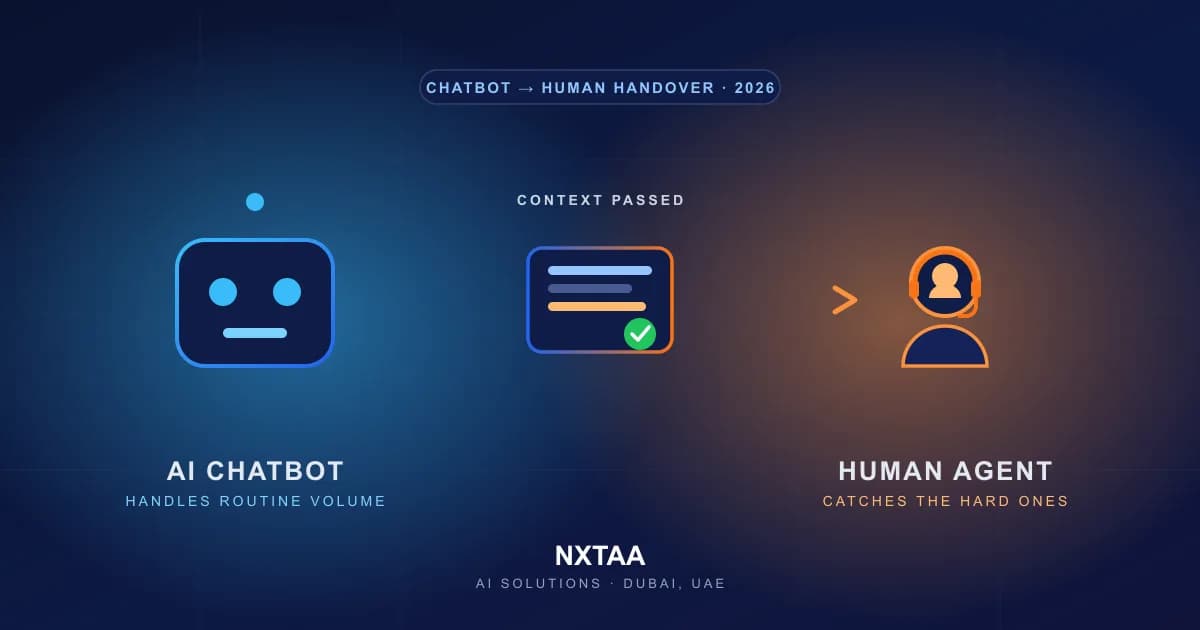
A good chatbot-to-human handover passes the full conversation to the agent, fires on the right signals — repeated failure, negative sentiment, an explicit request, or a high-stakes intent — and moves the customer across without making them repeat a word. Get it right and the bot earns its keep. Get it wrong and every deflected chat quietly turns into a worse experience than having no bot at all.
Key Takeaways
- The handover, not the bot's answers, is where most hybrid support setups fail — 85% of escalations feel disjointed to the customer.
- 81% of customers want the option to reach a human at any point, and 72% escalate after just one or two small bot mistakes.
- Escalation should trigger on four signals: repeated comprehension failure, negative sentiment, an explicit "talk to a human" request, and high-stakes intent (payments, complaints, cancellations).
- Always pass context — conversation history, customer identity, and detected intent — so the agent never asks the customer to start over.
- CSAT drops 22 points when an escalation is required and craters below 51% when the handoff itself takes multiple contacts. The transfer design is the whole game.
Why the Handover Is the Part That Actually Matters
Most businesses obsess over the wrong half of the problem. They spend months tuning the chatbot's answers, its tone, its knowledge base — and almost no time on what happens in the three seconds when the bot gives up and a human takes over. That's backwards. The data from 2026 is blunt about it: the handoff between chatbot and human agent is where most hybrid support models break, and 85% of escalations feel disjointed to the customer — they repeat their issue, the agent has no context, or the transfer drags on for minutes.
Customers have made their expectations clear. 81% want the option to escalate to a human at any point, 65% expect that escalation to be seamless, and 26% rank human handoff as the single most important quality of a chatbot interaction — above almost everything else the bot does. Patience for bots that trap them is gone: 72% escalate after just one or two small mistakes, and frustration with AI agents has climbed from 54% to 59% year over year, with 31% saying they'd hang up entirely if connected to AI.
Here's the uncomfortable math underneath all of it. Pure-AI handling lands around 4.1 out of 5 on CSAT versus 4.3 for a human agent — a gap most businesses can live with. But a botched escalation erases that tolerance instantly: CSAT drops 22 points the moment an escalation is required, and falls below 51% when the escalation itself takes multiple contacts to resolve. The flip side is the opportunity — hybrid flows with a clean handoff narrow the AI-versus-human satisfaction gap to 0.05 points. Same bot, same agents. The only variable is the transfer.
A Dubai Retailer's Handover Disaster (and the Fix)
Back during a Dubai Shopping Festival rush, a mid-size home-appliance retailer we'll call the client came to us with a number that didn't add up. Their chatbot was deflecting 68% of incoming chats — a genuinely good containment rate — yet their support CSAT had fallen off a cliff during the sale, dropping into the low 50s while order volume was at its peak. On paper the bot was a success. In the inbox, customers were furious.
We pulled two weeks of escalated conversations and read them end to end. The problem wasn't the bot's answers. It was the exit.
When the bot couldn't resolve something — a delivery running late, a damaged unit, a refund on a discounted item — it dumped the customer into a generic queue with a cheerful "Let me connect you to an agent!" and then vanished. The agent who picked up saw a blank slate. No order number. No history of what the bot had already tried. So the agent asked the customer to explain the whole thing again. During a festival sale, with a delivery already late, being asked to re-type your order number for the third time is how a mildly annoyed customer becomes a one-star review.
Three weeks in, we found the worst pattern: high-value complaints — the exact conversations where a human should have taken over on the first sign of trouble — were the ones the bot fought hardest to contain, looping customers through FAQ suggestions while their frustration compounded. The bot was optimized to deflect, not to escalate. It was measuring the wrong success.
What we rebuilt wasn't the chatbot's brain. It was the bridge. We redesigned the handover around four things the old flow ignored: when to escalate, what to carry across, how to transfer, and who was ready to catch it. By the end of the following month, escalations still ran at roughly the same volume — but CSAT on escalated chats climbed back above 80%, and average handle time on those chats dropped by nearly a third, because agents opened every conversation already knowing what was wrong.
The lesson had nothing to do with AI quality. It was this: a chatbot's job isn't only to answer — it's to hand off cleanly when it can't. Deflection without a graceful exit is just a more expensive way to lose customers.
The Four Escalation Triggers That Actually Matter
The first fix is knowing when to hand over. Most bots escalate too late, grinding the customer through dead-end loops first. A well-designed bot watches for four signals and moves the moment any one of them fires.
| Trigger | What it looks like | Why it matters |
|---|---|---|
| Repeated comprehension failure | The bot misunderstands twice, or the customer rephrases the same question | 62% of escalations stem from comprehension failures; after two misses, trust is already gone |
| Negative sentiment | Frustration, anger, words like "useless," "cancel," "speak to someone" | Sentiment is the earliest warning; catching it early is the difference between recovery and a lost customer |
| Explicit human request | "Talk to a person," "I want an agent," "is anyone real there?" | 81% want this option at any point — honoring it instantly is non-negotiable |
| High-stakes intent | Payments, refunds, complaints, cancellations, legal or medical questions | These should often skip the bot's resolution attempts entirely and route straight to a human |
The narrative bridge here is simple: the old retailer bot only ever escalated on the third trigger, and only after several failed loops. Once we wired in the other three — especially sentiment detection and an instant route for complaints — the quality of escalations changed completely. Customers reached a human while they were still recoverable, not after they'd already decided to leave.
One caution worth stating plainly: escalating on everything defeats the point. Leading implementations keep escalation rates below 15% while top performers hold 90%+ containment. The goal isn't to hand off constantly — it's to hand off at exactly the right moment, and never a mistake later.
What to Carry Across: The Context Handoff
Knowing when to escalate is worthless if the customer arrives at the agent naked. The single most common handover failure — the one behind that 85% "disjointed" figure — is context loss. The customer explained everything to the bot, and then has to explain it all over again to a human. Every repeat is a fresh insult.
A proper context handoff carries three things across the bridge:
- The full conversation transcript — everything the customer typed and everything the bot tried, so the agent can see what's already been ruled out.
- Customer identity and record — name, order number, account status, past tickets. If the bot authenticated them, the agent shouldn't re-authenticate.
- Detected intent and sentiment — a one-line summary: "Frustrated customer, damaged air-conditioner delivered yesterday, order #48213, refund already denied by bot." The agent reads that in two seconds and opens with a solution instead of a question.
That summary line is the highest-leverage piece. When we added an auto-generated intent summary to the retailer's handoff, agents stopped opening with "How can I help you?" and started opening with "I can see your AC arrived damaged yesterday — let me sort the replacement." Same agent. Completely different customer reaction.
Losing customers in the handoff gap? NXTAA's AI Solutions team designs chatbot-to-human flows that pass full context automatically — so your agents never make a customer repeat themselves. Book a free handover audit.
Warm Transfer vs. Cold Drop: Getting the Mechanics Right
There's a difference between a warm transfer and a cold drop, and customers feel it even if they can't name it.
A cold drop is the old retailer flow: the bot announces it's connecting an agent, then disappears into a silent queue. The customer stares at a "please wait" message with no idea whether it'll be thirty seconds or thirty minutes. A warm transfer keeps the customer informed and the experience continuous.
| Cold Drop (avoid) | Warm Transfer (aim for) | |
|---|---|---|
| Queue transparency | Silent wait, no ETA | Live position or estimated wait time shown |
| Context | Agent starts blank | Agent opens with full history + summary |
| Continuity | Feels like starting over | Feels like one continuous conversation |
| Off-hours | Dead end | Captures the query, promises a callback, sets expectation |
| Channel | Often forces a channel switch | Stays in the same thread (WhatsApp, web, etc.) |
Staying in the same channel matters more in this market than most vendors admit. In the UAE, where a large share of support happens on WhatsApp, forcing a customer off WhatsApp and onto email or a phone line to reach a human is its own kind of cold drop. The best handovers keep the entire conversation — bot and human — inside the WhatsApp Business API thread the customer already trusts.
The Human Side: Your Agents Have to Be Ready to Catch
A handover is a two-sided bridge. All the context-passing in the world fails if there's no agent staffed to receive it, or if the agent isn't equipped to act on what lands in front of them.
The retailer's festival meltdown was partly a staffing failure. Their bot was tuned to contain 68% of chats, which meant they'd staffed their human team for the remaining 32% — but during the sale, the escalations that did come through were the hardest, angriest, highest-value conversations, and there simply weren't enough trained agents to catch them warmly. Handoffs sat in a queue precisely when speed mattered most.
Getting the human side right means three things. Staff for the complexity of escalated chats, not just the volume — an escalated conversation is, by definition, harder than an average one. Give agents a unified view so the bot's context actually shows up in their console instead of a separate system. And route by skill, not round-robin: a refund dispute and a technical fault need different people, and a smart handover knows the difference. This is the operational backbone a real contact center setup provides that a bolted-on chatbot never will.
A Realistic Rollout Timeline
Fixing a handover isn't a six-month platform migration. Here's the sequence that worked for the retailer, and that works for most mid-size UAE support teams.
- Week 1 — Audit the exits. Read your escalated transcripts. Find where context is lost and where the bot escalates too late or not at all. This alone usually reveals the top three failure patterns.
- Weeks 2–3 — Wire the triggers and the context handoff. Add sentiment and repeated-failure escalation, build the auto-summary, and connect the bot's transcript into the agent console.
- Week 4 — Fix the transfer mechanics. Add queue transparency, warm-transfer messaging, off-hours capture, and skill-based routing.
- Ongoing — Measure the handoff itself. Track escalation CSAT, repeat-context rate, and handoff time as first-class metrics, separate from the bot's containment rate.
That last point is the one most teams skip. If the only number you watch is containment, you'll optimize for a bot that never lets go — which is exactly how the retailer ended up with a great deflection rate and furious customers.
Common Mistakes That Sink a Handover
Optimizing purely for containment is the big one. A bot rewarded only for deflecting will fight escalation even when a human is clearly needed, looping high-stakes complaints through FAQ suggestions. Containment is a means, not the goal.
Hiding the human option is the second. Some businesses bury the "talk to an agent" path hoping to cut labor costs. Customers notice, and 31% of them will simply hang up. Making the human path obvious builds trust — most customers will happily let the bot try first if they know a person is one message away.
And treating the handoff as a technical afterthought is the third. The transfer is not plumbing. It's the moment your customer decides whether your support is competent or a runaround. Design it with the same care you'd give a checkout flow, because the stakes are the same: a customer about to leave.
This is the same reasoning behind choosing the right kind of bot in the first place — a decision we break down in AI Chatbots vs Rule-Based Chatbots: What Is the Difference? — and behind deploying it on the channel your customers already use, covered in our WhatsApp Chatbot Guide for Dubai Businesses.
How NXTAA Can Help
The businesses we work with across Dubai and the GCC rarely need a better chatbot. They need the bridge between the bot and their team built correctly — and that's exactly what NXTAA's AI Solutions team does:
- Trigger design done right. Sentiment, repeated-failure, explicit-request, and high-stakes routing tuned to your actual conversations, so customers reach a human while they're still recoverable.
- Automatic context passing. Full transcript, customer record, and an auto-generated intent summary delivered to your agents — no more "please repeat your order number."
- Warm transfers in-channel. Seamless bot-to-human handoff inside WhatsApp Business API, web chat, and voice, backed by a real contact center with skill-based routing.
Ready to stop losing customers in the gap between your bot and your team? Book a free handover audit with NXTAA — we'll read your escalated chats and map the fixes before you change a thing.
Frequently Asked Questions
What is chatbot-to-human handover? It's the process of transferring a customer from an automated chatbot to a live human agent when the bot can't resolve their issue — ideally passing full conversation context so the agent can pick up seamlessly.
When should a chatbot escalate to a human? On four signals: repeated comprehension failures, negative customer sentiment, an explicit request to speak to a person, or a high-stakes intent like a payment, complaint, or cancellation.
Why do most chatbot handovers fail? Context loss. Around 85% of escalations feel disjointed because the customer has to repeat their issue, the agent lacks history, or the transfer takes too long.
What is a warm transfer in customer support? A warm transfer passes the customer to an agent along with full context and keeps them informed of wait times, so the conversation feels continuous rather than restarting from zero.
Does escalation hurt customer satisfaction? A necessary escalation done well barely dents CSAT, but a badly handled one is costly — CSAT drops around 22 points when escalation is required and falls below 51% when the handoff itself needs multiple contacts.
How do I keep escalation rates low without trapping customers? Contain routine queries with a well-trained bot (top performers hold 90%+ containment) while making the human path instantly available — the goal is escalating at the right moment, not escalating rarely.
Should chatbot-to-human handover happen inside WhatsApp? Yes, especially in the UAE. Keeping both the bot and the human in the same WhatsApp thread avoids forcing a channel switch, which customers experience as a dead end.