Customer Engagement Platform for UAE Businesses: What to Look For in 2026
NXTAA Team
Customer Engagement Lead
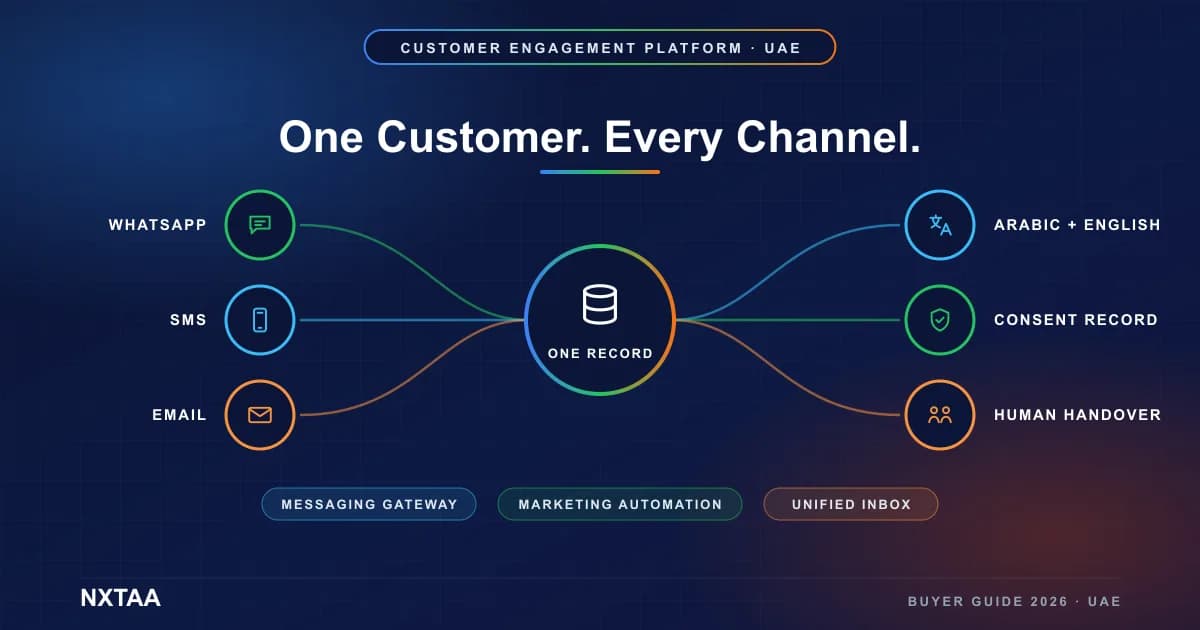
If you're choosing a customer engagement platform, UAE conditions narrow the field fast: pick the one that runs WhatsApp, SMS and email from a single customer record, handles Arabic and English properly, records consent, and hands conversations to your team without losing context. Decide the platform type before you compare vendors, because a messaging gateway, a marketing automation tool and a unified inbox solve different problems.
That's the decision. The rest of this guide is how to make it without buying the wrong category of tool.
Key Takeaways
- A customer engagement platform is the system your team uses to talk to customers across channels from one shared record
- In the UAE, WhatsApp carries the conversation, SMS covers OTPs and fallback, and email holds the formal record, so you need all three in one place
- Test five things before you sign: Arabic and English handling, consent tracking, CRM sync, human handover and AED billing
- Choose the platform type first (messaging gateway, marketing automation or unified inbox) and the vendor second
- Team size and industry decide the type more than feature lists do
- Operational notifications and human conversations often belong on separate WhatsApp accounts
What a Customer Engagement Platform Actually Is
Strip the marketing language away and it's simple. A customer engagement platform is the software your business uses to talk to customers, on whatever channel they prefer, with everyone in your team seeing the same history.
Salesforce describes it as technology for delivering seamless, personalized service across channels. That's a fair definition. In practice, for a UAE business, it usually means four jobs done in one place:
- Sending messages: campaigns, reminders, order updates, OTPs
- Receiving messages: enquiries, complaints, replies to those campaigns
- Routing each conversation to the right person or bot
- Remembering who the customer is, what they've said and what they've agreed to receive
Plenty of tools do one or two of these jobs well. Very few do all four well. That gap is where most buying mistakes happen.
How it differs from a CRM
A CRM is the record. A customer engagement platform is the conversation. Some platforms include a CRM, and some CRMs bolt on messaging, so the line blurs. The test is which one your agents live in all day. If your sales team spends its time inside WhatsApp threads, the engagement layer matters more than the pipeline view. We cover the CRM side in detail in our guide to omnichannel CRM for UAE businesses, so we won't repeat it here.
Why UAE Businesses Need WhatsApp, SMS and Email in One Place
Customers in this market don't pick one channel. They use each one for a different job.
WhatsApp is where they ask questions, negotiate, send a photo of the broken part and confirm the appointment. SMS is where they expect their OTP and, often, a delivery alert. Email is where they expect the invoice, the contract and anything they might need to forward to a manager or a government portal.
When those three live in separate tools, three things go wrong:
- Context disappears. A customer replies on WhatsApp to an email quote. The agent on WhatsApp can't see the quote.
- Consent gets muddled. Someone opts out of WhatsApp promotions, but the email tool keeps sending offers, because nobody synced the preference.
- Nobody owns the customer. Three teams touch one person and each assumes another is following up.
A single platform doesn't fix bad process. It does make the process visible, which is the first step to fixing it.
A Real Project: When "One Platform" Meant Two WhatsApp Accounts
Setup
We worked with a building products group in the UAE that sells through retail showrooms and distribution. Their communication needs split down the middle. On one side, their systems generated operational messages: order confirmations, delivery status, tracking links. On the other side, their people ran sales, support and marketing conversations with contractors, designers and homeowners.
They came to us asking for one customer engagement platform to handle everything.
Conflict
When we mapped the journeys, the problem showed up straight away. System-generated notifications and human conversations have different owners. IT owns the integration that fires a delivery update. Sales owns the conversation when a contractor replies to that update asking for a quote on another order.
Run both through one undivided setup and responsibilities blur. Automated traffic mixes with customer conversations. Agents wade through delivery receipts to find the real enquiries. And when something breaks, nobody knows which team should fix it.
Resolution
We designed a two-account WhatsApp structure:
- An API account for operations. Connected to their systems, it sends delivery-status notifications with customer-specific tracking links. IT owns it.
- A marketing and support account. It runs customer enquiries, team collaboration and campaigns through a shared inbox, with each conversation assigned to the right agent. Sales and support own it.
When a customer replies to an operational message with a real question, the conversation lands with a person on the support side instead of disappearing into an automated stream.
Lesson
Looking back, the client's request was right in spirit and wrong in shape. They needed one way of engaging customers, with clear ownership. That didn't mean one undivided channel. We wrote up the trade-offs of that decision in one WhatsApp number or two for operations and sales.
The bigger takeaway for anyone shortlisting platforms: before you compare vendors, write down which conversations your systems start and which ones your people own. That list tells you what kind of platform you need.
The Buyer's Checklist: Five Things to Test Before You Sign
Demos are designed to impress. A checklist is designed to protect you. These are the five areas where UAE buyers get caught out most often, and how to test each one in a trial instead of taking the sales deck's word for it.
| Area | What to ask | How to test it in a trial | Red flag |
|---|---|---|---|
| Arabic and English | Does the inbox, the bot and the template editor handle Arabic, right-to-left text and mixed messages? | Send Gulf-dialect and mixed Arabic-English messages; view them on a phone and in the agent inbox | "Arabic support" means translated menus only |
| Consent tracking | Where is opt-in stored, with what detail, and does opt-out sync across channels? | Opt a test contact in via a form, opt out on WhatsApp, then try to email them | Consent is a single yes/no field |
| CRM sync | Which CRM fields sync, in which direction, how often? | Change a phone number in the CRM and check the platform within minutes | One-way sync or nightly batch only |
| Human handover | Can a bot pass a conversation to a named agent with full history? | Trigger a handover mid-conversation and see what the agent sees | Agent sees only the last message |
| AED billing | Is the invoice in AED, with UAE VAT, and are Meta fees passed through or marked up? | Ask for a sample invoice and the per-message rate card | Bundled "credits" with no rate card |
Arabic and English support
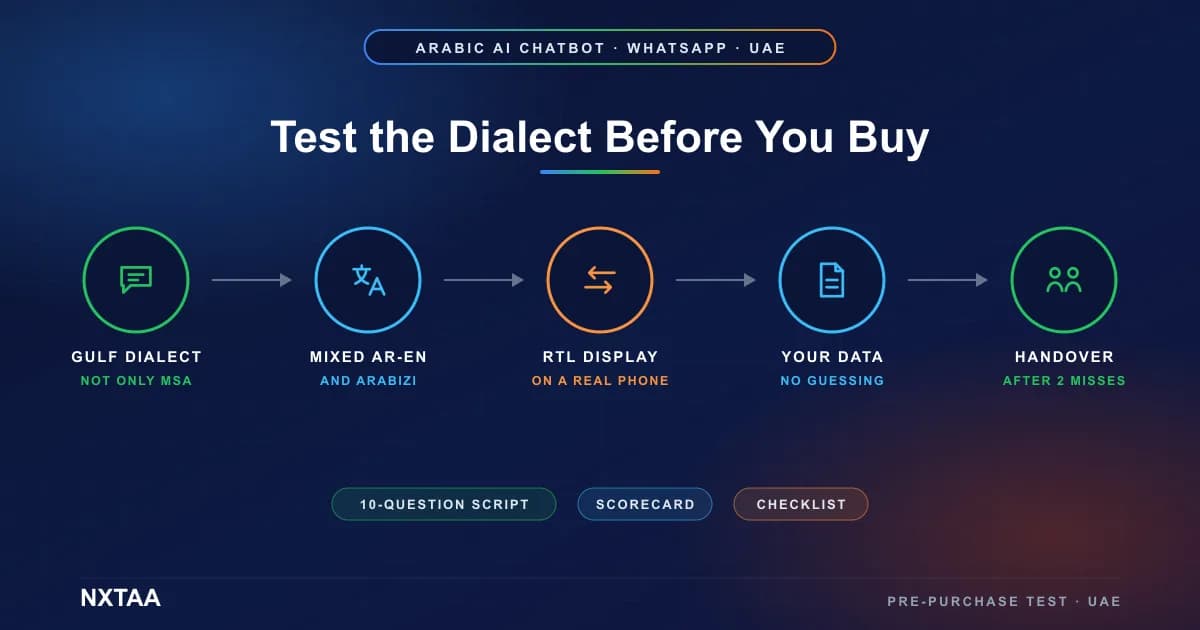
This is the one most often oversold. A platform can have an Arabic interface and still mangle Arabic messages: reversed punctuation, broken number formatting, bot replies in stiff formal Arabic to a customer writing casually in Emirati dialect. If a chatbot is part of the purchase, read our guide on how Arabic chatbots fail and how to test them before you sit through a demo. It includes a ten-question test script you can run on any vendor.
Consent tracking
A "subscribed" checkbox isn't consent tracking. You need to know when each customer opted in, where, what wording they saw, and when they opted out. UAE data protection law and Meta's WhatsApp policy both expect you to be able to show this. Our guide on how to collect and prove WhatsApp marketing consent lists the exact fields to log.
CRM sync
Two-way and near real time, or it causes more problems than it solves. The classic failure: a customer updates their number with your sales rep, the CRM changes, the engagement platform keeps messaging the old number for a week.
Human handover
The bot will fail. That's fine. What matters is what happens next. A good platform routes the conversation to a named person, shows them everything the bot collected, and tells the customer a human is on the way. If you want the detail on doing this well, here's how a platform hands a conversation to a person without losing context.
We've seen this pay off in practice with a UAE car rental business, where agents now see the vehicle a customer selected and the bot conversation before they type a word. The customer never has to repeat themselves.
AED billing
Ask three questions. Is the invoice in AED with UAE VAT shown properly? Are Meta's WhatsApp message fees passed through at cost, or bundled with a markup? What happens to unused credits at month end? Platforms quoted in USD with prepaid credit bundles can look cheap until you reconcile the first quarter.
Not sure which platform type fits your team? Talk to NXTAA about your customer journeys. We'll map which conversations your systems start and which your people own, then recommend the type of platform before anyone shows you a demo.
Comparing Platform Types (Not Vendors)
Vendor comparisons go stale every quarter. Platform types don't. Almost every product sold as a customer engagement platform in the UAE fits mainly into one of three categories, even when it claims to do everything.
| Messaging gateway | Marketing automation platform | Unified inbox | |
|---|---|---|---|
| Core job | Sending high volumes reliably through APIs | Sending the right message when a customer does something | Letting a team hold conversations together |
| Best at | OTPs, delivery alerts, transactional SMS and WhatsApp | Journeys, segments, reminders, re-engagement | Sales and support chats, assignment, notes |
| Typical owner | IT or product team | Marketing team | Sales and support team |
| Weak at | Two-way human conversations | Live agent work | Complex segmentation and journeys |
| Arabic risk | Low (it just carries messages) | Medium (templates, personalisation fields) | High (agents and bots write in real time) |
| Consent handling | Often left to you | Usually strong, built around lists | Varies widely; check carefully |
| Wrong choice when | Your problem is slow replies | Your problem is conversations nobody owns | Your problem is reaching 50,000 people a month |
As the table shows, each type is strong exactly where the others are weak. That's why the building products group needed two accounts. Their operational traffic was a gateway problem and their sales conversations were an inbox problem.
Messaging gateway
Think SMS aggregators and CPaaS providers. They're excellent plumbing. If you're sending OTPs, order confirmations and delivery alerts from your own systems, this is the category, and your developers will do most of the work. Don't expect a sales team to run their day from one.
Marketing automation platform
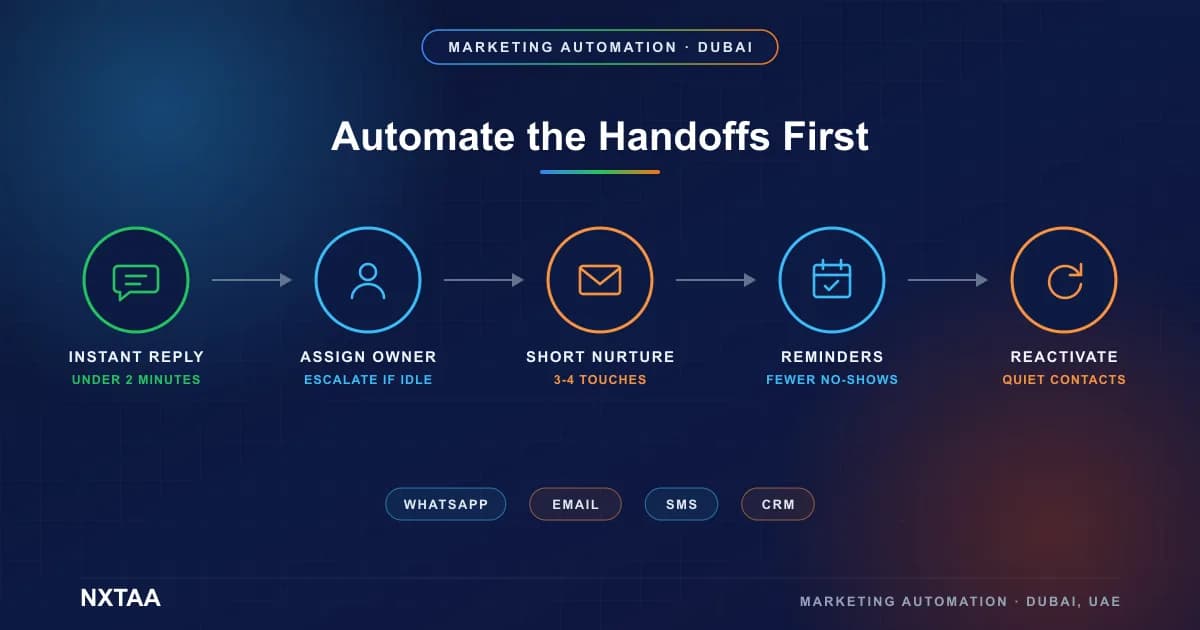
These tools trigger messages based on behaviour: a form fill, an abandoned booking, a renewal date. They shine when marketing needs journeys across WhatsApp, email and SMS. Where they struggle is the human part. If a hot lead replies, someone has to notice. We cover what to automate first, and what to keep human, in marketing automation for Dubai businesses.
Unified inbox
This is the shared workspace where every WhatsApp, Instagram, web chat and sometimes email conversation lands, gets assigned to someone, and gets answered. Most UAE sales and service teams feel this pain first. Bots, tags, notes and handover live here.
The "all-in-one" claim
Some products genuinely cover two or even three types. Most cover one well and the others thinly. Ask the vendor which type they started as. The answer tells you where the product is strongest, because the original category is where most of the engineering went.
How to Choose by Team Size and Industry
Feature lists don't decide this. Your team and your sector do.
By team size
| Team | What usually breaks first | Platform type to start with | Add later |
|---|---|---|---|
| 1-5 people handling customers | Chats on personal phones, nobody can cover for anyone | Unified inbox on the official WhatsApp API | Simple automation for reminders |
| 6-25 people | Leads without owners, slow first replies, inconsistent answers | Unified inbox with assignment rules and a scoped bot | Marketing automation for nurture and reactivation |
| 25+ people, or several brands | Operational and human traffic mixed together; reporting across teams | Gateway for system messages, inbox for people, automation for journeys | Data warehouse and BI connection |
If you're at the smallest end, the first win is getting off personal phones. We explain why in moving to a shared team inbox instead of personal phones.
By industry
| Industry | What matters most | Watch out for |
|---|---|---|
| Real estate | Speed of first reply, lead ownership, Arabic and English | Agents keeping leads on personal numbers |
| Clinics and healthcare | Appointment reminders, handover to front desk, data sensitivity | Medical questions answered by a bot |
| Retail and e-commerce | Order updates, catalogue messages, abandoned-cart journeys | Promotional volume hurting your WhatsApp quality rating |
| Automotive and car rental | Context handover from website to chat, booking changes | Agents asking customers to repeat what they already chose |
| Business setup and corporate services | Multiple lead sources, renewals, document collection | Enquiries without a named owner |
| B2B distribution | Separating system notifications from sales conversations | One account trying to do both jobs |
| Hospitality and events | Peak-time volume, multilingual guests, confirmations | Bots that can't hand over during a rush |
A quick decision path
- Is your main problem reaching people, or talking with them? Reaching: start with a gateway or automation. Talking: start with an inbox.
- Do your systems send messages on their own? If yes, plan a separate operational path from day one.
- Do more than five people answer customers? If yes, assignment rules and handover are must-haves, not extras.
- Will a bot answer in Arabic? If yes, run a dialect test before you sign.
- Do you send marketing messages? If yes, the consent record has to sit with the contact, across every channel.
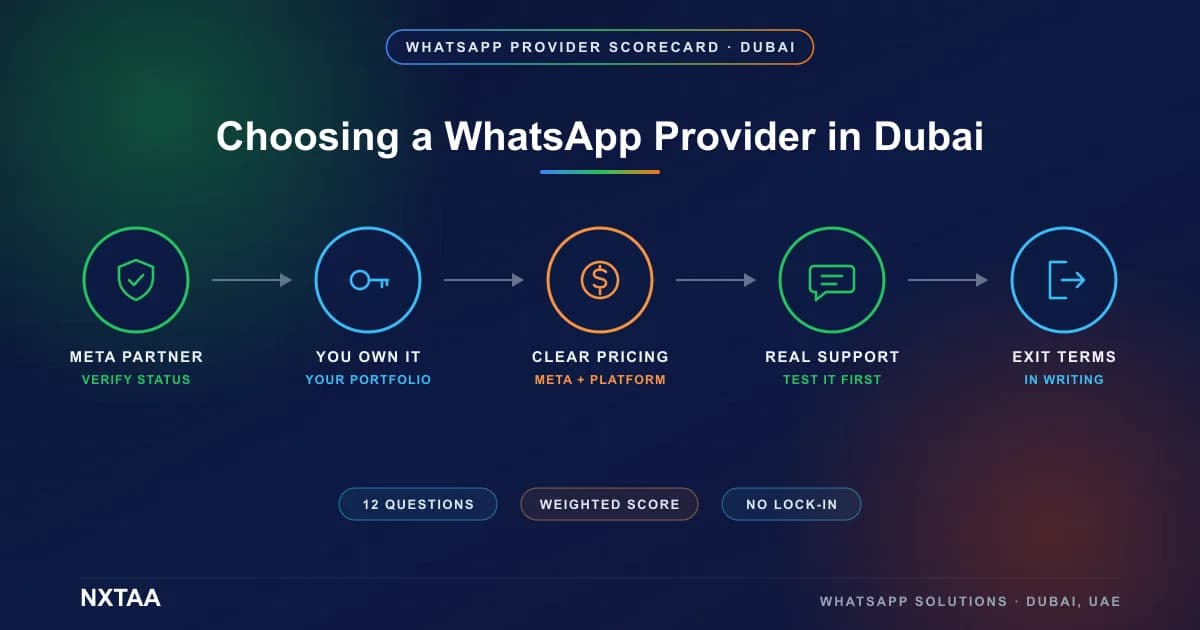
Answer those five honestly and most shortlists drop to two or three vendors. Before you speak to any of them, run through these questions to ask a WhatsApp solution provider.
Mistakes We See UAE Buyers Make
Buying on the demo bot. Demo bots are trained on the vendor's favourite questions. Test with your own customers' real messages.
Ignoring the template approval process. WhatsApp marketing and utility templates need Meta approval, separately for each language. Ask how the platform handles Arabic and English versions of the same template.
Treating consent as marketing's problem. Consent decides who you're allowed to message at all. It belongs in the platform's data model, not in a spreadsheet.
Skipping the exit plan. Ask how you export contacts, conversation history and consent records if you leave. If the answer is vague, assume it'll be painful.
Choosing for today's volume. The platform that suits 500 conversations a month may not suit 15,000. Ask what changes in price and setup as you grow.
How NXTAA Can Help
We help UAE businesses design how they engage customers before they commit to a tool, then build it on the official WhatsApp Business Platform with SMS and email alongside. That usually means:
- Mapping which conversations your systems start and which your people own
- Setting up WhatsApp Business API setup and management with a shared inbox, assignment rules and handover
- Building Arabic and English bots scoped to your own data
- Putting consent records and opt-out sync in place across channels
If you want a second opinion on a shortlist, or you're not sure which platform type you need, book a consultation with NXTAA.
Related Reading
- Omnichannel CRM for UAE businesses
- Marketing automation for Dubai businesses: what to automate first
- Arabic AI chatbot on WhatsApp: what to check before buying
- UAE PDPL and WhatsApp marketing: how to collect and prove consent
- WhatsApp Business API services from NXTAA
Frequently Asked Questions
What is the difference between a CRM and a customer engagement platform? A CRM stores customer records and sales pipelines. A customer engagement platform runs the conversations themselves across WhatsApp, SMS and email, and many now include a light CRM.
Do I need the WhatsApp Business API for a customer engagement platform? Yes, if more than one person answers customers or you want automation. The free WhatsApp Business app can't connect to a shared inbox, bots or CRM sync in a reliable, policy-compliant way.
How much does a customer engagement platform cost in the UAE? Expect a monthly platform fee, Meta's per-message WhatsApp charges, SMS costs and a one-off setup. Ask for an AED quote with a per-message rate card so you can compare vendors fairly.
Can one platform handle Arabic and English? Many claim to. Test it with real Gulf-dialect and mixed Arabic-English messages, on a phone and in the agent inbox, before you sign.