UAE PDPL and WhatsApp Marketing: How to Collect and Prove Consent
NXTAA Team
WhatsApp Compliance Lead
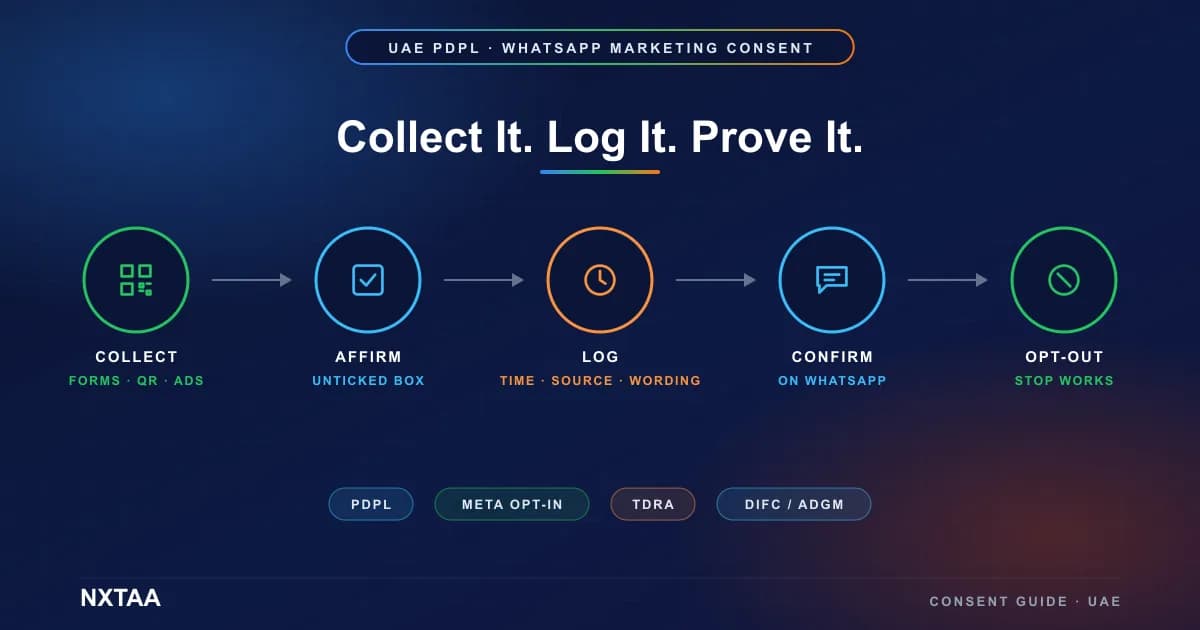
Under the UAE PDPL, WhatsApp marketing consent has to be specific, clear and given through an affirmative action, and you must be able to prove it later. Ask each customer separately for marketing messages, name your business, record when, where and how they agreed, and give them an easy way to stop.
That's the process. The rest of this guide shows how to build it into your forms, ads and chats, and what to do with the lists you already have.
This guide explains our understanding of how the rules apply to WhatsApp marketing. It isn't legal advice. For decisions about your own business, speak to a UAE-qualified lawyer and read the official text of Federal Decree-Law No. 45 of 2021 on the Protection of Personal Data.
Key Takeaways
- The PDPL expects marketing consent to be specific, clear and unambiguous, and you must be able to prove it
- Meta's WhatsApp policy adds its own opt-in rule; meeting one doesn't automatically meet the other
- Collect consent at the moments customers already engage: web forms, checkout, QR codes, Click-to-WhatsApp ads and the first chat
- Log the timestamp, source, exact wording shown and every opt-out, per contact
- A past purchase or a customer messaging you first is not marketing consent
- DIFC and ADGM run their own data protection laws, so check which regime applies
The Rule in Plain Words
The UAE's federal data protection law is Federal Decree-Law No. 45 of 2021, usually called the PDPL. It has applied since 2 January 2022.
For marketing on WhatsApp, three parts matter most:
Consent has a definition. The law defines consent as the data subject's agreement given in a specific, clear and unambiguous way, through a clear statement or affirmative action. A pre-ticked box, silence or "by using this website you agree" won't meet that standard.
Consent has conditions. Article 6 sets them out. In plain terms, you need to be able to prove the customer consented, the request has to be clear and easy to understand, and the customer must be told they can withdraw consent, and be able to do so easily.
Customers can object to direct marketing. Article 17 gives people the right to object to, and stop, the processing of their data for direct marketing. On WhatsApp, that means a STOP or "unsubscribe" reply has to actually stop the marketing messages.
The practical rule that follows: record when and where each customer opted in. If you can't show it, treat it as if it never happened.
Where the law stands today
At the time of writing, in November 2026, the PDPL is in force but its Executive Regulations, which add the procedural detail, haven't been published on the official legislation portal, according to the most recent commentary we could find. The transition period for businesses is tied to when those regulations are issued. That gap isn't a free pass. The consent rules in the law itself already apply, and Meta and the TDRA enforce their own rules regardless.
Check the UAE Legislation portal for updates before you rely on any date.
The TDRA's rules sit alongside the PDPL
The PDPL isn't the only rulebook. The Telecommunications and Digital Government Regulatory Authority (TDRA) has its own regulatory policy on unsolicited electronic communications, plus specific rules for marketing SMS. Cabinet Resolution No. 56 of 2024 on telemarketing, in force since August 2024, requires consent, clear identification of the business and respect for the national Do Not Call Register. Some commentary on that resolution suggests it reaches marketing through messaging apps as well as calls.
Our working assumption for clients is simple: treat WhatsApp marketing as covered by all of them, and design for the strictest. For the SMS side, see our TDRA guidelines for SMS marketing.
How the PDPL Works Alongside Meta's Opt-In Policy
Meta has its own opt-in rule for the WhatsApp Business Platform. It's narrower than the law in some ways and different in others.
| UAE PDPL | Meta WhatsApp opt-in policy | |
|---|---|---|
| What it protects | The customer's personal data | The WhatsApp user experience and platform quality |
| Who enforces it | UAE regulators | Meta, through quality ratings, limits and bans |
| Consent standard | Specific, clear, unambiguous, affirmative, provable | Customer agrees to receive messages from your named business |
| Must WhatsApp be named? | Not stated; being specific about the channel helps prove consent | No; a general opt-in is allowed if local law is met |
| Where it can be collected | Anywhere, if the standard is met | Any channel: web, SMS, IVR, in person, in WhatsApp |
| Opt-out | Right to object to direct marketing | Must honour requests to stop |
| Penalty for getting it wrong | Regulatory action | Blocks, low quality rating, messaging limits, account restrictions |
As the comparison shows, Meta's rule is the minimum to stay on the platform, and the PDPL is the standard to stay on the right side of the law. Meta's own opt-in guidance says to comply with local law. So build to the stricter of the two.
One practical point. Meta allows a general marketing opt-in that doesn't mention WhatsApp. We still recommend naming WhatsApp in the wording. When a customer later says "I never agreed to WhatsApp messages", a record showing they ticked a box that said WhatsApp ends the conversation.
A Real Project: Where Service Messages End and Marketing Begins
Setup
We built and ran the communication system for a series of large consumer promotions run by an FMCG brand in the UAE. Thousands of participants. Messages across email, WhatsApp and phone for participation confirmations, eligibility checks, ID verification, winner and non-winner communication, and prize instructions. We wrote about the operations side in our guide to winner and participant communication.
Conflict
Every message in that system had a reason tied to the promotion the participant had entered. A confirmation that their entry was received. A request for ID because they'd won. Instructions for collecting a prize. Customers expect those messages, and they're the point of the exercise.
The temptation at the end of any campaign like this is obvious. You now hold a large, clean list of verified mobile numbers. Why not use it for the next launch?
Resolution
Because taking part in a promotion is not agreement to receive marketing. Promotion messages and marketing messages are different purposes, and under the PDPL, consent has to be specific to the purpose. The clean way to build a marketing audience from a promotion is a separate, unticked opt-in at entry, worded for marketing, recorded on its own.
We see the same boundary with a business-setup consultancy whose WhatsApp workflow sends renewal reminders as well as promotional messages. A reminder that a customer's licence or service is due for renewal relates to something they already have with you. An offer for a new service is marketing. They need different permissions, and the platform has to know which is which.
Lesson
In hindsight, the hard part of consent isn't the checkbox. It's the discipline of labelling every message by purpose before it's sent. If you can't say whether a message is service or marketing, you can't say whether you're allowed to send it.
Where to Collect Consent
Collect consent where customers are already engaging with you, at the moment they'd naturally say yes. Here's how each touchpoint works.
| Touchpoint | How to ask | What to capture | Common mistake |
|---|---|---|---|
| Website form | An unticked checkbox, separate from the terms | Form ID, page URL, checkbox wording, timestamp | Bundling marketing consent into "I accept the terms" |
| Checkout | Unticked checkbox at the phone number field | Order ID, wording, timestamp | Pre-ticked box, or treating the order itself as consent |
| QR code in store or on packaging | QR opens WhatsApp with a pre-filled message, then the bot asks for marketing consent | QR source code, location, the customer's "yes" reply | Treating the first message as marketing consent |
| Click-to-WhatsApp ad | Ad starts the chat; the first reply asks for permission to send offers | Ad or campaign ID, the consent reply, timestamp | Adding every ad responder to the broadcast list |
| First chat | After you've helped, ask once: "Would you like offers from us on WhatsApp?" | The question sent, the reply, the agent or bot | Asking before the customer's question is answered |
| In person or by phone | Staff record verbal consent in the system, ideally followed by a WhatsApp confirmation | Staff ID, store or branch, confirmation reply | No record beyond "the agent said they agreed" |
Wording that works
Keep it short, name the business and the channel, and say how to stop:
Yes, send me offers and updates from [Business name] on WhatsApp. I can reply STOP at any time.
In Arabic:
نعم، أرغب في استلام العروض والتحديثات من [اسم الشركة] عبر واتساب. يمكنني إلغاء الاشتراك في أي وقت بإرسال كلمة STOP.
Show the language the customer is using, and log which version they saw.
Customer-initiated chats are not consent
When a customer messages you first, from a QR code, a wa.me link or a Click-to-WhatsApp ad, they've agreed to a conversation about what they asked. They haven't agreed to your next promotion. Answer the question, then ask for marketing permission separately.
What to Log
If you remember one section, make it this one. The consent record is what you'll show Meta, a regulator or a customer who says "I never signed up".
| Field | Example | Why it matters |
|---|---|---|
| Contact identifier | +971 5X XXX XXXX | Links consent to one person |
| Timestamp with time zone | 2026-11-13 14:32 GST | Proves when |
| Source | Website form "Book a viewing", QR code "Mall kiosk 3" | Proves where |
| Wording shown | Version ID of the exact text, plus language | Proves what they agreed to |
| Purpose or category | Promotions; product updates | Consent must be specific to the purpose |
| Affirmative action | Ticked box, replied "YES", tapped a button | Proves it was active, not assumed |
| Captured by | Form, bot, or staff member ID | Proves how |
| Confirmation message ID | The WhatsApp message ID of the confirmation | Shows the customer saw it on WhatsApp |
| Opt-out timestamp and channel | 2026-12-02 09:10, WhatsApp "STOP" | Proves you stopped |
| Re-consent history | Each later opt-in, with the same fields | Shows the current status and how it changed |
A few rules for keeping these records useful:
- Store wording by version. When you change the checkbox text, keep the old version. A record pointing at text you've since deleted proves nothing.
- Keep the evidence, not just a flag. A field saying "opted in: yes" isn't proof. The fields above are.
- Sync opt-outs everywhere. A STOP on WhatsApp should suppress WhatsApp marketing at once, and you should decide whether it also covers email and SMS. Your platform should do this automatically. It's one of the items on our customer engagement platform checklist.
- Hold your own copy. Don't rely on a vendor's retention period. Export consent records on a schedule.
Need a consent log built into your WhatsApp setup? Talk to NXTAA. We'll design the opt-in flows, the consent fields and the opt-out sync on the official WhatsApp Business API, so the record exists before the first campaign goes out.
What to Do With Old Lists
This is where most UAE businesses get stuck. They have years of customer numbers in a CRM, a POS system or an agent's phone, and no consent record for any of them.
Why a past purchase isn't consent
Buying from you gives you a reason to message that customer about that purchase: the delivery, the warranty, the invoice. It doesn't give you specific, provable consent to send marketing. The PDPL's definition of consent needs a clear statement or affirmative action, which implied consent can't supply, and Meta's policy requires opt-in too. A past purchase also isn't a recent signal. Someone who bought once three years ago and hasn't heard from you since is likely to block or report a promotional WhatsApp message.
A safe way to handle old contacts
- Sort the list by evidence. Contacts with a consent record you can show; contacts with a service relationship but no marketing consent; contacts with neither.
- Market only to the first group. Everyone else is suppressed from WhatsApp marketing until they opt in.
- Ask for permission at the next natural moment. When you send a genuine service message, such as a delivery update or renewal reminder, include an option to receive offers. Don't send a "would you like our offers?" template to a cold list. That message is itself marketing.
- Use other permitted channels carefully. If you hold valid email consent, an email inviting customers to join your WhatsApp updates is a cleaner route than messaging them on WhatsApp cold.
- Retire what you can't fix. Contacts with no relationship and no consent should be deleted or archived under your retention policy.
Your list will get smaller. It will also get better. Smaller lists of people who chose to hear from you get fewer blocks and protect your quality rating. When you do send, follow our guide to sending bulk WhatsApp messages the right way. Better still, replace one-off blasts with triggered messages, as set out in WhatsApp journeys instead of broadcasts.
Free Zones: DIFC and ADGM Run Separate Regimes
The federal PDPL doesn't apply everywhere in the UAE. Free zones with their own data protection legislation sit outside it:
- DIFC (Dubai International Financial Centre) has the DIFC Data Protection Law No. 5 of 2020, overseen by the DIFC Commissioner of Data Protection.
- ADGM (Abu Dhabi Global Market) has the ADGM Data Protection Regulations 2021, overseen by ADGM's Office of Data Protection.
Both are modelled closely on European-style data protection and have their own rules on consent, records and direct marketing. Other free zones without their own data protection law generally fall under the federal PDPL.
If your company is registered in DIFC or ADGM but markets to customers across the UAE, or you're a mainland business working with a free-zone partner, which regime applies is a real question for your lawyer. The consent process in this guide is designed to meet a high standard, so it adapts well either way, but the details differ.
The PDPL also carves out some kinds of data covered by their own laws, such as certain health and banking data. Clinics and financial businesses should check sector rules too.
The One-Page Consent Checklist
Print this, or paste it into your campaign approval process.
Before you collect
- Marketing consent is separate from terms and conditions
- Checkboxes are unticked by default
- Wording names your business, the channel and what you'll send
- Wording says how to opt out
- Arabic and English versions exist, each with a version ID
When you collect
- Timestamp with time zone is saved
- Source and touchpoint are saved
- Wording version and language shown are saved
- The affirmative action is saved (tick, reply or button)
- A WhatsApp confirmation message is sent and its ID stored
Before every campaign
- The message is labelled as marketing or service
- The audience only includes contacts with marketing consent for this purpose
- Opted-out contacts are suppressed across channels
- Contacts from DIFC- or ADGM-regulated relationships are reviewed
- The template includes a clear way to stop
Ongoing
- STOP replies take effect straight away
- Consent records are exported and held by you
- Old lists without consent are suppressed, not messaged
- The PDPL Executive Regulations and TDRA rules are checked for updates every quarter
How NXTAA Can Help
We set up WhatsApp marketing for UAE businesses with consent built in from the first form, not added after the first complaint. Our WhatsApp Business API work includes:
- Opt-in flows for forms, checkout, QR codes, Click-to-WhatsApp ads and first chats
- Consent records with timestamp, source, wording version and opt-out history
- Opt-out sync across WhatsApp, SMS and email
- Re-permission plans for old customer lists
To review your current consent process before your next campaign, book a consultation with NXTAA.
Related Reading
- UAE SMS guidelines: TDRA rules for SMS marketing
- How to send bulk WhatsApp messages
- WhatsApp journeys, not broadcasts: five patterns
- Customer engagement platform for UAE businesses: what to look for
- WhatsApp Business API services from NXTAA
Frequently Asked Questions
Is consent required for WhatsApp marketing in the UAE? Yes. The PDPL expects specific, provable consent for marketing, and Meta requires opt-in before you send marketing messages on WhatsApp.
Does a past purchase count as marketing consent? No. A purchase lets you send messages about that order, but marketing needs its own clear opt-in that you can prove.
Does the PDPL apply in DIFC and ADGM? No. DIFC and ADGM have their own data protection laws, so businesses there follow those regimes instead of the federal PDPL.
Have the PDPL Executive Regulations been issued? At the time of writing, in November 2026, they did not appear on the official UAE Legislation portal. Check the portal for the current position, because the consent rules in the law already apply.