Design WhatsApp Journeys, Not Broadcasts: Five Patterns from Real UAE Deployments
NXTAA Team
WhatsApp Journey Designer
A WhatsApp journey is a planned sequence of messages and human actions that carries a customer from one state to the next, such as enquiry to booking or winner to prize. A broadcast is a single message sent to a list. Journeys earn replies and orders. Broadcasts earn blocks.
Key Takeaways
- A broadcast ends when you press send, while a journey ends when the customer's goal is met
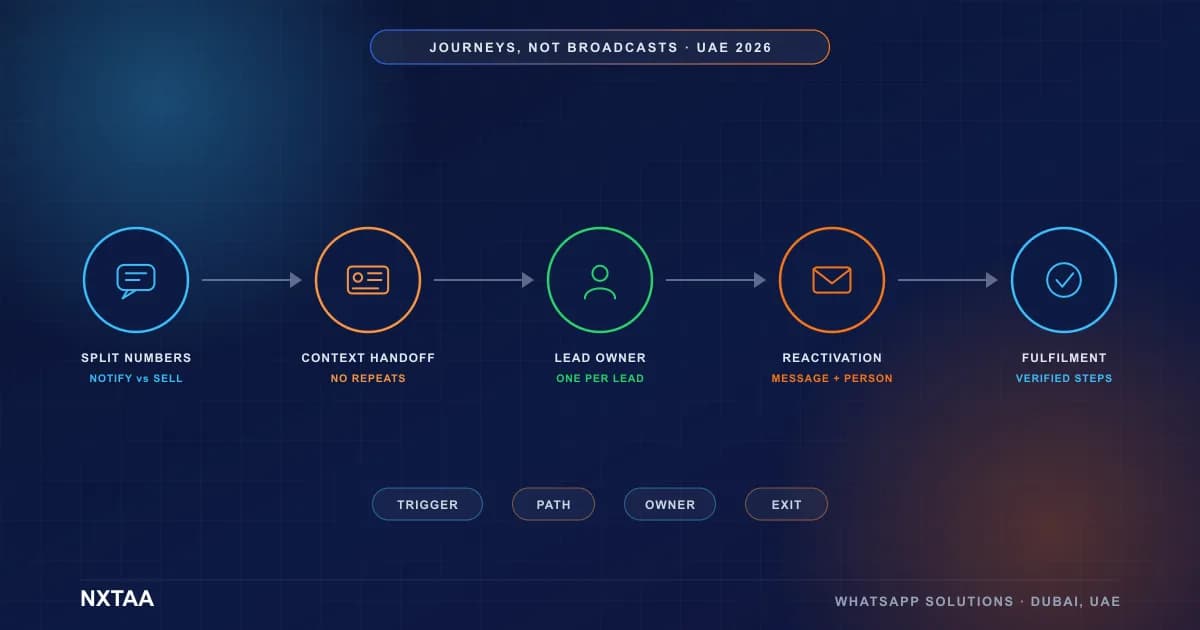
- Five patterns cover most UAE business needs: split numbers, context handoff, lead ownership, reactivation and verified fulfilment
- Every journey needs a trigger, a path, an owner and an exit
- Automation handles the predictable steps and people handle the exceptions
- Measure outcomes such as bookings, orders and completions, not message counts
- Start with one journey, prove it, then copy the pattern
The Broadcast Habit
Most businesses discover WhatsApp through broadcasts. A promotion goes out to the list. Some people reply, some ignore it, a few block the number. The team counts delivered messages and calls it a campaign.
Then something awkward happens. A customer replies to the broadcast with a real question, and nobody owns it. Another customer wants to book and the agent asks them to start over. The channel that felt like a megaphone turns out to be a conversation, and the business was not set up for one.
Across the deployments we have worked on in the UAE, the successful ones all made the same shift. They stopped asking "what should we send?" and started asking "what journey is this customer on, and what happens at each step?"
This article lays out five patterns that came out of those projects. Each one has its own deep-dive article, linked below.
Broadcast vs Journey
| Aspect | Broadcast | Journey |
|---|---|---|
| Unit of design | A message | A path with steps and outcomes |
| Ends when | The message is sent | The customer's goal is met |
| Reply handling | Often unplanned | Routed to an owner |
| Personalisation | Name merge at best | Based on the customer's state |
| Risk | Blocks and quality drops | Lower, because messages are expected |
| Measure | Delivered and read | Booked, ordered, completed |
Where Broadcasts Still Belong
None of this makes broadcasts wrong. Picture a Dubai furniture retailer announcing Eid opening hours, or a White Friday sale to customers who opted in to offers. It is one message, true for everyone who gets it, and nothing needs to happen next. Building a journey for that would be overkill.
A broadcast is fine when the audience opted in, the message is relevant to the whole segment, someone owns the replies and you have a frequency cap. Miss any of those and you are back to blocks.
Drip campaigns sit in between, and they are often confused with journeys:
| Format | How it behaves | Use it for |
|---|---|---|
| Broadcast | One message to a segment, then done | Timely news that applies to everyone |
| Drip | A timed sequence, the same path for everyone | Onboarding tips or a short education series |
| Journey | The next step depends on what the customer did | Bookings, orders, claims or anything with an outcome |
If the second message would change based on the reply to the first, a drip is the wrong tool. Most programmes end up using all three. Our bulk messaging guide covers how to run the broadcast part safely.
The Anatomy of a Journey
Every journey in this article has four parts:
- Trigger: what starts it (an order, an ad click, a draw result, a lapse in ordering)
- Path: the steps, with automated and human actions
- Owner: who is accountable at each stage
- Exit: the outcome that ends the journey, success or failure
If you cannot name all four, you have a broadcast with extra steps.
Pattern 1: Separate Operational Notifications from Sales
The situation: an order-driven business sends delivery and order updates automatically while sales agents handle human conversations on the same number.
The pattern: two numbers. One handles utility notifications with a bot-first reply policy. The other handles sales and support conversations with human routing.
Why it works: quality problems stay contained, queues stay clean and customers know what each number is for.
Use it when: automated traffic is high or mixed with sales. Read the full story in one WhatsApp number or two.
Pattern 2: Hand Off With Context
The situation: a bot guides a customer through a selection, then a human closes the booking.
The pattern: pass a context pack (selection, details, intent, summary) to the agent at the moment of transfer and require the first reply to use it.
Why it works: customers do not repeat themselves, and booking intent survives the transfer.
Use it when: any bot gathers information that a human completes. The details are in why your WhatsApp handoff loses customers.
Pattern 3: One Number, One Inbox, One Owner per Lead
The situation: enquiries arrive from ads, calls, portals and referrals, and leads fall between people.
The pattern: a single official number, a shared inbox, classification at intake, one named owner and timed escalation.
Why it works: nothing is unowned and managers can see everything open.
Use it when: several people share front-line enquiries. See who owns this lead, and the supporting piece on shared inboxes vs personal phones.
Pattern 4: Reactivate With Messages, Convert With People
The situation: a large vendor or customer list has a long, quiet tail.
The pattern: segment by recency, use newsletters to find interest, use WhatsApp to open conversations and have a salesperson follow every reply the same day.
Why it works: automation finds the ready accounts and humans convert them.
Use it when: your database is large and under-used. Read the whole approach in reactivating dormant B2B vendors.
Pattern 5: Verified Fulfilment Journeys
The situation: a business must reach many people, verify something and deliver something, such as promotion winners.
The pattern: staged journey from notification to verification to logistics to fulfilment, with email as the record, WhatsApp for speed and phone for exceptions.
Why it works: every step has an owner and every exception has a rule.
Use it when: you handle prizes, rewards, claims or any verified delivery. See winner communication at scale.
Matching the Pattern to Your Problem
Not sure where to start? Use this quick map.
| If your problem is... | Start with pattern |
|---|---|
| Order updates flooding your sales agents | 1: Separate numbers |
| Customers repeating themselves after a bot | 2: Context handoff |
| Leads nobody answered | 3: Ownership and shared inbox |
| A big list that stopped ordering | 4: Reactivation |
| Prizes, rewards or claims to fulfil | 5: Verified fulfilment |
Not sure which pattern fits your business? Talk to NXTAA and we will look at your current WhatsApp setup and suggest the first journey to build.
A Journey in Full: A Booking Example
To show how the parts fit, here is one journey written out step by step. It covers a customer who enquires about a service, books and receives confirmation.
| Step | Trigger | Action | Who acts | Exit if... |
|---|---|---|---|---|
| 1 | Customer messages the number | Greeting, two intake questions | Automation | Customer leaves the chat |
| 2 | Intake answered | Classify, assign owner | Automation | No owner available, so queue and tell the customer |
| 3 | Owner assigned | Agent reviews context, replies | Agent | No reply in 15 minutes, so escalate |
| 4 | Customer chooses an option | Confirm details, take booking | Agent | Customer hesitates, so schedule a follow-up |
| 5 | Booking confirmed | Send confirmation template | Automation | Delivery fails, so try email or phone |
| 6 | Day before the service | Send reminder | Automation | Customer replies to reschedule, so route to agent |
| 7 | After the service | Ask for feedback | Automation | Negative feedback, so alert the manager |
The table is short, but it already answers the questions that broadcasts leave open: who acts, what triggers the next step and what happens when things go wrong.
Automation or Human? A Division of Labour
Not every step should be automated. A useful rule: automate what is predictable and repetitive, hand over what needs judgement or empathy.
| Automate | Hand to a person |
|---|---|
| Greetings and intake questions | Negotiation and custom quotes |
| Status updates and reminders | Complaints and refunds |
| Confirmation messages | Sensitive documents and verification decisions |
| FAQ answers | Anything the customer is clearly upset about |
| Routing and tagging | High-value accounts |
Our piece on chatbot-to-human handover covers where that line should fall for your flows.
How to Tell You Have a Journey, Not a Broadcast
Ask five questions of any WhatsApp programme:
- If a customer replies, does someone own the reply?
- Does the next message depend on what the customer did?
- Is there a defined end, such as a booking, a delivery or a closed case?
- Can you tell, for any customer, which step they are on?
- Would you be comfortable if the customer saw the whole sequence?
If you answer no to two or more, you are still broadcasting.
Governance Across Journeys
As journeys multiply, a little structure prevents sprawl:
- A journey register. A simple list of each journey, its owner, its templates and its measures
- A template library. Categorised, approved and versioned, so teams reuse good messages
- A consent record. Where each contact's opt-in came from and when
- A review rhythm. A monthly look at outcomes, blocks and complaints, with weak journeys fixed or retired
Treat journeys as products with owners, not as one-off campaigns.
Designing Your First Journey
A short method:
- Name the goal. A booking, an order, a verified winner
- Map the customer's states. Where they start, where they should end and the stops between
- List the messages. One per transition, with the template category in mind
- Assign owners. Automation, agent or specialist at each step
- Define exceptions. Silence, confusion, refusal, escalation
- Set measures. One outcome measure and one speed measure
- Pilot small. One segment, one team, two weeks
The same method works for any of the five patterns, or for a new one. If you're deciding which marketing workflows to automate first, start with instant reply and lead assignment.
Metrics That Replace Open Rates
Read receipts say little about whether a journey works. Better measures follow the customer's progress:
| Journey type | Outcome measure | Speed measure | Health measure |
|---|---|---|---|
| Notifications | Fewer "where is my order" chats | Time from event to message | Block and report rate |
| Handoff | Handoff completion rate | Time to first agent reply | Repeat-question count |
| Lead intake | Leads converted | Time to first reply | Leads with no owner |
| Reactivation | Reactivated accounts | Time from reply to rep contact | Opt-out rate |
| Fulfilment | Prizes or claims completed | Time per stage | Escalations per hundred cases |
Pick one measure from each column for every journey, review them monthly and change the journey when a number slips. That discipline separates a programme that improves from one that simply keeps sending.
Where Journeys Meet Your CRM
Journeys work best when the customer record travels with them. The intake answers, the chosen product, the owner, the stage and the outcome should all be stored against the contact, not locked inside a chatbot or an agent's memory. That is what lets the next message depend on what already happened, lets a colleague take over without asking again and lets managers report on outcomes instead of messages. We explain how channels and records connect in our guide to omnichannel CRM for UAE businesses.
Mistakes We See Repeatedly
- Building the message first. Teams write copy before mapping the path
- Forgetting the human steps. Automation covers 80 percent. The remaining 20 percent decides whether it works
- Ignoring consent. Every journey that sends business-initiated messages needs opt-in. Our guide to bulk WhatsApp messaging rules explains the basics
- Writing templates that read like adverts. Our template guide shows what earns replies
- Not watching the pricing. Message types and charges change. Check the October 2026 pricing changes when you forecast cost
How NXTAA Can Help
We design and run WhatsApp journeys for UAE businesses end to end:
- Journey design, templates and API setup through our WhatsApp Business API service
- Human handoff, queues and escalation in our contact center solutions
- Automation and CRM connection with marketing automation
- AI-assisted routing and replies with our AI solutions
Ready to replace a broadcast with a journey? Contact NXTAA and we will help you design the first one.
You Might Also Like
- One WhatsApp Number or Two?
- Why Your WhatsApp Handoff Loses Customers
- Winner Communication at Scale
- WhatsApp Chatbot Guide for Dubai Businesses
FAQ
What is a WhatsApp journey? It is a planned sequence of automated messages and human actions that moves a customer toward a goal such as a booking, an order or a completed claim.
How is a journey different from a broadcast? A broadcast sends one message to a list and stops. A journey continues through steps, handles replies and ends when the customer's goal is met.
Do journeys need AI? No. Many effective journeys use simple rules and templates. AI can help with intent detection and summaries but is optional.
How many steps should a journey have? As few as it takes to reach the goal. Map the customer's states first, then add only the messages that move them between states.
What should I measure? Outcomes such as bookings, orders and completions, plus a speed measure like time to first response. Delivered and read counts are secondary.
Which pattern should I start with? Choose the one that matches your most expensive problem: swamped agents, lost leads, repeating customers, a dormant list or a fulfilment process.
Do journeys need opt-in? Yes. Any business-initiated message needs clear opt-in, a simple opt-out and compliance with WhatsApp policy and UAE rules.
Should I use broadcasts or drip campaigns on WhatsApp? Use a broadcast for one timely message that applies to the whole segment, and a drip for a fixed sequence such as onboarding. If the next message should depend on what the customer did, build a journey instead.