Why Your WhatsApp Handoff Loses Customers at the Moment They're Ready to Book
NXTAA Team
Customer Experience Specialist
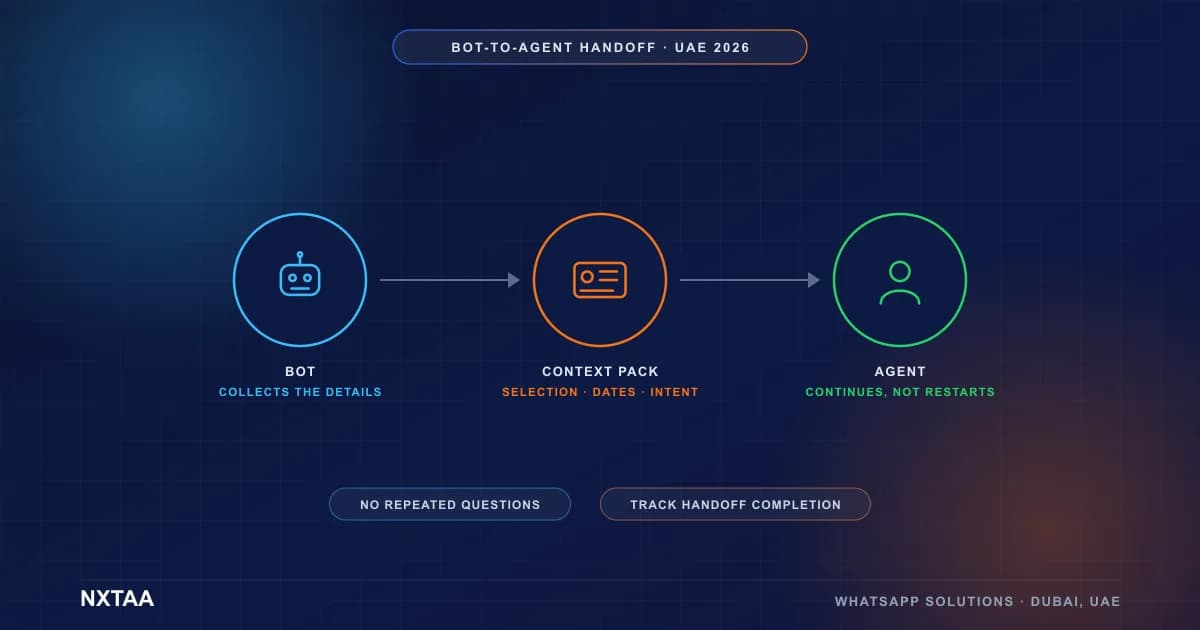
Customers abandon WhatsApp at the handoff because the agent who takes over does not know what the bot already learned, so the customer has to repeat everything. Pass the selected product, the conversation so far and the customer's intent to the agent at the moment of transfer, and the booking continues instead of restarting.
Key Takeaways
- The handoff is the highest-risk moment in a WhatsApp conversation because buying intent peaks right before it
- Customers forgive a bot's limits but not being asked the same question twice
- The agent's screen must show the selection (vehicle, room, product), the chat history and the stated intent before the first reply
- A handoff should be triggered by intent signals, not only by the customer typing "agent"
- Measure drop-off at the handoff separately from overall bot performance
- Fixing context passing usually beats improving the bot's own answers
The Booking That Almost Wasn't
Take a mid-sized car rental business in the UAE. Their WhatsApp bot does a decent job. It answers questions about deposits, mileage limits and airport pickup, then walks the customer through choosing a vehicle: category, dates, a quick comparison of two or three cars. When the customer says "I want to book the white SUV for the 14th," the bot hands over to a human agent to take payment details and confirm.
On paper the funnel looks healthy. Plenty of people reach the handoff. Fewer finish.
The operations lead pulled twenty abandoned conversations and read them line by line. The pattern was almost embarrassing. A customer spends six minutes with the bot choosing a car. Then the agent joins and writes: "Hello, how can I help you today?"
The customer, who has just told a machine everything, writes back: "I want to book the white SUV on the 14th." The agent replies: "Which city?" The customer already said Dubai. By the third repeated question, several customers simply stopped answering.
In hindsight, the bot had done its job. The handoff threw the result away.
Why Handoffs Fail
Handoff failures are rarely about the bot's intelligence. They come from three mechanical gaps.
The agent sees a blank screen
In many setups the human agent opens a conversation and sees a chat thread, but not a structured summary. The vehicle, dates, location and deposit question are buried 40 messages up. Agents are busy. They will not scroll through a long transcript while a customer waits, so they ask.
The bot does not pass what it knows
A bot may have collected structured information (selected vehicle, dates, pick-up city) inside its own flow, but that data never reaches the agent's screen. It lives in the bot's memory, not in the contact record. The customer experiences this as amnesia.
The handoff happens too late, or too early
Some bots hold on until the customer is frustrated, then transfer. Others transfer the instant a keyword appears, before the bot has captured the details an agent will need. Both lose customers. The first loses patience. The second loses context.
What a Good Handoff Looks Like
Let us compare the two experiences from the customer's side.
| Moment | Weak handoff | Strong handoff |
|---|---|---|
| Transfer announced | "Connecting you to an agent" and silence | "I'm passing you to Rana, who can confirm the white SUV for the 14th" |
| Agent's first message | "How can I help you today?" | "Hi, I can see you want the white SUV from the 14th to the 17th in Dubai. Shall I confirm it?" |
| Customer effort | Repeats vehicle, dates, city | Says "yes" |
| Time to confirmation | Minutes of re-asking | One or two messages |
| Drop-off risk | High | Low |
The strong version is not more advanced technology. It is the same bot and the same agent, with the data actually passed across.
The Context Pack: What Every Handoff Should Carry
A short, fixed bundle of information travels with every transfer. We call it the context pack:
- The selection: vehicle, room, product, plan, or whatever the customer chose
- The key details: dates, location, quantity, budget
- The stated intent: "wants to book," "wants a quote," "has a complaint," "needs a refund"
- The conversation so far: a short summary plus the last few messages
- The customer's record: name, language, previous bookings, notes
Notice the format. Fields, not paragraphs. An agent can absorb five labelled fields in three seconds. They cannot absorb a 40-message transcript.
Losing bookings at the handoff? Talk to NXTAA about context-aware handoffs. We will review your current flow and show you where customers are dropping off.
Triggering the Handoff at the Right Time
Do not wait for the customer to type "agent." Several signals say it is time:
- High-intent phrases: "book," "confirm," "reserve," "pay"
- Completed selection: the customer has chosen an item and dates
- Repeated confusion: the bot has failed to understand twice in a row
- Sensitive topics: payment disputes, damage, cancellations over a threshold
- Explicit requests: "speak to someone," "agent," or the Arabic equivalents
The best rule is to hand off at the moment of peak intent, once the bot has captured everything it can. Our guide to chatbot-to-human handover best practices goes deeper into trigger design and fallback rules.
The Four-Week Fix: What We Changed
The car rental business did not rebuild its bot. It fixed the handoff in four steps over about a month.
| Step | Change | Why it mattered |
|---|---|---|
| 1 | Defined the context pack fields | Agents knew exactly what to expect |
| 2 | Wrote bot data into the contact record at transfer | Information stopped living only in the bot |
| 3 | Added an agent sidebar showing the pack above the chat | Context visible before the first reply |
| 4 | Rewrote the transfer message to name the selection and the agent | Customers felt continuity |
Then they changed the agents' habit. The new rule: the first reply must reference something the customer already said. No "how can I help you today" when the screen already answers it.
Within a few weeks the transcripts looked different. Customers stopped writing "I already told the bot." Agents closed bookings in two or three messages instead of seven or eight.
Writing the First Agent Message
The first message after a transfer sets the tone for everything. It has one job: prove the agent has the context. A few patterns that work:
- Confirm and ask for the next step. "Hi, I'm Rana. I can see you'd like the white SUV from the 14th to the 17th in Dubai. Shall I take your payment details to confirm?"
- Flag what is missing, and only that. "I have your dates and the car. I just need your licence details to finish the booking."
- Acknowledge a problem the bot hit. "Sorry the system could not match your pick-up time. I've checked it and 10 am is free."
Compare that with "Hello, how can I help you today?" and you can see why customers feel unheard. The best first messages are specific, short and end with a clear next action.
Coaching Agents to Use the Context Pack
Tooling alone does not change behaviour. Agents have habits, and the habit of opening with a greeting is strong. What helped:
- A two-minute rule at shift start. Read three recent handoffs and the first reply each agent wrote
- Peer review of first replies. Team leads flag any first reply that ignores the context pack, and share good ones
- A visible metric. Repeat-question count per agent, shown without blame, turned the habit into a goal
- A short script library. Ready-made openers for booking, quote, complaint and refund handoffs, which agents adapt rather than invent
None of this is complicated. It just needs someone to own it.
What a Lost Booking Really Costs
Take an illustrative example. Say a rental business gets 400 bot conversations a week that reach the booking stage, and 150 of them are transferred to agents. If a fifth of those customers drop out during the handoff and the average booking is worth a few hundred dirhams, that is dozens of bookings a month lost to a problem that never shows up in a "bot accuracy" report. The numbers are only illustrative, but the shape is real: handoff leakage hides inside the funnel, and small improvements pay back quickly.
Mistakes We Made Along the Way
- We passed too much. The first version dumped the whole transcript into the sidebar. Agents ignored it. Summaries and fields beat raw history
- We forgot language. A customer who chatted in Arabic got an agent greeting in English. The pack now carries the language and routes accordingly
- We did not tell the customer. Early transfers happened silently. A short message naming the agent and what happens next lowered abandonment noticeably
- We ignored after-hours. Handoffs at night went to nobody. Now the bot says when a human will reply and saves the request for the morning queue
Measuring the Right Thing
Most teams track overall bot containment: how many conversations the bot resolved without a human. That number tells you nothing about handoff quality. Track these instead:
- Handoff rate: share of conversations transferred
- Handoff completion rate: share of transferred conversations that end in a booking or sale
- Repeat-question count: how many times an agent asked for something the bot already had
- Time to first agent reply after transfer
- Drop-off between "transfer announced" and "agent replies"
If completion rate lags far behind the rest of your funnel, the handoff is leaking. Fix that before you invest in a smarter bot.
It Is Not Only Car Rental
The same failure shows up in hotels (the guest selected a room type), travel agencies (the itinerary was shaped in chat), clinics (the preferred slot was already chosen) and e-commerce (the cart is waiting). Any business where a bot gathers details and a human closes the deal has a handoff.
If you are building the bot side too, our WhatsApp chatbot guide for Dubai businesses covers flow design, and our comparison of AI chatbots vs rule-based bots helps you choose the engine.
Handoff Checklist
- List the fields every agent needs before replying
- Make the bot write those fields to the contact record, not just to its own memory
- Show the fields above the chat in the agent's view
- Trigger transfer on intent signals, not only keywords
- Announce the transfer by naming the selection and the agent
- Require agents to reference prior context in their first reply
- Handle after-hours with an honest expectation message
- Track handoff completion rate and repeat-question count weekly
How NXTAA Can Help
We build bot-to-agent journeys where context survives the transfer:
- WhatsApp bot flows with structured data capture on the WhatsApp Business API
- Agent workspaces that show the context pack in our contact center platform
- AI-assisted summaries and intent detection through our AI solutions
Ready to stop losing customers at the handoff? Speak to NXTAA and we will audit one live conversation flow end to end.
You Might Also Like
- Chatbot-to-Human Agent Handover: Best Practices
- Who Owns This Lead? Building an Accountable WhatsApp Enquiry Workflow
- Shared Team Inbox vs Personal WhatsApp Phones
- WhatsApp Chatbot Guide for Dubai Businesses
- Design WhatsApp Journeys, Not Broadcasts
FAQ
What is a chatbot-to-agent handoff? It is the moment a bot passes a conversation to a human agent. A good handoff transfers the customer's selection, details and intent so the agent can continue instead of restarting.
Why do customers drop off after a WhatsApp handoff? Mostly because they have to repeat information the bot already collected. The delay and the repetition both signal that the business is not paying attention.
When should a bot hand over to a human? At peak intent, once the bot has captured the key details. Booking phrases, completed selections, repeated confusion and sensitive topics are all good triggers.
What information should an agent see at handoff? The selection, key details such as dates and location, the stated intent, a short conversation summary and the customer's record. Present them as labelled fields above the chat.
Do I need AI for a good handoff? No. A rule-based bot that writes its collected fields to the contact record can hand off well. AI helps with summaries and intent detection but is not required.
How do I measure handoff quality? Track handoff completion rate, repeat-question count and time to first agent reply. Overall bot containment hides handoff problems.
Does this apply outside car rental? Yes. Hotels, travel, clinics and e-commerce all gather details with a bot and close with a human, so the same context-passing rules apply.