The WhatsApp Chatbot Guide Dubai Businesses Actually Need in 2026
NXTAA Team
WhatsApp Business Specialists
The WhatsApp Chatbot Guide Dubai Businesses Actually Need in 2026
A WhatsApp chatbot is an automated messaging system built on Meta's WhatsApp Business API that answers customer questions, books appointments, and sends order updates without a human typing every reply. For Dubai businesses, where WhatsApp penetration sits around 90%, it's less an optional add-on than a second front desk that never clocks out.
Key Takeaways
- A real business chatbot runs on the official WhatsApp Business API through a Meta-authorized provider (BSP) — not the free green-icon app, which can't scale or automate.
- Compliance isn't optional in Dubai: TDRA consent rules and PDPL data-protection law govern every message, and getting it wrong can get your number banned outright.
- Budget for two costs: Meta's per-message rates (AED 0.15–1.45 by category, since the July 2025 billing change) plus a BSP platform fee (AED 150–600/month), on top of a one-time build.
- Approval takes weeks, not days — plan 2–3 weeks for verification, number registration, and template approval before the bot build even starts.
- The two costliest mistakes: skipping the opt-in trail, and building a bot with no clean human handoff.
What Counts as a "WhatsApp Chatbot" in Dubai Right Now?
A real WhatsApp chatbot for business runs on the official WhatsApp Business Platform (formerly the WhatsApp Business API), not the free consumer app. It uses pre-approved message templates, automated flows, and — increasingly — AI to handle FAQs, bookings, payments links, and order tracking, all inside the same chat thread customers already use with friends and family.
That distinction matters more than most vendors let on.
The free WhatsApp Business app, the one with the green icon your local café probably uses, caps out fast. One device, no team inbox, no automation beyond a canned away message. It works for a single shopkeeper answering twenty messages a day. It falls apart the moment a real order queue, a support team, or a Ramadan sale hits your phone with three hundred messages an hour.
Businesses in Dubai that actually scale on WhatsApp go through a Meta-authorized Business Solution Provider, or BSP — companies like Twilio, SleekFlow, 360dialog, or regional players with UAE data residency options. The BSP gives you API access, a dashboard, and the infrastructure to route messages to a team or a bot. Meta doesn't sell API access directly to small businesses; you go through one of these partners or build on the Cloud API yourself if you have engineering resources. (New to the API itself? Start with our WhatsApp Business API registration guide.)
Why Dubai Businesses Specifically Should Care
Email open rates in the UAE hover in the teens. WhatsApp messages get opened within minutes, most of the time within three. That gap alone explains why restaurants, real estate brokers, salons, and logistics companies across Dubai have quietly shifted their entire customer communication stack onto WhatsApp over the past two years.
Consider a mid-size salon chain in JBR. Before automating, front desk staff juggled walk-ins, phone calls, and a flood of WhatsApp booking requests on one shared phone. Messages got buried. A client asking about Saturday availability at 11pm wouldn't hear back until the next afternoon, by which point she'd already booked elsewhere. After switching to a WhatsApp chatbot that handled slot availability, deposits, and reminders automatically, the salon cut no-shows by nearly a third and stopped losing bookings to slow replies — without hiring anyone new.
That's the actual case for automation here. Not novelty. Recovered revenue that was leaking out through response lag.
Real estate and logistics run into the same wall, just at higher volume. A brokerage fielding inquiries from Bayut and Property Finder listings, or a delivery company managing hundreds of daily "where's my order" messages, cannot staff around the clock without either burning out a support team or bleeding customers who expect an instant answer.
The Legal Side: TDRA and PDPL Rules You Can't Skip
This is where a lot of businesses trip. Dubai's regulatory environment for automated messaging isn't loose, and getting it wrong costs more than a fine — WhatsApp will ban your business number outright. (If that's already happened to you, our account recovery guide covers the appeal process.)
Two frameworks govern this space. The Telecommunications and Digital Government Regulatory Authority (TDRA) sets rules around unsolicited commercial messaging, and Federal Decree-Law No. 45 of 2021 on Personal Data Protection applies to any system processing customer data, which a chatbot obviously does.
A few things are non-negotiable:
- You need explicit, verifiable opt-in before sending marketing messages. Double opt-in is the safer standard. A customer messaging you first to ask a question does not count as consent to receive future promotions.
- Opt-in records need to be kept and available on request — plan for at least two years of retention.
- Customers must have a clear, working way to opt out, and that request has to be honored immediately, not "processed within 30 days."
- Marketing messages must use Meta's pre-approved templates. You cannot freeform blast promotional content outside the 24-hour service window.
- Late-night promotional sends are restricted under TDRA guidance, so a 2am flash-sale message is a compliance problem before it's a customer-experience one.
None of this is exotic if you've run email marketing under GDPR-adjacent rules before. It's the same instinct — get real consent, keep records, make it easy to leave — applied to a channel where the penalty for ignoring it is losing your number entirely.
What It Actually Costs in 2026
Meta changed its billing model in mid-2025, and a lot of pricing pages online still haven't caught up. Worth knowing before a vendor quotes you off an old rate card.
Through June 2025, WhatsApp billed per 24-hour conversation window — one flat fee no matter how many messages you crammed into that window. As of July 1, 2025, that model is gone. Meta now charges per delivered template message, split by category:
- Marketing messages — roughly AED 1.20–1.45 per message in the UAE
- Utility messages (order confirmations, shipping updates, appointment reminders) — roughly AED 0.15–0.20
- Authentication messages (OTPs) — roughly AED 0.30–0.40
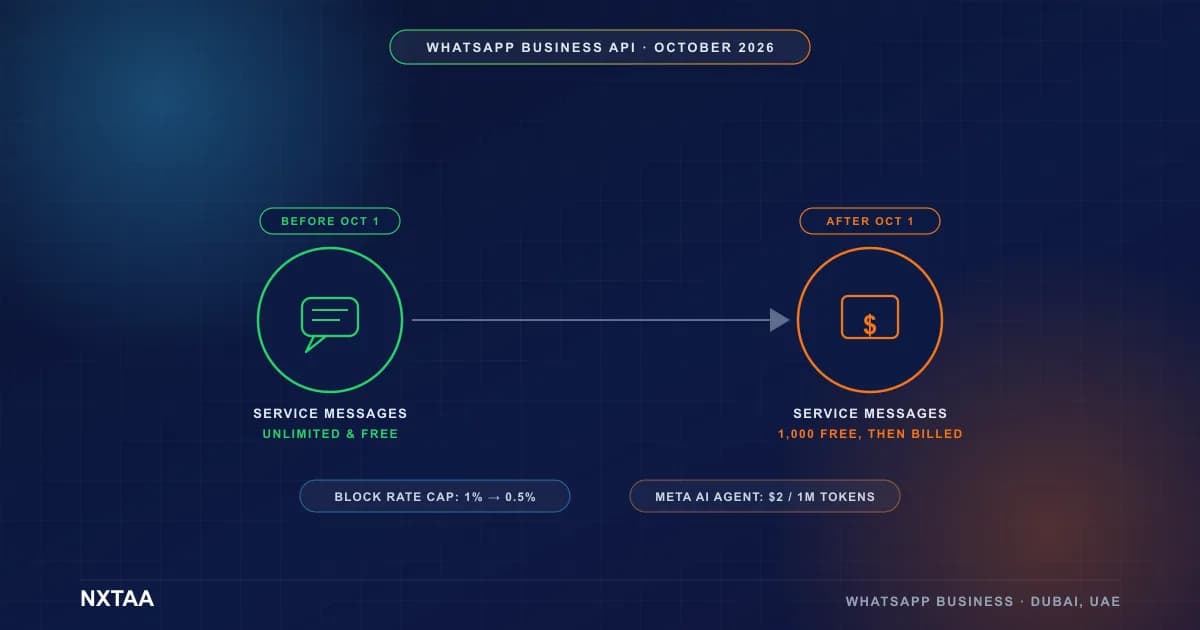
- Service messages — free, and have been since November 2024, as long as they're replies within a customer-initiated 24-hour window
On top of Meta's per-message rates, your BSP charges its own platform fee, typically AED 150–600 a month depending on features and message volume. Building an actual chatbot flow — booking logic, payment integration, multi-department routing — runs anywhere from roughly AED 2,600 for a simple lead-capture bot up to AED 13,000 or more for AI-driven flows with multiple decision branches.
Budget for both numbers. Vendors love quoting the platform fee and leaving Meta's per-message charges as a surprise on your first invoice. (For the full pricing and compliance picture, see our WhatsApp Business API UAE 2026 playbook.)
Want a real AED number for your use case, not a range? NXTAA's WhatsApp Business API team will scope your message volume, categories, and build complexity into one transparent quote. Request a costed plan.
Choosing a BSP: What Actually Matters
Every WhatsApp API reseller in Dubai will claim "instant setup" and "best pricing." Neither claim tells you much. Ask instead:
Does the provider offer UAE-region data hosting, or does customer data route through servers outside the country? For a business handling health, financial, or real estate data, this isn't a nice-to-have — PDPL compliance depends on knowing where the data sits.
Can you actually reach a human at the BSP when Meta flags your template for review and rejects it — which happens more often than vendors admit? Template rejection is the single most common reason chatbot rollouts stall for two or three weeks longer than planned.
Does the pricing model show Meta's per-message cost separately from the platform fee, or is it bundled into an opaque "package"? Bundled pricing usually means you're overpaying once volume grows.
Getting Started: The Realistic Timeline
Most Dubai businesses underestimate how long WhatsApp Business API approval takes. Budget two to three weeks, not two to three days.
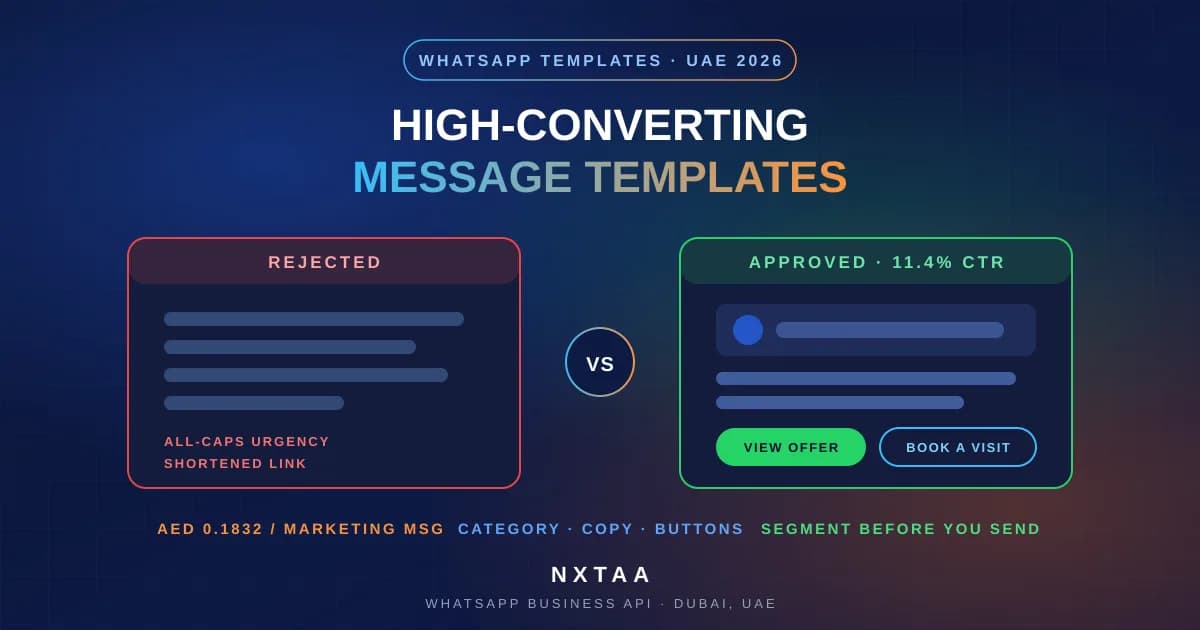
Meta Business verification comes first — your trade license, business address, and a verified Facebook Business Manager account all need to check out. Then comes number registration, which usually requires porting an existing number or dedicating a new one solely to WhatsApp (it can't run on the free app afterward). Template approval follows, and this is the step that trips people up most: templates get rejected for vague reasons like "sounds too promotional" even when they're utility messages, and resubmission adds days.
Only after all three steps clear does the actual chatbot build start — mapping conversation flows, connecting a booking or CRM system, and testing edge cases like a customer typing in Arabic mid-flow or sending a voice note instead of text.
Which brings up a design decision worth making deliberately: whether your bot runs on fixed rules, AI, or both. We break down that trade-off in AI Chatbots vs Rule-Based Chatbots: What Is the Difference? — short version, most Dubai businesses end up wanting AI for open-ended volume with rule-based guardrails on anything high-stakes.
What a Well-Built WhatsApp Chatbot Actually Delivers
It's worth being concrete about the return, because "automation" as a word promises everything and specifies nothing. Here's what Dubai businesses running this well tend to see:
- Response time collapses to seconds, around the clock. The gap between a customer messaging at 11pm and getting an answer isn't a day anymore — it's instant. In a market where WhatsApp messages are typically opened within three minutes, that speed directly recovers bookings and orders that used to leak away overnight.
- Routine volume gets deflected. Order status, opening hours, booking slots, delivery updates — the questions that make up the bulk of most inboxes get handled without a human, freeing your team for the conversations that actually need judgment.
- No-shows and drop-offs fall. Automated reminders, deposit links, and confirmations quietly reduce the revenue lost to forgetfulness — the salon example earlier cut no-shows by nearly a third on reminders alone.
- Staffing stops scaling linearly with volume. A Ramadan or Black Friday spike that used to mean temporary hires or a burned-out support team becomes a traffic number the bot absorbs.
The point isn't that a chatbot is magic. It's that response lag is a measurable leak, and closing it is measurable revenue — which is exactly why the businesses that treat WhatsApp as their primary channel don't go back once the automation is in place.
Common Mistakes That Cost Money
Skipping the opt-in trail is the biggest one. Businesses assume that because a customer replied once, they're cleared for ongoing marketing. They're not, and Meta's own enforcement plus TDRA rules both treat that as a violation.
Building the entire bot around FAQs and forgetting the handoff to a human is the second. A chatbot that traps a frustrated customer in a menu loop with no escape to a real agent does more brand damage than no automation at all.
And treating template approval as a formality rather than a step to plan around — teams that submit templates the week before a campaign launch, then watch the launch slip because Meta's review queue takes longer than expected.
How NXTAA Builds WhatsApp Chatbots for Dubai Businesses
This entire stack — API onboarding, compliance, and the bot itself — is what NXTAA's WhatsApp Business API service handles end to end:
- Meta verification and number setup done for you. Trade license, Business Manager, number registration, and template approval managed by a team that's cleared Meta's review queue hundreds of times.
- Compliant by design. Opt-in capture, consent records, and instant opt-out flows built to TDRA and PDPL standards from the first message.
- AI where it helps, rules where it protects. Our AI Solutions team builds hybrid flows — AI handling Arabic, English, and Arabizi conversations naturally, with rule-based guardrails and clean human handoff into your contact center.
Ready to stop losing leads to slow replies? Book a free consultation with NXTAA and we'll scope your WhatsApp chatbot — timeline, compliance, and real AED costs — before you commit.
You Might Also Like
- How to Generate High-Quality Leads in the UAE: A 2026 Playbook for Businesses
- WhatsApp Business API UAE 2026: Pricing and Compliance Playbook
- How to Register WhatsApp Business API in UAE
- AI Chatbots vs Rule-Based Chatbots: What Is the Difference?
- Chatbot-to-Human Agent Handover: Best Practices
- How to Send Bulk WhatsApp Messages in UAE
- NXTAA WhatsApp Business API Service
Frequently Asked Questions
Is a WhatsApp chatbot legal for businesses in Dubai? Yes, as long as it runs on the official WhatsApp Business API through a Meta-authorized provider and follows TDRA consent rules and PDPL data protection requirements.
Do I need a trade license to set up WhatsApp Business API in the UAE? Yes. Meta Business verification requires a valid trade license and a verified business address before approving API access.
How much does a WhatsApp chatbot cost for a small business in Dubai? Expect roughly AED 150–600 a month in platform fees, plus Meta's per-message charges (AED 0.15–1.45 depending on category), plus a one-time build cost starting around AED 2,600 for a basic flow.
Can I use my personal WhatsApp number for the Business API? No. Once a number registers with the WhatsApp Business API, it can't run the free consumer or Business app simultaneously — it's dedicated to the API.
How long does WhatsApp Business API approval take in the UAE? Realistically two to three weeks, covering Meta Business verification, number registration, and message template approval.
What happens if I send marketing messages without opt-in? You risk both TDRA penalties and Meta banning your business number, which cuts off the entire channel, not just the offending campaign.
Is service messaging really free? Yes — replies within a 24-hour window that a customer initiates have been free since November 2024, regardless of message category.