AI Chatbots vs Rule-Based Chatbots: What Is the Difference?
AI Solutions Architect
Nxtaa Team
AI Chatbots vs Rule-Based Chatbots: What Is the Difference?
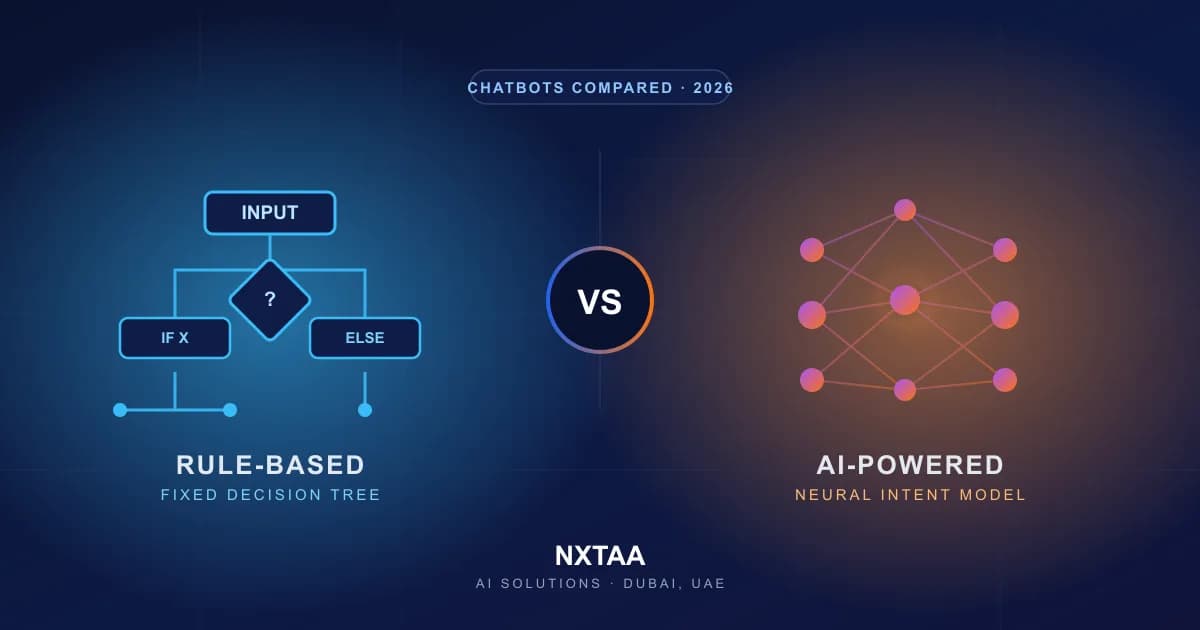
A rule-based chatbot follows a fixed decision tree — if the customer types X, it replies with Y, and anything outside that script gets a shrug or a handoff. An AI chatbot uses natural language processing to interpret intent, so it can handle a question phrased three different ways and still land on the right answer. The gap between them isn't a matter of one being "smarter" in some vague sense. It's a matter of what breaks first when a real customer says something you didn't anticipate.
Key Takeaways
- Rule-based bots follow hand-built decision trees — cheap, predictable, and safe, but they break the moment a customer phrases something off-script.
- AI chatbots interpret intent with NLP, so they handle unpredictable, varied, multi-part questions — but need guardrails, or they risk confidently wrong answers.
- Cost per interaction is the number that matters: roughly $1.45 for AI versus $4.60 for a human agent — about a 68% reduction.
- Most businesses need both — AI for open-ended volume, rule-based logic as guardrails on high-stakes queries, with a clean handoff to a human.
- Start with your query mix, not the technology. If 80% of questions fit ten categories, rules may be enough; if they're varied and open-ended, you need AI.
The Core Mechanical Difference
Rule-based bots run on logic trees someone built by hand. "If user says 'track order,' show tracking form. If user says 'refund,' route to refund flow." It works exactly as well as the tree was designed, and not one bit better.
That's the whole system. No learning. No adaptation. A rule-based bot answering the same question for the ten-thousandth time performs identically to the first time.
AI chatbots work differently at the root. They parse the actual meaning behind a message using NLP, so "where's my package," "has my order shipped yet," and "I never got a shipping confirmation" all route to the same underlying intent even though none of them match a scripted phrase exactly. Modern systems built on large language models go further — they hold context across a conversation, handle follow-up questions, and in many implementations improve their responses over time as more real conversations feed back into the model. (This is also the line between a scripted bot and a true autonomous agent — a distinction we unpack in AI Chatbots vs AI Agents: The 2026 Customer Service Guide.)
Where Each One Actually Breaks
Every rule-based chatbot has the same failure mode: the moment a user steps outside the anticipated script, the conversation stalls. Type a typo, phrase a question sideways, or ask two things in one message, and you'll hit "Sorry, I didn't understand that" — the most familiar dead end in customer service software.
AI chatbots fail differently, and arguably worse in some cases. They don't stall. They guess. An AI system with weak guardrails will confidently answer a question it doesn't actually know the answer to, sometimes inventing details that sound plausible and aren't true. That's a real risk for regulated industries — a chatbot hallucinating a refund policy or a medical disclaimer is a liability problem, not just a bad user experience.
Neither failure mode is hypothetical. A logistics company running a purely rule-based bot found that roughly a third of its chat sessions ended in a dead "I don't understand" loop during peak shipping season, when customers were asking oddly specific delivery questions the tree never accounted for. Frustrated users abandoned the chat and called support anyway — meaning the bot hadn't reduced load, it had just added a step customers resented.
What Each One Costs
Off-the-shelf rule-based tools are the cheap, fast option — most SaaS platforms run somewhere between $15 and $500 a month for small businesses, and a custom-built simple flow (order tracking, FAQ routing) typically lands in the $5,000–$30,000 range as a one-time build.
AI chatbots span a much wider range, and the number you'll see quoted depends heavily on whether buying a subscription or commissioning custom development. Subscription-based AI chatbot platforms for mid-size businesses run roughly $1,200–$5,000 a month at the enterprise tier. Fully custom AI builds with deep NLP, sentiment analysis, and system integrations run $75,000 to $500,000, and enterprise deployments in regulated industries like banking or healthcare can clear $1 million.
Here's the number that actually matters for the decision, though: cost per interaction. A human-handled support conversation averages around $4.60. An AI chatbot interaction averages around $1.45 — roughly a 68% reduction. Rule-based bots are cheaper to build but don't scale that cost advantage the same way, because every new question type requires someone manually adding a new branch to the tree. AI systems, once trained, absorb novel phrasing without a developer touching the flow.
Not sure which model your budget justifies? NXTAA's AI Solutions team maps your actual query volume to the right build — rule-based, AI, or hybrid — so you don't overpay for capability you won't use. Get a free chatbot assessment.
Where Rule-Based Still Wins
Simplicity is a feature, not just a limitation. For a business with a genuinely narrow set of repetitive questions — store hours, appointment booking, order status, password resets — a rule-based bot answers those questions with zero risk of a wrong or invented response. There's nothing to hallucinate.
Rule-based systems are also faster to launch, cheaper to audit, and easier to explain to a compliance team. If your legal department needs to sign off on every possible response a customer-facing bot can give, a fixed decision tree is auditable in an afternoon. An AI model's response space is not.
Where AI Chatbots Win
Anywhere the conversation genuinely varies — sales inquiries, technical support, multi-step troubleshooting, anything involving context from earlier in the conversation — AI chatbots handle volume that would otherwise require a human or a frustratingly long rule tree. Adoption reflects that: 91% of businesses with more than 50 employees now use chatbots somewhere in the customer journey, and 78% of enterprises run conversational AI in at least one core business function. For a deeper look at how these systems are being deployed across customer service teams, see our 2026 AI customer service guide.
They also scale differently. Adding a new product line to a rule-based bot means mapping new branches by hand. Adding it to a well-trained AI system often means updating a knowledge base and letting the model handle the phrasing variety on its own.
The Honest Answer: Most Businesses Need Both
Treating this as a binary choice is where a lot of chatbot projects go wrong. The practical pattern that's emerged among businesses running this well isn't "AI or rules" — it's AI handling the volume and open-ended queries, rules acting as guardrails around anything high-stakes (refunds over a certain amount, medical or legal questions, anything requiring a compliance-approved exact answer), and a clear handoff to a human the moment either system hits its limit.
A rule-based layer sitting in front of an AI model, catching specific known-risk queries before they ever reach the language model, gives you the cost efficiency and adaptability of AI without handing over full control on the situations where a wrong answer actually costs you something.
What the Hybrid Model Looks Like in Practice
The theory of "use both" is easy to nod along to and surprisingly easy to get wrong. Here's how a well-built hybrid actually routes a conversation.
A customer opens a chat and types something. The first thing the system does is classify intent — not answer, classify. If that intent matches a known high-stakes category (a refund request above a set amount, a question about medical eligibility, anything your compliance team has flagged), it gets pulled down a rule-based path with pre-approved, deterministic responses. There's no language model improvising here, because this is precisely where improvisation costs you money or exposes you legally.
Everything else — the long tail of "how do I," "does this work with," "I'm having trouble with" phrased four hundred different ways — flows to the AI path, which interprets meaning and responds conversationally. And sitting across both paths is a confidence threshold: when the AI isn't sure enough, it doesn't guess, it escalates to a human with the full conversation context attached, so the customer never has to repeat themselves.
That three-layer structure — deterministic guardrails, AI for volume, confidence-gated human handoff — is what separates a chatbot that quietly deflects 60–70% of routine tickets from one that traps customers in a loop and trains them to distrust the widget entirely.
The Numbers Businesses Actually See
The payoff shows up in a few consistent metrics once a hybrid is running well:
- Deflection rate: a well-scoped deployment resolves 60–80% of routine inquiries without a human touching them.
- Cost per interaction: the drop from roughly $4.60 to $1.45 compounds fast at volume — at 10,000 monthly conversations, that's a meaningful line item, not a rounding error.
- Response time: instant, 24/7, across every time zone and through demand spikes (Ramadan, Black Friday, a product launch) that would otherwise force temporary hiring.
- ROI: businesses report roughly $3.50 back for every $1 spent on AI-driven customer service once the system is trained and deflecting at scale.
None of those numbers materialize from switching on an off-the-shelf bot and walking away. They come from scoping the query mix correctly, drawing the rule-versus-AI line in the right place, and tuning the handoff — which is the actual work.
How to Decide for Your Business
Start with the shape of your query volume, not the technology. If 80% of what customers ask fits into ten or fewer categories, a rule-based bot handles that cheaply and safely — you may not need AI at all yet. If your support queue is full of open-ended, varied, or multi-part questions, a pure rule-based system will frustrate more customers than it helps, and that "I didn't understand" loop becomes your biggest churn driver.
Factor in your compliance exposure next. Regulated industries should lean rule-based for anything touching money, health, or legal advice, and reserve AI for lower-stakes conversational volume.
And be realistic about budget and timeline. A rule-based bot can be live in weeks for a few thousand dollars. A well-built AI system is a bigger investment upfront but pays that back through lower cost-per-interaction as volume grows — companies report roughly $3.50 returned for every $1 spent on AI-driven customer service, which is a number worth weighing against the higher build cost.
How NXTAA Builds Hybrid Chatbots for UAE Businesses
The businesses we work with in Dubai and across the GCC rarely need to pick a side. They need the hybrid model working correctly — and that's exactly what NXTAA's AI Solutions team designs:
- Rule-based guardrails on the risky stuff. Refund thresholds, compliance-sensitive answers, and anything your legal team needs pre-approved run on deterministic logic — no hallucination surface.
- AI for the open-ended volume. Sales questions, multi-step troubleshooting, and the endless variety of how customers actually phrase things get handled by NLP-driven models, including Arabic, Khaleeji dialect, and Arabizi.
- Deployed where your customers already are. We roll these agents out on WhatsApp Business API, web chat, and voice, with a clean handoff into your live contact center the moment a human is the better answer.
The result is the cost curve of AI with the auditability of a rule tree — the setup that keeps a wrong answer from ever reaching a customer where it counts.
Not sure which model fits your support volume? Book a free consultation with NXTAA and we'll map your query mix to the right build — before you spend a dirham on the wrong one.
You Might Also Like
- The WhatsApp Chatbot Guide Dubai Businesses Actually Need in 2026
- Chatbot-to-Human Agent Handover: Best Practices
- AI Chatbots vs AI Agents: The 2026 Customer Service Guide for UAE Businesses
- AI Chatbots vs AI Agents: 2026 Customer Service Guide
- Digital Marketing Trends in UAE: The 2026 Strategic Forecast
- NXTAA AI Solutions in Dubai
Frequently Asked Questions
What's the simplest way to explain the difference between AI and rule-based chatbots? A rule-based chatbot only understands exact phrases it was programmed to recognize; an AI chatbot interprets meaning, so it can answer the same question phrased in different ways.
Are AI chatbots always better than rule-based ones? No. Rule-based bots are cheaper, faster to launch, and safer for narrow, high-compliance use cases where every possible response needs to be pre-approved.
Can AI chatbots give wrong answers? Yes — AI models can generate confident but incorrect responses, sometimes called hallucinations, which is why many businesses pair AI with rule-based guardrails for sensitive topics.
How much does it cost to build a chatbot in 2026? Rule-based bots typically cost $5,000–$30,000 for a custom build or $15–$500/month for a SaaS platform; AI chatbots range from roughly $1,200–$5,000/month for subscription tools up to $75,000–$500,000+ for custom enterprise builds.
Do businesses actually need both types of chatbots? Many do — a common setup uses rule-based logic to handle high-risk or highly specific queries and AI to manage broader, more varied conversation volume.
What's the ROI difference between AI chatbots and human support? AI chatbot interactions average around $1.45 versus roughly $4.60 for a human-handled interaction, a reduction of about 68% per conversation.