How to Create High-Converting WhatsApp Marketing Templates (2026 Guide for UAE Businesses)
NXTAA Team
WhatsApp Business Specialists
How to Create High-Converting WhatsApp Marketing Templates (2026 Guide for UAE Businesses)
What Makes a WhatsApp Marketing Template Convert?
A high-converting WhatsApp marketing template does three things: it names a specific offer instead of a vague one, it puts the action inside a tappable button rather than a link buried in text, and it goes to a segmented list of people who opted in recently. Get those right and 8-12% click rates are normal. Get them wrong and you'll sit at 0.5% while your quality rating slides toward red.
Key Takeaways
- Wrong category selection is the single biggest cause of template rejection — Marketing, Utility, and Authentication have different rules and different costs.
- Marketing templates in the UAE cost AED 0.1832 (about USD 0.0499) per delivered message on Meta's current rate card, so a bad template is a real budget line, not a rounding error.
- Buttons outperform inline links. Quick-reply and CTA buttons lift click rates because they remove typing and guessing.
- Meta re-categorizes templates automatically. Labelling a promo as "Utility" to save money gets it reclassified and can get your template paused.
- Quality rating is scored on blocks and opt-outs, not on send volume. Segment hard, send less, and your limits climb faster.
- Two templates and a split list will teach you more in a week than six months of guessing.
The Ramadan Campaign That Got Rejected Four Times
Picture a home furnishings retailer in Dubai. Four showrooms, a decent e-commerce site, about 42,000 opted-in WhatsApp contacts collected over two years of in-store signups and website popups. The marketing lead had a clear plan for Ramadan: a two-week sale, 30% off dining and majlis furniture, pushed through WhatsApp because their email open rates had been sitting at 14% for a year.
They submitted their first template eleven days before the campaign was supposed to launch.
Rejected. Resubmitted with edits. Rejected again. By the fourth rejection they had burned nine days, the creative team had rewritten the copy three times, and nobody could explain what Meta actually objected to — the rejection reason just said the template didn't comply with the Business Messaging Policy.
They got approval on day ten. One day before launch. The campaign went out to all 42,000 contacts in a single blast.
The results: 1.9% click rate. 340 people blocked the number within the first six hours. Quality rating dropped from green to yellow by the second morning, then to red by day three. Meta held their messaging tier in place, which meant the follow-up sends they had planned for the second week were capped well below what the campaign needed.
That's roughly AED 7,700 in message costs for a campaign that generated fewer showroom visits than a single Instagram post the month before.
Where It Actually Went Wrong
The rejections and the poor conversion were the same problem wearing two different hats.
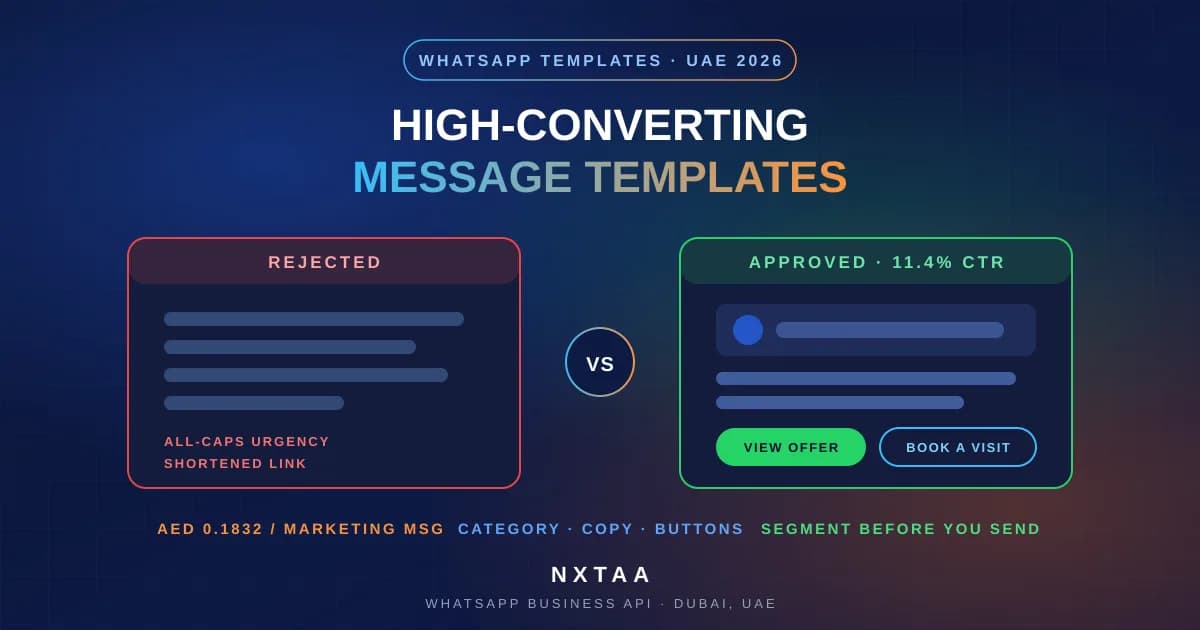
Their template read something like this: "BIGGEST RAMADAN SALE EVER! Don't miss out — LIMITED TIME ONLY! Visit us now: bit.ly/ram25"
Every element of that message is a known trigger. All-caps urgency. Unverifiable superlatives. A URL shortener. No business identification. No indication of why this person was receiving it. And once it finally squeaked through review, the message gave a customer nothing specific enough to act on — "biggest sale ever" tells you nothing about what's discounted or by how much.
Looking back, the sequence of rejections was Meta doing them a favour they didn't recognize at the time. The template that eventually got approved was the weakest version, stripped of the specifics that would have made it work, because each rewrite removed content instead of rethinking the approach.
Template Categories: Pick Wrong and Nothing Else Matters
Before a single word of copy matters, you choose a category. This decision governs how strictly Meta reviews your template, what you're allowed to say, and what each message costs.
To make sense of why their submissions kept bouncing, we mapped every message the retailer wanted to send against the three categories and what each one permits.
| Marketing | Utility | Authentication | |
|---|---|---|---|
| Purpose | Promotions, offers, product launches, re-engagement | Transactional updates the customer expects — order confirmations, delivery updates, appointment reminders | One-time passwords and login verification codes |
| Review strictness | Highest. Spam risk means aggressive scrutiny | Moderate. Easiest category to get approved | Rigid format, minimal flexibility |
| UAE cost per message | AED 0.1832 (USD 0.0499) | AED 0.0576 (USD 0.0157) | AED 0.0576 (USD 0.0157) |
| Opt-in requirement | Explicit marketing opt-in required | Opt-in still required, but tied to a real transaction | Tied to a user-initiated login |
| Typical rejection cause | Aggressive sales language, vague claims | Promotional content smuggled into a transactional frame | Missing the mandatory "do not share this code" warning |
| Can be auto-recategorized? | Yes — upward and downward | Yes — promotional content gets moved to Marketing | Rarely |
The cost gap is what tempts people. Marketing messages run more than three times the price of Utility in the UAE, so the obvious move is to dress a promotion up as an order update and pay less.
That doesn't work, and it's worth knowing exactly why.
How Meta Re-Categorizes You Anyway
Meta's classification system reads the template content, not just the label you attached to it. Submit a delivery notification that ends with "and enjoy 20% off your next order" and it gets reclassified as Marketing. You'll be billed at the Marketing rate regardless. If the mismatch is severe enough — a straight promotional blast filed under Utility — the template gets rejected outright, and repeated attempts start affecting how your whole account is reviewed.
Category mismatch is the most common rejection reason across the entire platform. Not bad grammar, not the wrong link, not a formatting error. Just picking the wrong box.
The Nine Rejection Triggers Worth Memorizing
After the fourth rejection we audited every template the retailer had in their library — 23 of them, mostly written by whoever needed a message that week. Fourteen contained at least one of these:
- All-caps urgency. "BUY NOW", "LAST CHANCE", "HURRY". One or two capitalized words is fine. Whole phrases read as shouting.
- Unverifiable claims. "Best prices in Dubai", "biggest sale ever", "guaranteed results". If a reviewer can't confirm it, treat it as a liability.
- URL shorteners. bit.ly, tinyurl, and similar services hide the destination. Use your own domain, and if you need tracking, use a branded short domain you control.
- Requests for sensitive data. Full card numbers, passwords, Emirates ID numbers, bank details. Never in a template, in any category.
- Broken or unexplained variables. A template that opens with a bare placeholder and gives the reviewer no sample value looks like a blank cheque for spam.
- Missing business identity. The reader should know who is messaging within the first line. Templates that never name the business get flagged.
- No context for the message. If nothing in the template explains why this person is receiving it, that's a problem — especially for Marketing.
- Formatting errors. Trailing spaces, double line breaks, emoji-heavy blocks, and variables sitting at the very start or end of the body text.
- Category mismatch. Covered above. Still the number one cause.
Fixing those nine things took an afternoon and cleared their approval problem permanently. Their rejection rate since then has been under 5%, and the rejections they do get are usually edge cases on new offer types.
The Category Decision Tree
The retailer's team kept second-guessing themselves on borderline messages — is a restock alert Utility or Marketing? — so we gave them a decision path to run every new template through before submission.
Step 1 — Is the message a login or verification code? Yes, it goes in Authentication. No, continue to step 2.
Step 2 — Did the customer take a specific action this message responds to? An order placed, an appointment booked, a repair requested. No, it goes in Marketing. Yes, continue to step 3.
Step 3 — Does the message contain any offer, discount, upsell, or product recommendation? Yes, it goes in Marketing, regardless of the transactional wrapper around it. No, continue to step 4.
Step 4 — Would the customer be surprised or annoyed to receive it? Yes, it goes in Marketing. No, it goes in Utility.
The tree resolves borderline cases by defaulting to Marketing, which costs more but almost never gets rejected for category mismatch. As the four steps show, a restock alert for an item the customer specifically asked to be notified about is Utility — but a restock alert for a category they once browsed is Marketing, because the customer never asked for it.
Anatomy of a Template That Converts
A WhatsApp template has four components. Most businesses use one of them properly.
Header
Text, image, video, or document. The image header is doing more work than most people realize — a product photo in the header lifts engagement noticeably compared to a text-only message, because WhatsApp renders it large in the chat list preview. For a furniture retailer, showing the actual dining set beats writing about it.
Keep text headers under 60 characters and treat them like a subject line: specific, not clever.
Body
Up to 1,024 characters, but that's a ceiling, not a target. The messages that convert sit between 150 and 300 characters. Name the business, name the offer with a number, name what happens next.
Bold your key figure. Don't bold three different things — the emphasis cancels out.
Footer
Optional, 60 characters, no variables. This is where your opt-out instruction lives. "Reply STOP to unsubscribe" in the footer does two useful things: it satisfies compliance expectations, and it gives an uninterested reader an exit that isn't the block button. Blocks damage your quality rating. Opt-outs barely register by comparison.
That single change — adding a footer opt-out to every marketing template — cut the retailer's block rate by more than half.
Buttons
The component that moves conversion most, and the one most templates skip.
- Call-to-action buttons — up to two. One URL button, one phone button. The URL button can carry a dynamic variable so you can pass a product ID or customer reference.
- Quick-reply buttons — up to three. Pre-written replies the customer taps instead of typing.
Quick-reply buttons have a second benefit people miss: a tap opens the 24-hour customer service window, during which your replies are free. A customer who taps "Show me the collection" has just given you a day of unmetered conversation. That's a much better economic position than paying for a second marketing message to follow up.
Rewriting the Ramadan Template: Before and After
Here's what the original looked like next to the version we shipped six weeks later, for the same audience and the same product category.
| Original | Rebuilt | |
|---|---|---|
| Header | None | Image: styled 8-seater dining set |
| Body | BIGGEST RAMADAN SALE EVER! Don't miss out — LIMITED TIME ONLY! Visit us now: bit.ly/ram25 | Hi Fatima, it's [Retailer] in Al Quoz. Our 8-seater dining sets are 30% off until 12 April — including the walnut range you looked at in store. Free delivery across Dubai and Sharjah. |
| Footer | None | Reply STOP to unsubscribe |
| Buttons | None | View the collection (URL) · Book a showroom visit (Quick reply) |
| Audience | All 42,000 contacts | 6,800 contacts who visited a showroom or browsed dining in the last 90 days |
| Click rate | 1.9% | 11.4% |
| Block rate | 0.81% | 0.06% |
The rebuilt version is longer, less excited, and mentions a specific street address. It converted six times better. Nothing about that is a coincidence — the second message reads like it came from a shop the customer has actually been to, because every element ties back to something real.
Note what didn't change: the discount. Same 30%, same product, same two-week window. The offer was never the problem.
Variables: Where Most Rejections Actually Come From
Variables are the part of template writing where technically correct submissions still get rejected.
Rules that matter:
- Number them sequentially, starting at one. Skipping numbers fails validation.
- Never open or close the body with a variable. A body that starts with a bare name placeholder gets rejected; "Hi" followed by that placeholder passes.
- Provide realistic sample values on submission. Submitting a variable sample of "test" invites a rejection; a sample of "Fatima" shows the reviewer what the message will look like.
- Don't put two variables next to each other with only a space between them.
- Keep the variable count low. Three or four in a marketing body is plenty. Ten reads as a mail-merge and gets scrutinized harder.
One more thing that trips people up: if a variable can be empty in your data, the send fails at delivery time rather than at approval time. A first-name variable against a contact list where 30% of records have no first name will silently drop those messages. Fill your gaps with a fallback before you send, not after.
Personalization Beyond the First Name
A bare name merge is not personalization. It's a merge field, and UAE consumers have been receiving merge fields since SMS.
What actually shifts response rates:
- Referencing a real interaction. "The walnut range you looked at in store" works because it's verifiable to the reader.
- Location specificity. "Free delivery across Dubai and Sharjah" outperforms "free delivery" because it answers a question the reader was about to ask.
- Recency framing. "Since your last order in March" gives the message a reason to exist.
- Language matching. For UAE audiences, running Arabic and English versions of the same template against a language-tagged list consistently beats a single English send. Templates are approved per language, so build both.
Segmentation: The Reason Conversion Actually Doubled
The retailer's instinct was that a bigger list meant a bigger campaign. Every marketer's instinct is. It's wrong on WhatsApp in a way it isn't on email, because WhatsApp charges you per delivered message and punishes you for annoying people.
Send to 42,000 people at AED 0.1832 and you've spent AED 7,694 before a single click. Send to the 6,800 who showed relevant intent in the last quarter and you've spent AED 1,246 — and because those people wanted to hear from you, your quality rating stays green and your messaging tier keeps climbing.
Segments worth building before your next campaign:
- Last purchase within 90 days
- Browsed or enquired but didn't buy
- Opted in within the last 6 months (recency of consent matters enormously for block rates)
- Location, where you have it — delivery and showroom messaging changes by emirate
- Language preference
- Previous WhatsApp engagement — anyone who has tapped a button before is your best segment, full stop
If you're sending at volume, our guide on how to send bulk WhatsApp messages covers the delivery mechanics that sit underneath this segmentation work.
Timing and Frequency for UAE Audiences
Send windows that work here don't match European or US playbooks.
The UAE working week runs Monday to Friday, with Friday afternoons quieter. Weekday sends between 11am and 1pm, or 7pm and 9pm, consistently outperform early morning. Avoid sending during Friday prayers entirely.
During Ramadan the pattern shifts again — post-Iftar hours, roughly 8pm to 11pm, see the strongest engagement of the year, and morning sends collapse.
On frequency: more than one marketing message per contact per week is where block rates start climbing in the data we've seen. Two per month is a comfortable baseline for retail. If you have something genuinely worth saying more often than that, it probably belongs in a Utility template.
What Marketing Templates Actually Cost in the UAE
Since July 2025, Meta bills per delivered message rather than per 24-hour conversation window. That changed the maths for anyone running high-volume campaigns.
These are the rates Meta publishes for the United Arab Emirates market on its own pricing tool, effective 1 July 2026:
| Message type | UAE rate (AED) | UAE rate (USD) | When you pay |
|---|---|---|---|
| Marketing | 0.1832 | 0.0499 | Every delivered marketing template |
| Utility | 0.0576 | 0.0157 | Every delivered utility template |
| Authentication | 0.0576 | 0.0157 | Every delivered domestic OTP |
| Authentication — International | 0.1872 | ~0.0510 | Cross-border OTP delivery |
| Service | 0.0000 | Free | Within 24h of the customer's last message |
Three details in that table are worth pulling out.
Marketing is 3.2 times the price of Utility. That ratio is the entire economic argument for building a Utility-heavy template library and reserving Marketing for sends that genuinely need to sell something.
Volume discounts exist, but only for Utility and Authentication. Marketing rates are flat no matter how much you send, so scale doesn't rescue a badly targeted campaign.
Service messages are free today, and they won't be from 1 October 2026 — Meta has announced that service messages inside the 24-hour window will be charged at the same rates as Utility and Authentication. If your customer support economics currently depend on that window being free, plan for it now.
Add your provider's markup on top — typically USD 0.003-0.010 per message — and budget accordingly. Rates change with one month's notice, so confirm the live figures on Meta's pricing tool before you commit a campaign budget.
Running WhatsApp campaigns in the UAE and not sure your templates are pulling their weight? NXTAA builds and manages WhatsApp Business API programmes for businesses across Dubai, Abu Dhabi, and the wider Emirates — from template libraries and approval to segmentation and campaign execution. See our WhatsApp Business API service or talk to our team.
Quality Rating: The Metric That Decides Whether You Scale
Quality rating is scored green, yellow, or red, based on how recipients react — blocks, reports, and opt-outs. Not on volume. Not on how many messages you send.
A red rating no longer automatically cuts your messaging limit the way it once did. It holds you at your current tier instead. You don't lose ground, but you stop climbing, which for a growing business amounts to the same problem.
Meta now evaluates accounts roughly every six hours to decide whether you qualify for the next tier, so recovery is faster than it used to be if you fix the underlying behaviour. Unverified business portfolios start at 250 messages per 24 hours; business verification moves you to 1,000, and verified accounts climb from there. Since October 2025 those limits apply at the business portfolio level rather than per phone number, so spinning up extra numbers doesn't buy you extra capacity.
If you land in red: pause marketing sends for seven days, keep utility and authentication running, then resume with your tightest, most engaged segment only. Ratings recover. Reputations with your customer list take longer. If your number has already been restricted, our guide on how to unblock a WhatsApp Business API account in the UAE walks through the appeal process.
The Six-Week Recovery
Here's how the retailer got from red back to green and into a campaign that worked.
| Week | Action | Outcome |
|---|---|---|
| 1 | All marketing sends paused. Utility templates kept running. Full audit of the 23-template library. | Rating held at red. 14 templates flagged for rewrite. |
| 2 | Rewrote and resubmitted 14 templates with footers, buttons, and specific offers. Category-corrected 6 of them. | 13 of 14 approved on first submission. Rating moved to yellow. |
| 3 | Built 6 segments from CRM and showroom data. Cleaned 4,100 contacts with no engagement in 18 months off the list. | List down to 37,900. Rating still yellow. |
| 4 | First send post-recovery: 2,200 contacts, highest-engagement segment only, new template with image header and quick-reply buttons. | 14.2% click rate. Zero blocks. Rating to green. |
| 5 | Scaled to 6,800-contact segment. A/B tested two body variants against a split list. | 11.4% click. Variant with the showroom reference beat the generic one by 3.1 points. |
| 6 | Full campaign across three segments with language-matched Arabic and English versions. | 9.6% blended click rate across 18,000 sends. Rating green throughout. |
The timeline makes something clear that the retailer hadn't accepted at the start: the recovery wasn't a copywriting fix. Three of the six weeks went to auditing, cleaning, and segmenting — work with no visible output — and those were the weeks that actually changed the outcome.
Testing Templates Without Burning Your Quality Rating
You can't run twelve variants on WhatsApp the way you might on paid social. Every failed test costs money and risks blocks. Test narrowly:
- Two variants maximum per test. Split one segment down the middle.
- Change one element at a time — the offer, the header image, or the button copy. Not all three.
- Use a segment of at least 1,000 per arm so the numbers mean something.
- Judge on button taps and replies, not deliveries. Delivery rate tells you about your data quality, not your message.
- Give it 48 hours before calling it. WhatsApp engagement has a long tail compared to email.
Keep a simple record of every test — template name, variable changed, click rate, block rate. After a quarter you'll have a house style backed by your own numbers instead of somebody's blog post.
Opt-In: The Foundation Nobody Wants to Talk About
Every conversion tactic above assumes your list is legitimately opted in. If it isn't, none of it helps and the blocks will find you regardless.
Valid opt-in means the person actively agreed to receive WhatsApp messages from your business, and it was clear what they were agreeing to. A checkbox on a checkout page, a "yes" to a WhatsApp confirmation, a QR scan at a showroom, a click-to-WhatsApp ad. Not a scraped list, not a database bought from a lead vendor, not phone numbers collected for delivery purposes and quietly repurposed for promotions.
Keep the record — timestamp, source, and what the customer saw when they consented. If Meta reviews your account, that record is what protects you.
Consent recency matters as much as consent itself. Someone who opted in three years ago and hasn't engaged since is a block waiting to happen. Sunset those contacts before they cost you your rating.
Mistakes That Kill Conversion Even After Approval
Approval and conversion are different problems. A template can sail through review and still perform terribly:
- Vague offers. "Great deals inside" gives the reader nothing to evaluate.
- No deadline. A discount with no end date creates no reason to act today.
- Sending from an unverified profile. The green verified badge changes how the message reads before a word is processed.
- Link-only CTAs. If the action requires reading a URL and deciding to tap it, you've added friction a button would remove.
- Ignoring replies. People reply to WhatsApp messages. If nobody is watching the inbox, you've paid to open a conversation and then walked away from it. A WhatsApp chatbot covers the gap when your team is offline.
- Same message to everyone. The single most expensive habit in WhatsApp marketing.
A Template Library Worth Building
Rather than writing a template each time a campaign comes up, build a standing library and reuse the approved ones. A workable starter set for a UAE retail or services business:
- Welcome message for new opt-ins (Marketing)
- Abandoned cart or abandoned enquiry recovery (Marketing)
- Seasonal offer with image header and dual buttons (Marketing)
- Restock or back-in-stock alert for requested items (Utility)
- Order confirmation and delivery update (Utility)
- Appointment or showroom visit reminder (Utility)
- Post-purchase review request (Marketing)
- Win-back for contacts inactive 90+ days (Marketing)
- OTP for account login (Authentication)
Nine approved templates cover most of what a mid-sized business needs for a year. Submit them together, get them approved once, and stop losing ten days to review cycles every time a campaign comes up.
The Lesson
The retailer's real problem was never the copy. It was that they treated WhatsApp like a broadcast channel with better open rates — same message, everyone, as often as possible.
WhatsApp doesn't work that way, and the pricing model since July 2025 makes that explicit. You pay per message, and the platform scores you on whether people wanted to receive it. Those two facts together mean the discipline that wins is subtraction: fewer contacts per send, fewer claims per message, fewer sends per month.
What we learned the hard way on that account is that a rejection is cheap and a block is expensive. Meta will tell you within a day if your template breaks the rules. Your customers won't tell you anything — they'll just quietly make sure they never hear from you again.
Write for the second audience. The first one takes care of itself.
You Might Also Like
- WhatsApp Business API in the UAE: 2026 Market Insights
- How to Register for the WhatsApp Business API
- How to Send Bulk WhatsApp Messages Without Getting Banned
- The WhatsApp Chatbot Guide Dubai Businesses Actually Need
- How to Unblock a WhatsApp Business API Account in the UAE
How NXTAA Can Help
We run WhatsApp Business API programmes for businesses across the UAE — which means we've submitted a lot of templates and learned what Meta actually rejects.
- Template design and approval. We write, categorize, and submit your template library, including Arabic and English versions, and handle resubmissions if anything bounces.
- Segmentation and campaign execution. We build the audience logic off your CRM or POS data so your sends go to people who want them, and manage the campaign end to end.
- Account health and recovery. Quality rating stuck in yellow or red, or messaging limits capped lower than you need? We diagnose the cause and work the account back up.
Ready to build a WhatsApp programme that converts instead of costing? Explore our WhatsApp Business API service or get in touch with the NXTAA team.
Frequently Asked Questions
How long does WhatsApp template approval take? Most templates are reviewed within minutes to a few hours, though Meta allows up to 24 hours. Repeated rejections on the same account can slow subsequent reviews.
Why does Meta keep rejecting my WhatsApp marketing template? The most common cause is category mismatch — submitting promotional content as Utility. After that, it's aggressive sales language, URL shorteners, and unverifiable claims like "best prices in Dubai."
How much does a WhatsApp marketing message cost in the UAE? Meta's current UAE rate is AED 0.1832 (about USD 0.0499) per delivered marketing message, plus your provider's markup. Utility and authentication messages cost AED 0.0576 each — under a third of the marketing rate.
Can I edit an approved WhatsApp template? You can edit an approved template a limited number of times per month, and edits push it back through review. Substantial changes are usually cleaner as a new template submission.
What's a good click rate for a WhatsApp marketing template? Well-segmented campaigns with buttons typically see 8-12%. Anything under 3% usually points to a list problem rather than a copy problem.
Do I need buttons on every marketing template? Not strictly, but you should. Buttons lift click rates and a quick-reply tap opens a free 24-hour service window for follow-up conversation.
How do I recover a red quality rating? Pause marketing sends for about seven days while keeping utility messages running, clean inactive contacts off your list, then resume with your most engaged segment only. Meta re-evaluates accounts roughly every six hours.