Arabic AI Chatbot on WhatsApp: What UAE Businesses Should Check Before Buying
NXTAA Team
AI Solutions Lead
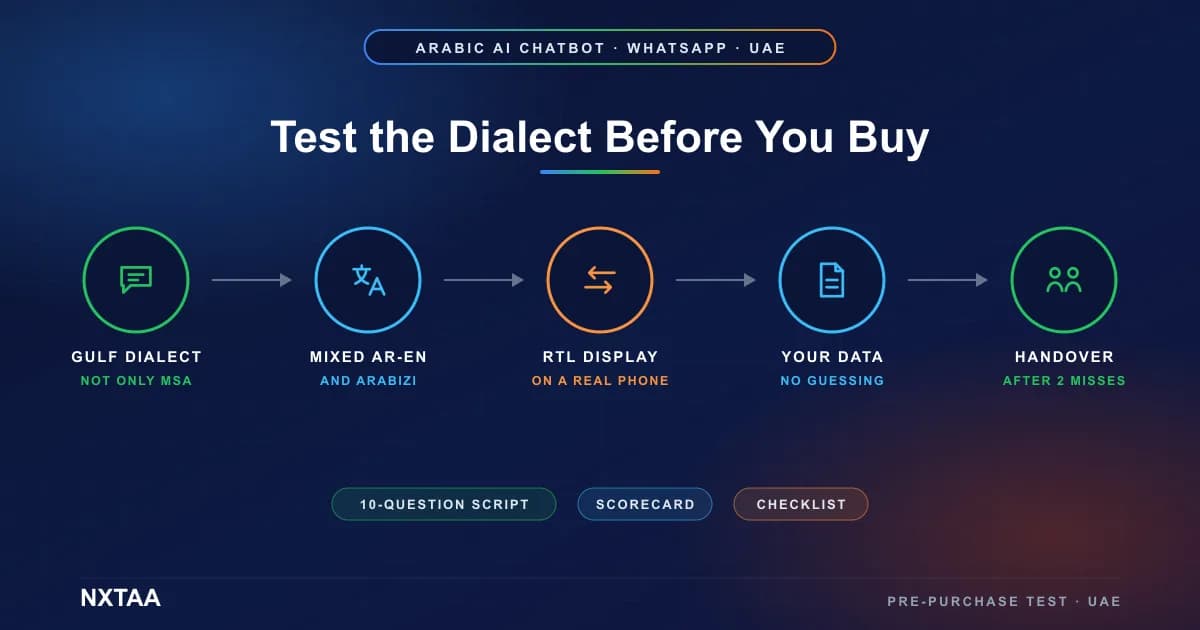
Before you buy an Arabic AI chatbot for WhatsApp, UAE customers' real messages should be your test, not the vendor's demo: Gulf dialect, mixed Arabic and English, Arabizi, prices and dates. If the bot can't understand those, answer from your own data and hand over cleanly, it will cost you conversions no matter how good the English version is.
The scorecard further down lets you run that test on any vendor in under an hour.
Key Takeaways
- Arabic quality decides whether Arabic-speaking customers stay in the chat or leave it
- Customers write in Gulf dialect, mixed Arabic-English and Arabizi; many bots are tuned mainly for Modern Standard Arabic
- Test right-to-left display, mixed-language messages and answers drawn from your own data, not general knowledge
- Decide the handover triggers before launch, including "the bot misunderstood Arabic twice"
- Run the ten-question test script on every shortlisted vendor and score it the same way
- Use the checklist and downloadable scorecard in this guide to compare vendors side by side
Why Arabic Quality Decides Conversions in the UAE
A customer who writes to you in Arabic has already told you something. That's the language they're comfortable buying in.
If your bot answers in clumsy, overly formal Arabic, or misreads the question and offers the wrong menu, the customer doesn't file a complaint. They just stop replying. You'll never see it as a lost sale. You'll see it as a "dropped conversation" in a dashboard nobody reads.
English-language bots get a free pass here because most demos happen in English. The vendor shows you a slick English flow, flips a toggle, shows the same flow in Arabic, and everyone nods. Nobody at the table types the way a customer in Al Ain or Ras Al Khaimah actually types on a phone.
If you're still deciding whether you need a chatbot at all, start with our complete WhatsApp chatbot guide for Dubai businesses. This post assumes you've decided and you're about to buy.
A Real Project: Where Arabic Quality Shows Up First
Setup
We built the WhatsApp workflow for a UAE business-setup consultancy. Enquiries arrive from ads, the website and other sources, and several people on the team handle them. The design is one official WhatsApp number, a shared inbox, and a welcome chatbot whose main job is to greet each enquiry, classify it and assign it to an owner. Follow-ups, renewal reminders and promotional messages come later in the journey.
Conflict
On paper, the welcome bot is the simplest part of that system. It asks what the customer needs and sorts them. In practice, classification is where language quality shows up first. A bot that misreads the opening message files the enquiry under the wrong service, and the wrong person picks it up. The customer then has to explain themselves again, to a human who should have had the right context from the start.
In the UAE, that opening message can arrive in English, formal Arabic, Gulf dialect, a mix of Arabic and English, or Arabic written in Latin letters. Sometimes all of those in one thread.
Resolution
So we treat the classification step as the thing to test hardest, with messages written the way customers actually write them, not the way a script writer would. That's where the ten-question test script in this guide comes from. It's the same structure we use on our own bilingual bots, and it works on any vendor's product.
Lesson
The lesson we keep relearning: Arabic quality isn't a feature you tick on a vendor comparison. It's a behaviour you only see when you test with real customer language. Every bot sounds fluent in its own demo.
Gulf Dialect vs Modern Standard Arabic
Modern Standard Arabic (MSA) is the formal Arabic of news broadcasts, contracts and government letters. Gulf Arabic, often called Khaleeji, is what most Emirati and many other Gulf customers speak and type in daily life. Within it, Emirati usage has its own words and spellings.
Here's the same intent written both ways:
| What the customer means | Modern Standard Arabic | How it's often typed in the UAE |
|---|---|---|
| What are your prices? | ما هي أسعاركم؟ | شو أسعاركم؟ |
| I want to book an appointment tomorrow | أريد أن أحجز موعداً غداً | أبغى أحجز موعد باكر |
| Is it available now? | هل هو متوفر الآن؟ | الحين متوفر؟ |
| Where exactly is your location? | أين موقعكم بالتحديد؟ | وين مكانكم بالضبط؟ |
| The link isn't opening | الرابط لا يفتح | الرابط مب راضي يفتح |
The words are different, the grammar is lighter, and spelling is inconsistent because people type fast. A bot trained mainly on formal text may get the first two right by luck and miss the rest.
What the research says
Large language models learn Arabic mostly from formal, written text, so MSA dominates. Academic benchmarks such as AraDiCE found that models handle dialect understanding better than dialect generation, and that they often fall back on MSA when asked to work in a dialect. Gulf Arabic is one of the better-covered dialects, but "better covered" isn't the same as "good enough for your customers".
What this means for buying
Many platforms advertise "Arabic support" when what they mean is MSA, or an interface translated into Arabic. Neither tells you whether the bot will understand "أبغى أحجز موعد باكر".
Should the bot reply in dialect?
Not necessarily. Understanding dialect is non-negotiable. Replying in it is a brand choice. Many UAE businesses prefer a clear, simple, friendly formal Arabic in replies, sometimes called "white" Arabic, because it reads as professional to every Arabic speaker, Emirati or not. What fails is stiff, textbook Arabic, or a sudden switch to English when the customer wrote in Arabic.
Three More Things to Test
Dialect is the big one. These three catch out almost as many bots.
1. Right-to-left display
Arabic runs right to left. Numbers, prices, English product names and links inside an Arabic sentence run left to right. When a platform handles that badly, you get flipped punctuation, prices that read backwards, and question marks at the wrong end of the sentence.
Check these on an actual phone, both iPhone and Android, not in the vendor's web preview:
- Prices inside Arabic text, such as "السعر AED 1,250 شامل الضريبة"
- Dates and times, and whether the bot uses Western digits (1, 2, 3) or Arabic-Indic digits (١، ٢، ٣) consistently
- Buttons and list menus in Arabic. WhatsApp caps reply-button titles at 20 characters, and Arabic labels get truncated in odd places
- Arabic templates with English variables, such as a booking reference or a car model
2. Mixed Arabic-English messages
UAE customers switch languages mid-sentence all the time: "كم السعر؟ و في discount لو خذيت ثنتين؟" A good bot answers the question. A weak bot either ignores the English word or decides the customer is writing in English and switches language entirely.
Then there's Arabizi, Arabic written in Latin letters and numbers, such as "salam, 3ndkm delivery el youm?" It's common among younger customers. Your bot doesn't need to reply in Arabizi, but it does need to understand it.
3. Answers drawn from your own data
An AI chatbot that answers from general internet knowledge is a liability. It will invent a delivery fee, guess an opening time or quote a price you stopped offering last year. In Arabic, these errors are harder for your team to spot in review, especially if nobody checking the logs reads Arabic fluently.
Insist that the bot answers only from your approved content: price lists, FAQs, policies, opening hours. When it doesn't know, it should say so and offer a person. If you're weighing a scripted bot against a generative one, our comparison of AI versus rule-based chatbots covers the trade-offs.
There's a platform reason too. Meta now restricts general-purpose AI assistants on the WhatsApp Business Platform, while business bots that handle bookings, FAQs and order questions remain allowed. A bot scoped to your own data is safer for your customers and for your account. See Meta's 2026 rules on AI chatbots for the detail.
When the Bot Should Hand Over to a Human
A bot that never gives up is worse than no bot. Agree these handover triggers with the vendor before launch, and test every one of them.
| Trigger | Example in Arabic | Why it matters |
|---|---|---|
| Customer asks for a person | ابي اكلم موظف | Ignoring a direct request is the fastest way to lose trust |
| Complaint or frustration | صار لي أسبوع أنتظر وما حد رد علي | An angry customer needs empathy and authority a bot doesn't have |
| Misunderstood twice | Customer rephrases the same question twice | Two misses in Arabic usually means a dialect gap |
| Money moves | Refunds, deposits, payment disputes | Errors here cost real money and real complaints |
| Sensitive topics | Medical, legal, visa or document issues | A wrong answer creates liability |
| High-value intent | Corporate account, bulk order, ready to pay | Speed matters more than automation here |
The trigger most bots miss is the third one. Two misunderstandings in a row in Arabic almost always means the bot can't parse the customer's dialect, and a third attempt won't fix it. Hand over and flag the conversation, so someone can review it and improve the bot.
What the human receives matters just as much. The agent should see the full Arabic conversation, the bot's best guess at the intent, and anything it already collected. Our guide to best practices for chatbot-to-human handover covers the routing and the messages around it.
One scope point while you're at it. If the vendor is really selling an AI agent that takes actions, such as changing bookings or issuing refunds, the Arabic test matters even more, because a misunderstanding becomes a wrong action rather than a wrong answer. Here's the difference between a chatbot and an AI agent.
The Pre-Purchase Test Script: 10 Questions
Send these ten messages to every shortlisted bot, configured with your own content, on a real WhatsApp number. Type them exactly as written. Don't fix the spelling; customers won't either. Replace the business details in brackets with your own.
| # | Send this message | What it tests | A pass looks like |
|---|---|---|---|
| 1 | شو أسعاركم؟ | Emirati dialect, open question | Asks which service, or gives your real price range |
| 2 | أبغى أحجز موعد باكر الساعة ٤ | Booking intent, Arabic-Indic digits | Understands tomorrow at 4pm and offers real slots |
| 3 | عندكم توصيل لين العين؟ | Gulf preposition, location | Answers your actual delivery policy for Al Ain |
| 4 | كم السعر؟ و في discount لو خذيت ثنتين؟ | Mixed Arabic-English | Answers the discount question, stays in Arabic |
| 5 | salam, 3ndkm delivery el youm? | Arabizi | Understands "do you deliver today?" |
| 6 | ابي اكنسل الطلب | Anglicised verb, cancellation | Starts the cancellation flow or hands over |
| 7 | Can I pay cash عند الاستلام؟ | English-first mixed message | Answers cash on delivery from your policy |
| 8 | الرابط مب راضي يفتح | Emirati negation, tech problem | Recognises a broken-link issue and helps |
| 9 | صار لي أسبوع أنتظر وما حد رد علي | Complaint, frustration | Apologises and hands over to a person quickly |
| 10 | ابي اكلم موظف | Direct request for a human | Hands over immediately, no extra questions |
How to score each answer
Score every reply on five criteria, 0 to 2 points each, for a maximum of 10 per question and 100 overall.
| Criterion | 0 points | 1 point | 2 points |
|---|---|---|---|
| Understood the intent | Wrong intent or generic fallback | Partly right, needed a clarifying question | Correct first time |
| Answer accuracy | Invented or wrong information | Vague but not wrong | Correct, from your own content |
| Language and tone | Switched to English, or stiff textbook Arabic | Understandable but awkward | Natural, clear Arabic matching your brand |
| Display on phone | Broken RTL, flipped numbers or truncated buttons | Minor glitch | Clean on iPhone and Android |
| Handover behaviour | Kept going when it should have stopped | Handed over late | Handed over at the right moment with context |
Total each vendor's score and read it this way:
- 85-100: Ready for real customers, with normal monitoring
- 70-84: Usable, but expect to spend the first month fixing gaps
- Below 70: Not ready for Arabic-speaking customers; ask for a re-test or walk away
Pay special attention to questions 9 and 10. A bot that fails either should not go live, whatever its total.
Download the scorecard
We've put the ten questions and the scoring grid into a spreadsheet you can fill in for up to three vendors: download the Arabic chatbot test scorecard (CSV). It opens in Excel or Google Sheets with the Arabic intact.
Want a second pair of eyes on the results? Send NXTAA your scorecards. Our team will review the transcripts with native Arabic speakers and tell you which gaps are fixable configuration and which are product limits.
The Pre-Purchase Checklist
Use this alongside the test script. Every item is something you can verify in a trial, not just ask about in a meeting.
Language
- Understands Gulf and Emirati dialect, not only MSA (questions 1, 3, 8)
- Handles mixed Arabic-English in both directions (questions 4, 7)
- Understands Arabizi (question 5)
- Replies in clear, natural Arabic in your brand's tone
- Stays in the customer's language unless they switch
Display
- Prices, dates and references display correctly inside Arabic text
- Digits are consistent, Western or Arabic-Indic, as you choose
- Arabic button and list labels fit without truncation
- Tested on a real iPhone and a real Android phone
Knowledge
- Answers only from your approved content
- Says "I don't know" and offers a person instead of guessing
- You can update prices and policies without the vendor's help
- Arabic and English answers come from the same source, so they never disagree
Handover
- Hands over on request, on complaints and after two misunderstandings
- The agent sees the full Arabic conversation and the detected intent
- Out-of-hours handover tells the customer when a person will reply
Commercial and compliance
- Runs on the official WhatsApp Business API
- Arabic and English templates are submitted and approved separately
- Conversation logs are exportable, with Arabic intact
- Clear AED pricing, including what counts as a billable message
- Marketing messages only go to contacts with recorded opt-in
If the bot is one part of a wider platform purchase, use our buyer's checklist for a customer engagement platform as well.
How to Run the Test Without Fooling Yourself
Use your content, not the vendor's. Ask every vendor to load the same price list and FAQ before testing. Otherwise you're testing their demo, not their product.
Get a native Arabic speaker to score. Ideally someone who grew up with Gulf Arabic. A fluent non-native speaker will miss tone problems that customers notice instantly.
Test on WhatsApp, not the web widget. Rendering, buttons and templates behave differently in the real app.
Run the script twice. AI bots aren't fully consistent. If the second run scores very differently, that inconsistency is a finding in itself.
Keep the transcripts. Screenshots of failures are the most useful thing to bring to a pricing negotiation.
How NXTAA Can Help
We build Arabic and English WhatsApp chatbots for UAE businesses, scoped to your own content and connected to a shared inbox, so customers reach a person the moment the bot should step aside. Our AI chatbot development work covers:
- Dialect testing with native Arabic speakers before launch
- Bots that answer only from your approved prices, policies and FAQs
- Handover rules, including the two-misunderstandings trigger
- Arabic and English templates and buttons checked on real devices
If you're comparing vendors right now, book a consultation with NXTAA and bring your scorecards.
Related Reading
- WhatsApp chatbot guide for Dubai businesses
- AI vs rule-based chatbots: what's the difference?
- Chatbot to human agent handover best practices
- AI chatbots vs AI agents in the UAE
- AI solutions from NXTAA
Frequently Asked Questions
Can AI chatbots understand Gulf Arabic? Many can understand common Gulf phrases, but quality varies widely and some are tuned mainly for Modern Standard Arabic. Test with real dialect messages before you buy.
Should a WhatsApp chatbot reply in dialect or formal Arabic? It must understand dialect, but it can reply in clear, simple formal Arabic. What fails is stiff textbook Arabic or switching to English when the customer wrote in Arabic.
How do I test an Arabic chatbot before buying? Load your own content, send the same ten dialect and mixed-language messages to each vendor on WhatsApp, and have a native speaker score the replies on the same rubric.
When should an Arabic chatbot hand over to a human? When the customer asks for a person, complains, raises money or sensitive issues, or the bot misunderstands twice in a row.