WhatsApp Business API Pricing Changes October 2026: What UAE Businesses Must Do Now
NXTAA Team
WhatsApp Business Platform Specialist
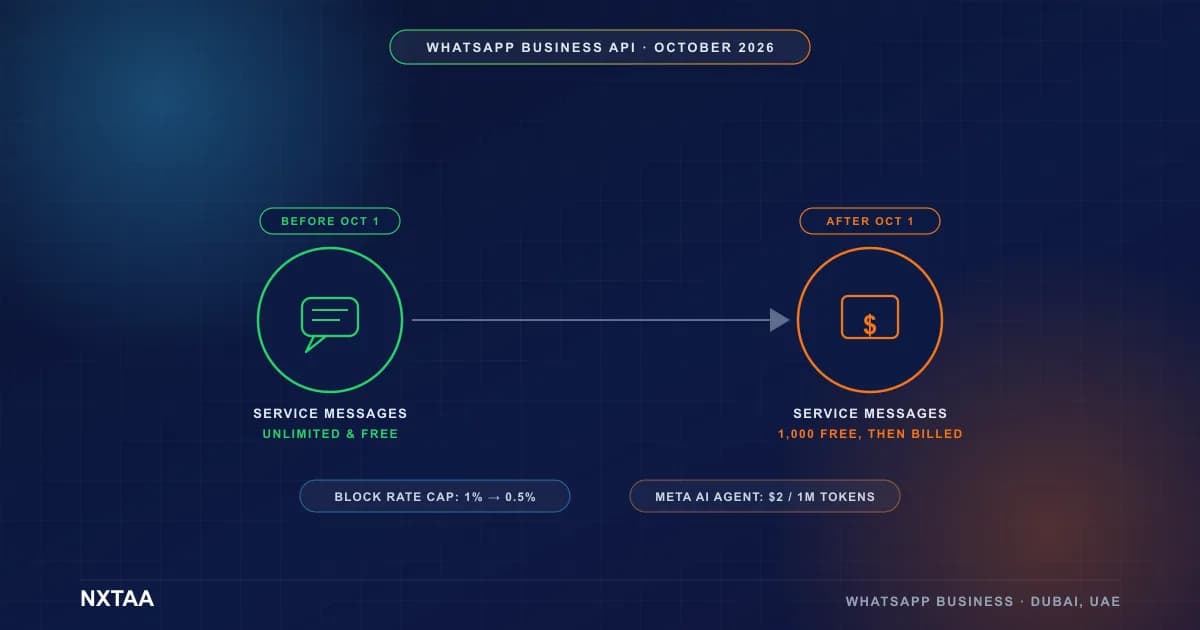
Starting October 1, 2026, Meta began charging for WhatsApp Business API service messages and utility replies inside the 24-hour customer window — two message types that used to be free. Every business phone number gets 1,000 free service messages a month before billing kicks in.
Key Takeaways
- Service messages (free-form replies, including from AI bots) are now billed after 1,000 free messages per phone number, per month
- Utility template messages sent inside the 24-hour customer service window are also now chargeable — previously these were free
- Meta's own AI assistant, the Meta Business Agent, bills separately at $2.00 per million tokens, roughly 4-5 cents per message
- The block-rate threshold for throttling dropped from 1% to 0.5% — fewer bad sends before Meta slows your number down
- General-purpose AI chatbots are banned from the WhatsApp Business Platform; business automation bots (order tracking, support flows) are still fine
- A payment method needs to be on file for your WhatsApp Business Account or messages stop sending, not just stop being free
Why This Changed Mid-Year and Caught People Off Guard
Meta doesn't usually touch WhatsApp Business Platform pricing without months of advance notice buried in a developer changelog nobody on the marketing team reads. This one was no different — the announcement sat in Meta's business help center since mid-2026, and most UAE companies found out when their BSP (Business Solution Provider) sent an email in September, or worse, when their October invoice looked wrong.
Here's the thing: this isn't a price hike on the messages you were already paying for. It's Meta starting to charge for two categories that used to be free outright. If your team runs a lean setup — a few agents replying to customer questions inside WhatsApp's 24-hour window, maybe a bot handling order status — you've been sending "service messages" this whole time without thinking about it as a cost center. Now it is one.
A Dubai logistics company we spoke with runs about 6,000 customer service replies a month across two agents and a basic FAQ bot. Under the old rules, that cost nothing beyond the API subscription. Under the new rules, after the 1,000 free messages, roughly 5,000 of those replies are now billable every single month — and nobody on their ops team had budgeted for it because nobody knew it was coming.
What Actually Changed on October 1, 2026
Three things shifted at once. Treat them as separate line items, because they hit your bill differently.
Service Messages Are No Longer Free
A service message is any free-form reply sent inside the 24-hour customer service window — not a template, just a regular reply, whether a human agent typed it or a bot generated it. Before October 1, these were unlimited and free. Now:
- Each business phone number gets 1,000 free service messages per month
- Every message past that threshold bills at the same rate as a utility or authentication template in that country
- The allowance resets monthly and doesn't roll over
For UAE-registered numbers, that per-message rate sits in line with regional utility pricing — not huge per message, but it adds up fast once a support team crosses a few thousand conversations a month.
Utility Messages Inside the 24-Hour Window Now Cost Money Too
Utility templates — order confirmations, shipping updates, appointment reminders — used to be free when sent in response to a customer who messaged you within the last 24 hours. That free-inside-the-window exception is gone. Utility templates now bill per delivery regardless of whether they're inside or outside the customer service window.
This one matters more for e-commerce and logistics businesses than it looks at first glance. If your "Your order has shipped" message used to ride free because the customer had messaged you that morning, it doesn't anymore.
The 1,000-Message Buffer Is Smaller Than It Sounds
A thousand messages a month feels like a lot until you count it against a real support volume. One agent handling 50 conversations a day, each with 3-4 replies, burns through the free tier in under a week. For most SMEs running an active WhatsApp support line, the free allowance covers maybe the first 10 days of the month — the rest is billed.
Not sure whether your current WhatsApp setup is even configured correctly for this? Get a WhatsApp Business API cost review from NXTAA — we'll map your actual message volume against the new pricing and tell you the real number before Meta's invoice does.
What This Actually Costs: A Worked Example
Take a mid-sized Dubai retail brand running WhatsApp support with 2 agents and a bot for order tracking. Say they handle 8,000 customer conversations a month, averaging 2.5 service message replies each — that's 20,000 service messages.
- Free allowance: 1,000 messages (one phone number)
- Billable messages: 19,000
- At a representative UAE-region utility rate, that's a new monthly cost that didn't exist in September
Add utility template sends for order updates — say 5,000 a month, all now billable where some used to ride free inside the window — and the total new monthly spend lands somewhere in the low hundreds of dollars for a business that paid close to zero for messaging itself before October.
That's not catastrophic for most UAE SMEs. But it's also not nothing, and the businesses getting blindsided are the ones who never saw this as a line item worth forecasting.
Block Rate Throttling Just Got Stricter
Alongside the pricing shift, Meta tightened the quality bar. The block-rate threshold that triggers throttling dropped from 1% to 0.5%. In plain terms: if more than 1 in every 200 recipients blocks your number, Meta slows down how fast you can send — and keeps slowing you down the longer the block rate stays elevated.
Meta now sends an "amber zone" warning through the API before a number gets throttled, which is a genuine improvement — it gives businesses a chance to fix the problem (usually poor targeting or over-messaging) before volume gets capped. But a 0.5% threshold means less room for error than before. A campaign that was borderline-acceptable in August could trip throttling today with the exact same send list.
If you're running bulk WhatsApp marketing sends, this is the moment to tighten segmentation rather than broadening lists for reach. Our guide on sending bulk WhatsApp messages without getting banned covers the mechanics of staying under block-rate thresholds — it's more relevant now than when we first wrote it.
Meta Business Agent: A New Line Item for AI Replies
Meta also introduced its own AI assistant for the Business Platform — the Meta Business Agent — and it bills completely separately from the message pricing above. It's token-based: $2.00 per million tokens, which works out to roughly 4 to 5 cents per message depending on length.
This only applies if you're actually using Meta's own AI agent feature. If you're running your own chatbot or a third-party automation tool (which is what most NXTAA clients do), this specific charge doesn't apply to you — but your bot's replies still count as service messages under the pricing above, so you're not avoiding the cost, just avoiding the extra token layer on top of it.
The AI Chatbot Policy Change Nobody Read
Separate from pricing, Meta restricted general-purpose AI chatbots on the WhatsApp Business Platform earlier in 2026. The distinction matters: a general-purpose assistant — something built to chat about anything, like a consumer AI companion — is no longer allowed on the platform. Business automation bots, the kind that handle order tracking, appointment booking, FAQ answers, or lead qualification, remain fully permitted.
Almost every legitimate business bot falls on the allowed side of that line. If your WhatsApp automation exists to serve a specific business function rather than hold open-ended conversations, this change doesn't affect you. It mainly closes a loophole some companies were using to offer general AI chat services riding on WhatsApp's infrastructure.
What to Check Before Your Next Invoice
Run through this before the next billing cycle catches you by surprise:
- Confirm a valid payment method is on file for your WABA. Without one, messages don't just stop being free — they stop sending entirely once you're past the free tier.
- Pull your last month's service message volume from your BSP dashboard or CRM reporting. If you don't know this number, you can't forecast the new cost.
- Check your current block rate. Anything approaching 0.5% needs attention now, not after throttling kicks in.
- Audit utility template sends inside the 24-hour window — these used to be invisible cost-wise and now aren't.
- If you're using Meta's own AI Business Agent, separate that spend out in your reporting so it doesn't get lumped in with regular service message costs.
Want someone to actually run this audit instead of guessing from a dashboard? Talk to NXTAA about a WhatsApp Business API cost and compliance check — we'll pull the real numbers and flag what's about to cost you money.
New Features That Shipped Alongside the Price Changes
Meta didn't only take things away in 2026 — a few genuinely useful features rolled out in the same window:
- Carousel templates are now broadly available, letting businesses show multiple products or options in a single scrollable message instead of a flat text block
- Voice message templates are supported now too, with compliance limits on length and content
- A Business Calling API has been announced for later in 2026, bringing per-minute voice calls through the same API, priced similarly to SMS rates
None of these offset the new message costs directly, but they're worth factoring into how you plan your WhatsApp strategy for the rest of the year — particularly carousel templates, which can reduce the number of follow-up messages needed to walk a customer through options, indirectly helping with both message volume and block rate.
How This Stacks Up Against SMS and Email in the UAE
WhatsApp is still the highest-engagement channel available to UAE businesses even after this pricing shift — open rates north of 98% don't disappear because Meta started charging for service replies. But the "WhatsApp is basically free once you're set up" assumption that a lot of businesses built their support model around is no longer accurate.
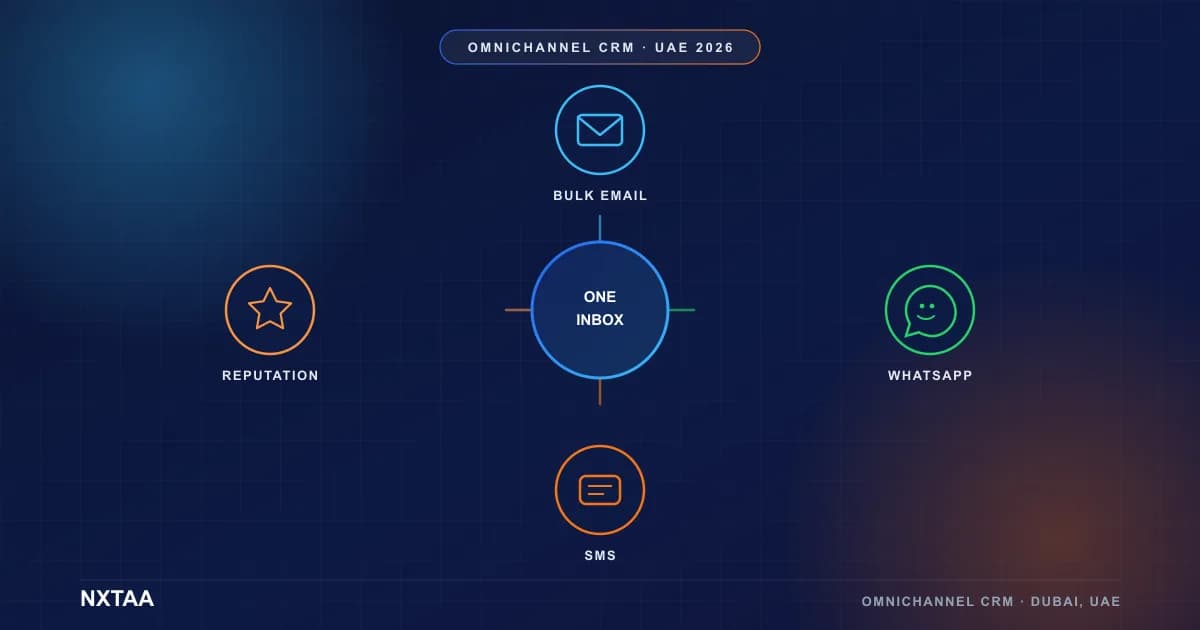
This is exactly the kind of shift that makes running WhatsApp, SMS, email, and reputation management through one connected system worth the switch — when one channel's cost structure changes overnight, a unified CRM lets you shift volume to the next-best channel instead of eating the increase blind. We covered this in detail in our guide to omnichannel CRM setups for UAE businesses, including how WhatsApp, bulk email, and SMS compare on cost and engagement once you're tracking them together.
How NXTAA Helps
NXTAA manages WhatsApp Business API infrastructure for UAE businesses end-to-end, including the parts that just got more complicated:
- Cost audits against the new pricing rules — we tell you your real monthly number before Meta's invoice does, through our WhatsApp Business API service
- Block-rate monitoring and campaign tuning so your sends stay under the new 0.5% threshold instead of getting throttled mid-campaign
- Bot configuration review to confirm your automation stays compliant with the general-purpose chatbot restriction
If October's invoice looked different than you expected, get in touch with NXTAA. We'll walk through your account, show you exactly where the new charges are coming from, and tell you honestly whether your setup needs changes.
You Might Also Like
- WhatsApp Business API in the UAE: 2026 Market Guide
- How to Send Bulk WhatsApp Messages (Without Getting Banned)
- Omnichannel CRM for UAE Businesses: WhatsApp, Email, SMS & Reviews
- WhatsApp Business Account Banned Recovery in UAE
- How to Register for WhatsApp Business API in the UAE
FAQ
When did WhatsApp Business API pricing actually change? October 1, 2026. Service messages and in-window utility messages became chargeable on that date, after Meta had announced the change earlier in the year.
How many free service messages do I get? 1,000 per business phone number, per month. The allowance resets monthly and doesn't carry over unused messages.
Does this affect the free WhatsApp Business app? No. These changes apply only to the paid WhatsApp Business Platform (the API), whether you access it directly or through a provider. The free consumer-facing WhatsApp Business app is unaffected.
What happens if I don't add a payment method? Messages stop sending once you exceed the free tier, not just stop being free. A missing payment method can take your WhatsApp channel down entirely.
Is my chatbot still allowed under the new AI policy? Almost certainly yes, if it's built for a specific business function — order tracking, appointment booking, FAQs, lead capture. Only general-purpose conversational AI assistants are restricted.
What's the new block rate threshold? 0.5%, down from 1%. Meta now also sends an "amber zone" API warning before throttling a number, giving businesses a chance to fix targeting first.
Is the Meta Business Agent the same as my existing chatbot? No. The Meta Business Agent is Meta's own AI feature with separate token-based pricing ($2.00 per million tokens). A third-party or custom bot is billed under regular service message pricing instead.